


Lévy process
In probability theory, a Lévy process, named after the French mathematician Paul Lévy, is a stochastic process with independent, stationary increments: it represents the motion of a point whose successive displacements are random, in which displacements in pairwise disjoint time intervals are independent, and displacements in different time intervals of the same length have identical probability distributions. A Lévy process may thus be viewed as the continuous-time analog of a random walk.
The most well known examples of Lévy processes are the Wiener process, often called the Brownian motion process, and the Poisson process. Further important examples include the Gamma process, the Pascal process, and the Meixner process. Aside from Brownian motion with drift, all other proper (that is, not deterministic) Lévy processes have discontinuous paths. All Lévy processes are additive processes.[1]
Mathematical definition[edit]
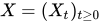
A Lévy process is a stochastic process that satisfies the following properties:

- almost surely;
- Independence of increments: For any , are mutually independent;
- Stationary increments: For any , is equal in distribution to
- Continuity in probability: For any and it holds that






If is a Lévy process then one may construct a version of such that is almost surely right-continuous with left limits.


Properties[edit]
Independent increments[edit]
A continuous-time stochastic process assigns a random variable Xt to each point t ≥ 0 in time. In effect it is a random function of t. The increments of such a process are the differences Xs − Xt between its values at different times t < s. To call the increments of a process independent means that increments Xs − Xt and Xu − Xv are independent random variables whenever the two time intervals do not overlap and, more generally, any finite number of increments assigned to pairwise non-overlapping time intervals are mutually (not just pairwise) independent.
Stationary increments[edit]
To call the increments stationary means that the probability distribution of any increment Xt − Xs depends only on the length t − s of the time interval; increments on equally long time intervals are identically distributed.
If is a Wiener process, the probability distribution of Xt − Xs is normal with expected value 0 and variance t − s.
If is a Poisson process, the probability distribution of Xt − Xs is a Poisson distribution with expected value λ(t − s), where λ > 0 is the "intensity" or "rate" of the process.
If is a Cauchy process, the probability distribution of Xt − Xs is a Cauchy distribution with density .
![{\displaystyle f(x;t)={1 \over \pi }\left[{t \over x^{2}+t^{2}}\right]}](https://wikimedia.org/api/rest_v1/media/math/render/svg/ddf7c50d9186ba09d9a30912bb1921741d2bc703)
Infinite divisibility[edit]
The distribution of a Lévy process has the property of infinite divisibility: given any integer n, the law of a Lévy process at time t can be represented as the law of the sum of n independent random variables, which are precisely the increments of the Lévy process over time intervals of length t/n, which are independent and identically distributed by assumptions 2 and 3. Conversely, for each infinitely divisible probability distribution , there is a Lévy process such that the law of is given by .


Moments[edit]
In any Lévy process with finite moments, the nth moment , is a polynomial function of t; these functions satisfy a binomial identity:


Lévy–Khintchine representation[edit]
The distribution of a Lévy process is characterized by its characteristic function, which is given by the Lévy–Khintchine formula (general for all infinitely divisible distributions):[2]
If is a Lévy process, then its characteristic function is given by
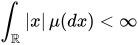
where , , and is a σ-finite measure called the Lévy measure of , satisfying the property

![{\displaystyle \varphi _{X}(\theta )(t):=\mathbb {E} \left[e^{i\theta X(t)}\right]=\exp {\left(t\left(ai\theta -{\frac {1}{2}}\sigma ^{2}\theta ^{2}+\int _{\mathbb {R} \setminus \{0\}}{\left(e^{i\theta x}-1-i\theta x\mathbf {1} _{|x|<1}\right)\,\Pi (dx)}\right)\right)}}](https://wikimedia.org/api/rest_v1/media/math/render/svg/9a5e8e9dc403aceba388c3b3e85be417c71e7100)


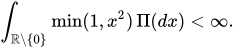
In the above, is the indicator function. Because characteristic functions uniquely determine their underlying probability distributions, each Lévy process is uniquely determined by the "Lévy–Khintchine triplet" . The terms of this triplet suggest that a Lévy process can be seen as having three independent components: a linear drift, a Brownian motion, and a Lévy jump process, as described below. This immediately gives that the only (nondeterministic) continuous Lévy process is a Brownian motion with drift; similarly, every Lévy process is a semimartingale.[3]


Lévy–Itô decomposition[edit]
Because the characteristic functions of independent random variables multiply, the Lévy–Khintchine theorem suggests that every Lévy process is the sum of Brownian motion with drift and another independent random variable, a Lévy jump process. The Lévy–Itô decomposition describes the latter as a (stochastic) sum of independent Poisson random variables.
Let — that is, the restriction of to , renormalized to be a probability measure; similarly, let (but do not rescale). Then
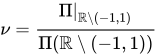

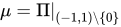

The former is the characteristic function of a compound Poisson process with intensity and child distribution . The latter is that of a compensated generalized Poisson process (CGPP): a process with countably many jump discontinuities on every interval a.s., but such that those discontinuities are of magnitude less than . If , then the CGPP is a pure jump process.[4][5] Therefore in terms of processes one may decompose in the following way
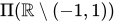



where is the compound Poisson process with jumps larger than in absolute value and is the aforementioned compensated generalized Poisson process which is also a zero-mean martingale.


Generalization[edit]
A Lévy random field is a multi-dimensional generalization of Lévy process.[6][7] Still more general are decomposable processes.[8]
See also[edit]
- Independent and identically distributed random variables
- Wiener process
- Poisson process
- Gamma process
- Markov process
- Lévy flight
References[edit]
- ^ Sato, Ken-Iti (1999). Lévy processes and infinitely divisible distributions. Cambridge University Press. pp. 31–68. ISBN 9780521553025.
- ^ Zolotarev, Vladimir M. One-dimensional stable distributions. Vol. 65. American Mathematical Soc., 1986.
- ^ Protter P.E. Stochastic Integration and Differential Equations. Springer, 2005.
- ^ Kyprianou, Andreas E. (2014), "The Lévy–Itô Decomposition and Path Structure", Fluctuations of Lévy Processes with Applications, Universitext, Springer Berlin Heidelberg, pp. 35–69, doi:10.1007/978-3-642-37632-0_2, ISBN 9783642376313
- ^ Lawler, Gregory (2014). "Stochastic Calculus: An Introduction with Applications" (PDF). Department of Mathematics (The University of Chicago). Archived from the original (PDF) on 29 March 2018. Retrieved 3 October 2018.
- ^ Wolpert, Robert L.; Ickstadt, Katja (1998), "Simulation of Lévy Random Fields", Practical Nonparametric and Semiparametric Bayesian Statistics, Lecture Notes in Statistics, Springer, New York, doi:10.1007/978-1-4612-1732-9_12, ISBN 978-1-4612-1732-9
- ^ Wolpert, Robert L. (2016). "Lévy Random Fields" (PDF). Department of Statistical Science (Duke University).
- ^ Feldman, Jacob (1971). "Decomposable processes and continuous products of probability spaces". Journal of Functional Analysis. 8 (1): 1–51. doi:10.1016/0022-1236(71)90017-6. ISSN 0022-1236.
- Applebaum, David (December 2004). "Lévy Processes—From Probability to Finance and Quantum Groups" (PDF). Notices of the American Mathematical Society. 51 (11): 1336–1347. ISSN 1088-9477.
- Cont, Rama; Tankov, Peter (2003). Financial Modeling with Jump Processes. CRC Press. ISBN 978-1584884132..
- Sato, Ken-Iti (2011). Lévy Processes and Infinitely Divisible Distributions. Cambridge University Press. ISBN 978-0521553025..
- Kyprianou, Andreas E. (2014). Fluctuations of Lévy Processes with Applications. Introductory Lectures. Second edition. Springer. ISBN 978-3642376313..
