


Golden trout
| Golden trout | |
|---|---|

| |
Scientific classification 
| |
| Domain: | Eukaryota |
| Kingdom: | Animalia |
| Phylum: | Chordata |
| Class: | Actinopterygii |
| Order: | Salmoniformes |
| Family: | Salmonidae |
| Genus: | Oncorhynchus |
| Species: | |
| Subspecies: | O. m. aguabonita
|
| Trinomial name | |
| Oncorhynchus mykiss aguabonita | |

| |
| Kern River trout range map | |
The California golden trout (Oncorhynchus aguabonita or Oncorhynchus mykiss aguabonita) is a species of trout native to California. The golden trout is normally found in the Golden Trout Creek (tributary to the Kern River), Volcano Creek (tributary to Golden Trout Creek), and the South Fork Kern River. The Golden trout is the official freshwater state fish of California since 1947.[2]
The California golden trout is closely related to two rainbow trout subspecies. The Little Kern golden trout (O. m. whitei), found in the Little Kern River basin, and the Kern River rainbow trout (O. m. gilberti), found in the Kern River system. Together, these three trout form what is sometimes referred to as the "golden trout complex".[3]


Taxonomy[edit]
Originally the golden trout was described as a subspecies of the salmon species, with a name Salmo mykiss agua-bonita,[4] and it is still often considered a subspecies (now called Oncorhynchus mykiss aguabonita) along with several other rainbow trout subspecies commonly known as redband trout.
FishBase and the Catalog of Fishes however now (2014) list O. aguabonita as an independent species rather than as subspecies of O. mykiss.[4][5] Likewise, while ITIS lists O. m. whitei and O. m. gilberti as subspecies of O. mykiss,[6] O. aguabonita instead is listed as a full species.[1][7]
Description[edit]
The golden trout has golden flanks with red, horizontal bands along the lateral lines on each side and about 10 dark, vertical, oval marks (called "parr marks") on each side. Dorsal, lateral and anal fins have white leading edges. In their native habitat, adults range from 6 to 12 inches (15 to 30 cm) long. Fish over 12 inches (30 cm) are considered large. Golden trout that have been transplanted to lakes have been recorded up to 11 pounds (5.0 kg).
The golden trout should be distinguished from the similarly named golden rainbow trout, also known as the palomino trout. The golden rainbow is a color variant of the rainbow trout.[8]
The golden trout is commonly found at elevations from 6,890 feet (2,100 m) to 10,000 feet (3,000 m) above sea level, and is native to California's southern Sierra Nevada mountains. Outside of its native range in California, Golden trout are more often found in cirques and creeks in wilderness areas around 10,500–12,000"+, often beyond 12,500"+ passes that are not passable without crampons, ice axes, and ropes until after the Fourth of July.[9] Their preferred water temperature is 58 to 62 °F (14 to 17 °C) but they can tolerate temperatures in degraded streams on the Kern Plateau as high as 70 °F (21 °C) so long as those waters cool during the night.[9] The only other species of fish indigenous to the native range of California golden trout is the Sacramento sucker (Catostomus occidentalis occidentalis).[10]
Record catches[edit]
The Wyoming Game & Fish Department state record golden trout measured 28 in (71 cm) and weighed 11.25 lb (5.10 kg), caught in Cooks Lake, Wyoming in 1948.[11] The IGFA "All-Tackle Length Record" for O. m. aguabonita measured 21 in (53 cm) caught in Golden Lake, Wyoming in 2012.[12]
Distribution[edit]
O. m. aguabonita is native to the southern Sierra Nevada, including the upper reach and tributaries of the South Fork of the Kern River, and Golden Trout Creek and its tributaries.[13] It has been introduced in hundreds of lakes and streams outside the native range, though most of these populations did not last or hybridized with cutthroat trout and other subspecies of rainbow trout.[13]
History[edit]
In 1892, the California golden trout was originally described by David Starr Jordan, the first President of Stanford University, as Salmo mykiss agua-bonita. The fish was named after the Agua Bonita Waterfall where the first specimens were collected, at the mouth of Volcano Creek, at the creek's confluence with the Kern River.[14] A century later they were listed as Oncorhynchus mykiss aguabonita in Behnke's Native trout of western North America.[15]
In 1904, Stewart Edward White communicated to his friend President Theodore Roosevelt, that overfishing could lead to extinction of the golden trout. In White's novel The Mountains, he wrote about the threatened golden trout on California's Kern Plateau. Roosevelt shared White's concern and, through U.S. Fish Commissioner George M. Bowers, dispatched biologist Barton Warren Evermann of the U.S. Bureau of Fisheries to study the situation. In 1906 Evermann published The Golden Trout of the Southern High Sierras.[16] Based on morphology, Evermann accurately described four forms of this native fish: Salmo roosevelti from Golden Trout (Volcano) Creek, Salmo aguabonita from nearby South Fork of the Kern River, Salmo whitei (named in recognition of Stewart Edward White) from the Little Kern River, and Salmo gilberti, the Kern River rainbow.[10]
Genetic studies have since clarified three groups of trout native to the Kern River: California golden trout (O. m. aguabonita) native to the South Fork Kern River and Golden Trout Creek (tributary to the Kern River mainstem but the historic course of the South Fork Kern River and now only separated from it by a lava flow and ridge of sediment), Little Kern River golden trout (O. m. whitei), and Kern River rainbow trout (O. m. gilberti).[17]
Conservation[edit]
Years of overexploitation, mismanagement and competition with exotic species have brought golden trout to the brink of being designated as "threatened".[citation needed] Introduced brook trout (Salvelinus fontinalis) outcompete them for food, introduced brown trout (Salmo trutta) prey on them and introduced rainbow trout (O. mykiss) hybridize with them, damaging the native gene pool through introgression. Populations have been in steady decline for decades.
In 1978, the Golden Trout Wilderness was established within Inyo National Forest and Sequoia National Forest, protecting the upper watersheds of the Kern River and South Fork Kern River. It also resulted in the closure of the Tunnel Air Camp airstrip and air charters operations for sport fishermen in the region.[18]
In September 2004, the California Department of Fish and Game signed an agreement with federal agencies to work on restoring back-country habitat, heavily damaged by overgrazing from cattle and sheep, as part of a comprehensive conservation strategy.[9]
The US Endangered Species Act (USESA) designated the subspecies O. m. whitei as LT, or Listed Threatened, since 1978, under the name Oncorhynchus aguabonita whitei.[19]
Subspecies designations[edit]
NatureServe has designated the following NatureServe Conservation Status for the three subspecies:
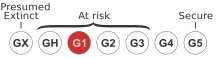
- Oncorhynchus mykiss aguabonita—Golden trout (G5T1): Critically Imperiled, last reviewed in 2013.[13] The primary threat is hybridization and introgression with stocked rainbow trout.[13] Other threats include competition with non-native brown trout and rainbow trout, predation by brown trout, habitat degradation from cattle grazing, and possibly expanding beaver populations in the native range.[13] Genetic studies showed hybridization with stocked rainbow trout in almost all known wild populations analyzed to as of 2003.[13] Non-hybridized populations are restricted to less than 1% of their native range, and confinement to these areas for long periods create a significant risk of inbreeding depression, and loss of heterozygosity and genetic variance.[13]
- Oncorhynchus mykiss gilberti—Kern River rainbow trout (G5T1Q): Critically Imperiled, with questionable taxonomy that may reduce conservation priority, last reviewed in 2005.[20] Few if any genetically pure populations still exist. Primary threats include continued introgression with introduced rainbow trout, habitat loss from grazing, logging and road building, unpredictable events such as floods, drought, and fire (and subsequent landslides), and reduced habitat availability due to introduced beaver.[20]
- Oncorhynchus mykiss whitei—Little Kern golden trout (G5T2Q): Imperiled, with questionable taxonomy that may reduce conservation priority, last reviewed in 2005.[19] Hybridization with introduced rainbow trout is considered a threat, and "there is a constant threat from introductions of other salmonids by disgruntled anglers."[19] The subspecies still occurs in the Little Kern River, above the falls on the lower river, though some populations show signs of introgression with coastal rainbow trout.[19]
The American Fisheries Society has designated all three subspecies as Threatened since August 2008.[13][19][20]
Translocations outside of endemic range[edit]
For sportfishing, the golden trout underwent many twentieth century translocations into multiple Western states and established populations survive in California, Idaho, Montana, Utah, Washington, Colorado, and Wyoming. Populations in the high-elevation lakes in the Ruby Mountains, Nevada, have died out.[21] The current status in other states where the California golden trout were planted (Arizona, New Mexico and Oregon) lacks documentation.
However, a former New Mexico population is relatively well known and storied as, when then-Colonel Chuck Yeager introduced one of his commanding officers, General Irving "Twig" Branch, to the Sierra Nevada populations of golden trout, Branch ordered Yeager and Bud Anderson to introduce the species to the mountain streams of New Mexico.[22] These New Mexico populations have since also died out.[21] In his second memoir, Press On, Yeager detailed his annual fishing trips to catch golden trout which he extols as one of the best game fish and best eating fish to be found.
A self-sustaining introduced population also exists in the Rocky Mountains of Alberta, Canada; the province's golden trout population is managed by translocating fish between lakes to balance populations, but no new fish from other populations are introduced.[23]
See also[edit]
- Garibaldi (the state saltwater fish of California)
References[edit]
- ^ a b "Oncorhynchus mykiss aguabonita". Integrated Taxonomic Information System. Retrieved 27 December 2013.
- ^ "California Golden Trout". Caltrout.org. 25 April 2017. Retrieved 21 March 2022.
- ^ Inland Fishes of California, Peter B. Moyle. p. 20
- ^ a b W. Eschmeyer (2014) aguabonita, Salmo mykiss Catalog of Fishes. California Academy of Sciences. (accessed 3 Nov 2014)
- ^ Froese, Rainer; Pauly, Daniel (eds.) (2014). "Oncorhynchus aguabonita" in FishBase. April 2014 version.
- ^ "Oncorhynchus mykiss". Integrated Taxonomic Information System. Retrieved 27 January 2013.
- ^ "Oncorhynchus aguabonita". Integrated Taxonomic Information System. Retrieved 27 January 2013.
- ^ S. Dobosz, K. Kohlmann, K. Goryczko, H. Kuzminski. "Growth and vitality in yellow forms of rainbow trout". Journal of Applied Ichthyology, Volume 16, Issue 3 pp. 117–120, June 2000 doi:10.1046/j.1439-0426.2000.00147.x.
- ^ a b c Stanley J. Stephens; Christy McGuire; Lisa Sims (2004-09-17). Conservation Assessment and Strategy for the California Golden Trout (Oncorhynchus mykiss aguabonita) Tulare County, California (PDF) (Report). California Department of Fish and Game. Archived from the original (PDF) on 2011-07-19. Retrieved 2012-10-14.
- ^ a b Edwin Philip Pister (2010). "California Golden Trout: Perspectives on Restoration and Management". Fisheries. 35 (11): 550–553. doi:10.1577/1548-8446-35.11.550.
- ^ "Wyoming's Record Fish". Wyoming Game and Fish Department. 27 December 2013.
- ^ "IGFA All-Tackle World Records - Trout, golden". Igfa.org. Retrieved 2022-03-21.
- ^ a b c d e f g h Hammerson, G (2013). "Comprehensive Report Species – Oncorhynchus mykiss aguabonita". NatureServe Explorer. NatureServe Inc. Retrieved 27 December 2013.
- ^ David Starr Jordan (1892-07-24). "A description of the golden trout of Kern River, California, Salmo mykiss agua-bonita". Proceedings of the United States National Museum. xv (916): 481–483. doi:10.5479/si.00963801.15-916.481. Retrieved 2012-10-16.
- ^ Robert J. Behnke (1992). Native trout of western North America. Monograph No. 6. American Fisheries Society. p. 275. ISBN 978-0-913235-79-9.
- ^ Barton Warren Evermann; Oliver Peebles Jenkins; Chancey Juday (1906). The golden trout of the southern high Sierras. Government Printing Office. p. 51. Retrieved 2012-10-15.
- ^ Molly R. Stephens (2007). Systematics, genetics and conservation of golden trout. Ph.D. dissertation (PDF) (Thesis). University of California Davis. Archived from the original (PDF) on 2013-05-14. Retrieved 2012-10-14.
- ^ "Bob White, Tunnel Airfield, Tunnel Guard Camp". www.owensvalleyhistory.com. Retrieved 2023-12-27.
- ^ a b c d e Hopkins, T; Moyle, P; Hammerson, G (2005). "Comprehensive Report Species – Oncorhynchus mykiss whitei". NatureServe Explorer. NatureServe Inc. Retrieved 27 December 2013.
- ^ a b c Hopkins, T; Moyle, P; Hammerson, G (2005). "Comprehensive Report Species – Oncorhynchus mykiss gilberti". NatureServe Explorer. NatureServe Inc. Retrieved 27 December 2013.
- ^ a b Pam Fuller and Matt Neilson (2012-03-29). "Oncorhynchus aguabonita (Golden Trout)". USGS Nonindigenous aquatic species (NAS) database. Retrieved 2012-10-14.
- ^ Yeager, Chuck and Janos, Leo. Yeager: An Autobiography. Pages 348-351 (paperback). New York: Bantam Books, 1986. ISBN 0-553-25674-2.
- ^ "A Summary of Sport Fish Communities in Seven High Mountain Lakes in Southwest Alberta" (PDF). Ab-conservation.com. Retrieved 2022-03-21.
Other sources[edit]
- Finkle, David (Summer 2005). "The New Gold Rush: Celebrating and Protecting the California Golden Trout in the Sierra Nevada" (PDF). The American Fly Fisher. 31 (3): 10–21. Archived from the original (PDF) on 2014-11-29. Retrieved 2014-11-16.

Trout and char of the world | ||
|---|---|---|
| Trout of Europe and Atlantic basin Salmo |   .png) | |
| Trout of the Pacific basin Oncorhynchus | ||
| True char Salvelinus | ||
 Media related to Trout at Wikimedia Commons Media related to Trout at Wikimedia Commons | ||
| Authority control databases: National |
|---|

- NatureServe critically imperiled species
- Oncorhynchus
- Endemic fauna of California
- Fauna of the Sierra Nevada (United States)
- Fish of the Western United States
- Freshwater fish of the United States
- Fish described in 1892
- Critically endangered fish
- Critically endangered fauna of California
- Symbols of California
- Subspecies
- Freshwater fish of North America
- Taxa named by David Starr Jordan