Spectral sequence
In mathematics, in the field of homological algebra, the Grothendieck spectral sequence, introduced by Alexander Grothendieck in his Tôhoku paper, is a spectral sequence that computes the derived functors of the composition of two functors  , from knowledge of the derived functors of
  and
and  .
Many spectral sequences in algebraic geometry are instances of the Grothendieck spectral sequence, for example the Leray spectral sequence.
.
Many spectral sequences in algebraic geometry are instances of the Grothendieck spectral sequence, for example the Leray spectral sequence.
Statement[edit]
If  and
and  are two additive and left exact functors between abelian categories such that both
  and
and  have enough injectives and takes injective objects to -acyclic objects, then for each object
  of there is a spectral sequence:

where  denotes the p-th right-derived functor of , etc., and where the arrow '
 ' means convergence of spectral sequences.
Five term exact sequence[edit]
The exact sequence of low degrees reads

Examples[edit]
The Leray spectral sequence[edit]
If  and
and  are topological spaces, let
  and
and  be the category of sheaves of abelian groups on and , respectively.
For a continuous map  there is the (left-exact) direct image functor
  .
We also have the global section functors
.
We also have the global section functors
 and
and 
Then since  and the functors
  and
and  satisfy the hypotheses (since the direct image functor has an exact left adjoint
  , pushforwards of injectives are injective and in particular acyclic for the global section functor), the sequence in this case becomes:

for a sheaf  of abelian groups on
  .
.
Local-to-global Ext spectral sequence[edit]
There is a spectral sequence relating the global Ext and the sheaf Ext: let F, G be sheaves of modules over a ringed space  ; e.g., a scheme. Then
 [1]
[1]
This is an instance of the Grothendieck spectral sequence: indeed,
 ,
,  and
and  .
.
Moreover, 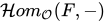 sends injective
  -modules to flasque sheaves,[2] which are
  -acyclic. Hence, the hypothesis is satisfied.
Derivation[edit]
We shall use the following lemma:
Lemma — If K is an injective complex in an abelian category C such that the kernels of the differentials are injective objects, then for each n,

is an injective object and for any left-exact additive functor G on C,

Proof: Let  be the kernel and the image of
  . We have

which splits. This implies each  is injective. Next we look at

It splits, which implies the first part of the lemma, as well as the exactness of

Similarly we have (using the earlier splitting):

The second part now follows. 
We now construct a spectral sequence. Let  be an injective resolution of A. Writing
  for
for  , we have:

Take injective resolutions  and
and  of the first and the third nonzero terms. By the horseshoe lemma, their direct sum
  is an injective resolution of
  . Hence, we found an injective resolution of the complex:

such that each row  satisfies the hypothesis of the lemma (cf. the Cartan–Eilenberg resolution.)
Now, the double complex 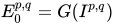 gives rise to two spectral sequences, horizontal and vertical, which we are now going to examine. On the one hand, by definition,
 ,
,
which is always zero unless q = 0 since is G-acyclic by hypothesis. Hence,  and
and  . On the other hand, by the definition and the lemma,

Since  is an injective resolution of
  (it is a resolution since its cohomology is trivial),

Since  and
and  have the same limiting term, the proof is complete.
References[edit]
Computational Examples[edit]
This article incorporates material from Grothendieck spectral sequence on PlanetMath, which is licensed under the Creative Commons Attribution/Share-Alike License.


