


Hazen–Williams equation
The Hazen–Williams equation is an empirical relationship that relates the flow of water in a pipe with the physical properties of the pipe and the pressure drop caused by friction. It is used in the design of water pipe systems[1] such as fire sprinkler systems,[2] water supply networks, and irrigation systems. It is named after Allen Hazen and Gardner Stewart Williams.
The Hazen–Williams equation has the advantage that the coefficient C is not a function of the Reynolds number, but it has the disadvantage that it is only valid for water. Also, it does not account for the temperature or viscosity of the water,[3] and therefore is only valid at room temperature and conventional velocities.[4]
General form
[edit]Henri Pitot discovered that the velocity of a fluid was proportional to the square root of its head in the early 18th century. It takes energy to push a fluid through a pipe, and Antoine de Chézy discovered that the hydraulic head loss was proportional to the velocity squared.[5] Consequently, the Chézy formula relates hydraulic slope S (head loss per unit length) to the fluid velocity V and hydraulic radius R:

The variable C expresses the proportionality, but the value of C is not a constant. In 1838 and 1839, Gotthilf Hagen and Jean Léonard Marie Poiseuille independently determined a head loss equation for laminar flow, the Hagen–Poiseuille equation. Around 1845, Julius Weisbach and Henry Darcy developed the Darcy–Weisbach equation.[6]
The Darcy-Weisbach equation was difficult to use because the friction factor was difficult to estimate.[7] In 1906, Hazen and Williams provided an empirical formula that was easy to use. The general form of the equation relates the mean velocity of water in a pipe with the geometric properties of the pipe and the slope of the energy line.

where:
- V is velocity (in ft/s for US customary units, in m/s for SI units)
- k is a conversion factor for the unit system (k = 1.318 for US customary units, k = 0.849 for SI units)
- C is a roughness coefficient
- R is the hydraulic radius (in ft for US customary units, in m for SI units)
- S is the slope of the energy line (head loss per length of pipe or hf/L)
The equation is similar to the Chézy formula but the exponents have been adjusted to better fit data from typical engineering situations. A result of adjusting the exponents is that the value of C appears more like a constant over a wide range of the other parameters.[8]
The conversion factor k was chosen so that the values for C were the same as in the Chézy formula for the typical hydraulic slope of S=0.001.[9] The value of k is 0.001−0.04.[10]
Typical C factors used in design, which take into account some increase in roughness as pipe ages are as follows:[11]
| Material | C Factor low | C Factor high | Reference |
|---|---|---|---|
| Asbestos-cement | 140 | 140 | - |
| Cast iron new | 130 | 130 | [11] |
| Cast iron 10 years | 107 | 113 | [11] |
| Cast iron 20 years | 89 | 100 | [11] |
| Cement-Mortar Lined Ductile Iron Pipe | 140 | 140 | – |
| Concrete | 100 | 140 | [11] |
| Copper | 130 | 140 | [11] |
| Steel | 90 | 120 | – |
| Galvanized iron | 120 | 120 | [11] |
| Polyethylene | 140 | 140 | [11] |
| Polyvinyl chloride (PVC) | 150 | 150 | [11] |
| Fibre-reinforced plastic (FRP) | 150 | 150 | [11] |
Pipe equation
[edit]The general form can be specialized for full pipe flows. Taking the general form
and exponentiating each side by 1/0.54 gives (rounding exponents to 3–4 decimals)

Rearranging gives
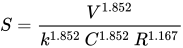
The flow rate Q = V A, so

The hydraulic radius R (which is different from the geometric radius r) for a full pipe of geometric diameter d is d/4; the pipe's cross sectional area A is π d2 / 4, so

U.S. customary units (Imperial)
[edit]When used to calculate the pressure drop using the US customary units system, the equation is:[12]

where:
- Spsi per foot = frictional resistance (pressure drop per foot of pipe) in psig/ft (pounds per square inch gauge pressure per foot)
- Sfoot of water per foot of pipe
- Pd = pressure drop over the length of pipe in psig (pounds per square inch gauge pressure)
- L = length of pipe in feet
- Q = flow, gpm (gallons per minute)
- C = pipe roughness coefficient
- d = inside pipe diameter, in (inches)
- Note: Caution with U S Customary Units is advised. The equation for head loss in pipes, also referred to as slope, S, expressed in "feet per foot of length" vs. in 'psi per foot of length' as described above, with the inside pipe diameter, d, being entered in feet vs. inches, and the flow rate, Q, being entered in cubic feet per second, cfs, vs. gallons per minute, gpm, appears very similar. However, the constant is 4.73 vs. the 4.52 constant as shown above in the formula as arranged by NFPA for sprinkler system design. The exponents and the Hazen-Williams "C" values are unchanged.
SI units
[edit]When used to calculate the head loss with the International System of Units, the equation will then become

where:
- S = Hydraulic slope
- hf = head loss in meters (water) over the length of pipe
- L = length of pipe in meters
- Q = volumetric flow rate, m3/s (cubic meters per second)
- C = pipe roughness coefficient
- d = inside pipe diameter, m (meters)
- Note: pressure drop can be computed from head loss as hf × the unit weight of water (e.g., 9810 N/m3 at 4 deg C)
See also
[edit]- Darcy–Weisbach equation and Prony equation for alternatives
- Fluid dynamics
- Friction
- Minor losses in pipe flow
- Plumbing
- Pressure
- Volumetric flow rate
References
[edit]- ^ "Hazen–Williams Formula". Archived from the original on 22 August 2008. Retrieved 6 December 2008.
- ^ "Hazen–Williams equation in fire protection systems". Canute LLP. 27 January 2009. Archived from the original on 6 April 2013. Retrieved 27 January 2009.
- ^ Brater, Ernest F.; King, Horace W.; Lindell, James E.; Wei, C. Y. (1996). "6". Handbook of Hydraulics (Seventh ed.). New York: McGraw Hill. p. 6.29. ISBN 0-07-007247-7.
- ^ Pumping station design. Jones, Garr M. (3rd ed.). Burlington, MA: Butterworth-Heinemann. 2006. p. 3.4. ISBN 978-0-08-094106-6. OCLC 144609617.
{{cite book}}: CS1 maint: others (link) - ^ Walski, Thomas M. (March 2006), "A history of water distribution", Journal of the American Water Works Association, 98 (3), American Water Works Association: 110–121, doi:10.1002/j.1551-8833.2006.tb07611.x, S2CID 108604497, p. 112.
- ^ Walski 2006, p. 112
- ^ Walski 2006, p. 113
- ^ Williams & Hazen 1914, p. 1, stating "Exponents can be selected, however, representing approximate average conditions, so that the value of c for a given condition of surface will vary so little as to be practically constant."
- ^ Williams & Hazen 1914, p. 1
- ^ Williams & Hazen 1914, pp. 1–2
- ^ a b c d e f g h i j Hazen-Williams Coefficients, Engineering ToolBox, retrieved 7 October 2012
- ^ 2007 version of NFPA 13: Standard for the Installation of Sprinkler Systems, page 13-213, eqn 22.4.2.1
- ^ "Comparison of Pipe Flow Equations and Head Losses in Fittings" (PDF). Archived from the original (PDF) on 21 January 2022. Retrieved 6 December 2008.
Further reading
[edit]- Finnemore, E. John; Franzini, Joseph B. (2002), Fluid Mechanics (10th ed.), McGraw Hill
- Mays, Larry W. (1999), Hydraulic Design Handbook, McGraw Hill
- Watkins, James A. (1987), Turf Irrigation Manual (5th ed.), Telsco
- Williams, Gardner Stewart; Hazen, Allen (1905), Hydraulic tables: showing the loss of head due to the friction of water flowing in pipes, aqueducts, sewers, etc. and the discharge over weirs (first ed.), New York: John Wiley and Sons
- Williams and Hazen, Second edition, 1909
- Williams, Gardner Stewart; Hazen, Allen (1914), Hydraulic tables: the elements of gagings and the friction of water flowing in pipes, aqueducts, sewers, etc., as determined by the Hazen and Williams formula and the flow of water over sharp-edged and irregular weirs, and the quantity discharged as determined by Bazin's formula and experimental investigations upon large models. (2nd revised and enlarged ed.), New York: John Wiley and Sons
- Williams, Gardner Stewart; Hazen, Allen (1920), Hydraulic tables: the elements of gagings and the friction of water flowing in pipes, aqueducts, sewers, etc., as determined by the Hazen and Williams formula and the flow of water over sharp-edged and irregular weirs, and the quantity discharged as determined by Bazin's formula and experimental investigations upon large models. (3rd ed.), New York: John Wiley and Sons, OCLC 1981183
External links
[edit]- Engineering Toolbox reference
- Engineering toolbox Hazen–Williams coefficients
- Online Hazen–Williams calculator for gravity-fed pipes.
- Online Hazen–Williams calculator for pressurized pipes.
- https://books.google.com/books?id=DxoMAQAAIAAJ&pg=PA736
- https://books.google.com/books?id=RAMX5xuXSrUC&pg=PA145 States pocket calculators and computers make calculations easier. H-W is good for smooth pipes, but Manning better for rough pipes (compared to D-W model).