


Helmeted guineafowl
 | This article has multiple issues. Please help improve it or discuss these issues on the talk page. (Learn how and when to remove these messages)
|


| Helmeted guineafowl | |
|---|---|
.jpg)
| |
| Specimen in Serengeti National Park, Tanzania | |

| |
| Specimen in the Kruger National Park, South Africa | |
Scientific classification 
| |
| Domain: | Eukaryota |
| Kingdom: | Animalia |
| Phylum: | Chordata |
| Class: | Aves |
| Order: | Galliformes |
| Family: | Numididae |
| Genus: | Numida Linnaeus, 1764 |
| Species: | N. meleagris
|
| Binomial name | |
| Numida meleagris | |

| |
| Natural range. Introduced to Western Cape, Madagascar and elsewhere. | |
| Synonyms | |
| |
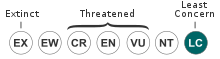


The helmeted guineafowl (Numida meleagris) is the best known of the guineafowl bird family, Numididae, and the only member of the genus Numida. It is native to Africa, mainly south of the Sahara, and has been widely introduced, as a domesticated species, into the West Indies, North America, Colombia, Brazil,[2] Australia and Europe.
Taxonomy
[edit]
The helmeted guineafowl was formally described by Swedish naturalist Carl Linnaeus in 1758 in the tenth edition of his Systema Naturae under the binomial name Phasianus meleagris.[3] In 1764, Linnaeus moved the helmeted guineafowl to the new genus Numida.[4] The genus name Numida is Latin for "North African".[5]
In the early days of the European colonisation of North America, the native wild turkey (Meleagris gallopavo) was confused with this species. The word meleagris, Greek for guineafowl, is also shared in the scientific names of the two species, though for the guineafowl it is the species name, whereas for the turkey, it is the name of the genus and (in inflected form) the family.
Subspecies
[edit]The nine recognised subspecies are:[6]
- N. m. coronata (Gurney, 1868) – Gurney's helmeted guineafowl – The type locality is restricted to Uitenhage; it occurs in eastern and central South Africa and western Eswatini.[7]
- N. m. galeatus (Pallas, 1767) – West African guineafowl – western Africa to southern Chad, central Zaire, and northern Angola
- N. m. marungensis (Schalow, 1884) – Marungu helmeted guineafowl – south Congo Basin to western Angola and Zambia
- N. m. meleagris (Linnaeus, 1758) – Saharan helmeted guineafowl – eastern Chad to Ethiopia, northern Zaire, Uganda and northern Kenya
- N. m. mitrata (Pallas, 1764) – tufted guineafowl – Terra Typica "Madagascar" (introduced or erroneous). Occurs in Tanzania to Zambia, Botswana, northern South Africa, eastern Eswatini and Mozambique.[7]
- N. m. damarensis (Roberts, 1917) – Damara helmeted guineafowl – Terra Typica: Windhoek. Occurs from arid southern Angola to northern Namibia and Botswana north of 26°S[7]
- N. m. reichenowi (Ogilvie-Grant, 1894) – Reichenow's helmeted guineafowl – Kenya and central Tanzania
- N. m. sabyi (Hartert, 1919) – Saby's helmeted guineafowl – northwestern Morocco
- N. m. somaliensis (Neumann, 1899) – Somali tufted guineafowl – northeastern Ethiopia and Somalia
Description
[edit]_(18199736631).jpg)
The helmeted guineafowl is a large, 53 to 58 cm (21 to 23 in) bird with a round body and small head. They weigh about 1.3 kg (2.9 lb). The body plumage is gray-black speckled with white. Like other guineafowl, this species has an unfeathered head, which in this species is decorated with a dull yellow or reddish bony knob, and bare skin with red, blue, or black hues. The wings are short and rounded, and the tail is likewise short. Various subspecies are proposed, differences in appearance being mostly a large variation in shape, size, and colour of the casque and facial wattles.
Behaviour and ecology
[edit]This is a gregarious species, forming flocks outside the breeding season typically of about 25 birds that also roost communally. Guineafowl are particularly well-suited to consuming massive quantities of ticks, which might otherwise spread Lyme disease.[8] These birds are terrestrial, and prone to run rather than fly when alarmed. Like most gallinaceous birds, they have a short-lived, explosive flight and rely on gliding to cover extended distances. Helmeted guineafowl can walk 10 km and more in a day. Their bodies are well-suited for running and they are remarkably successful in maintaining dynamic stability over rough terrain at speed.[9] They make loud harsh calls when disturbed.
Their diet consists of a variety of animal and plant foods. During the nonbreeding season, N. meleagris consumes corns, tubers, and seeds, particularly of agricultural weeds, as well as various agricultural crop spillage.[10][11] During the breeding season, more than 80% of their diet may be invertebrates, particularly arthropods such as beetles.[12] Guineafowl are equipped with strong claws and scratch in loose soil for food much like domestic chickens, although they seldom uproot growing plants in so doing. As with all of the Numididae, they have no spurs. They may live for up to 12 years in the wild.
Males often show aggression towards each other, and partake in aggressive fighting, which may leave other males bloodied and otherwise injured. They attempt to make themselves look more fearsome by raising their wings upwards from their sides and bristling their feathers across the length of their bodies, and they may also rush towards their opponent with a gaping beak. The nest is a well-hidden, generally unlined scrape, and a clutch is normally some 6 to 12 eggs, which the female incubates for 26 to 28 days. Nests containing larger numbers of eggs are generally believed to be the result of more than one hen using the nest; eggs are large, and an incubating bird could not realistically cover significantly more than a normal clutch.
Domesticated birds, at least, are notable for producing very thick-shelled eggs that are reduced to fragments as the young birds (known as keets among bird breeders) hatch, rather than leaving two large sections and small chips where the keet has removed the end of the egg. Domesticated guinea hens are not the best of mothers, and often abandon their nests. The keets are cryptically coloured, and rapid wing growth enables them to flutter onto low branches barely a week after hatching.
Reproduction
[edit]Helmeted guinea fowl are seasonal breeders. Summer is the peak breeding season in which the testes could weigh up to 1.6 gm, while during winter no breeding activity takes place. The serum testosterone level is up to 5.37 ng/ ml during the breeding season.[13]
Habitat
[edit],_parque_nacional_Kruger,_Sud%C3%A1frica,_2018-07-25,_DD_48.jpg)
They breed in warm, fairly dry and open habitats with scattered shrubs and trees such as savanna or farmland.
Domestication
[edit]
Helmeted guineafowl are often domesticated, and it is this species that is sold in Western supermarkets. Feral populations descended from domestic flocks are now widely distributed and occur in the West Indies, North America, Australia and Europe.[1]
References
[edit]- ^ a b BirdLife International (2018). "Numida meleagris". IUCN Red List of Threatened Species. 2018: e.T22679555A132052202. doi:10.2305/IUCN.UK.2018-2.RLTS.T22679555A132052202.en. Retrieved 13 November 2021.
- ^ "Tô-fraco, galinha d'angola, capota ou cocá? Ave conquistou o campo". Compre Rural. 3 April 2022. Retrieved 9 October 2022.
- ^ Linnaeus, Carl (1758). Systema Naturae per regna tria naturae, secundum classes, ordines, genera, species, cum characteribus, differentiis, synonymis, locis (in Latin). Vol. 1 (10th ed.). Holmiae (Stockholm): Laurentii Salvii. p. 158.
- ^ Linnaeus, Carl (1764). Museum S:ae R:ae M:tis Adolphi Friderici Regis (in Latin). Vol. 2. Holmiae (Stockholm): Salvius. p. 27.
- ^ Jobling, James A. (2010). The Helm Dictionary of Scientific Bird Names. London: Christopher Helm. p. 276. ISBN 978-1-4081-2501-4.
- ^ Martínez, I.; Kirwan, G.M. (2020). Del Hoyo, Josep; Elliott, Andrew; Sargatal, Jordi; Christie, David; De Juana, Eduardo (eds.). "Helmeted Guineafowl (Numida meleagris)". Handbook of the Birds of the World Alive. Lynx Edicions, Barcelona. doi:10.2173/bow.helgui.01. S2CID 216362040. Retrieved 18 October 2017.
- ^ a b c Gibbon, Guy. Roberts VII Multimedia Birds of Southern Africa (iPhone and iPad version 2.4 ed.). John Voelker Book Fund. Southern African Birding CC 2012–2016.
- ^ Duffy, David Cameron; Downer, Randall; Brinkley, Christie (June 1992). "The effectiveness of Helmeted Guineafowl in the control of the deer tick, the vector of Lyme disease" (PDF). The Wilson Bulletin. 104 (2): 342–345. Archived from the original (PDF) on 2009-10-07.
- ^ Daley, M. A.; Usherwood, J. R.; Felix, G.; Biewener, A. A. (2006). "Running over rough terrain: guinea fowl maintain dynamic stability despite a large unexpected change in substrate height" (PDF). Journal of Experimental Biology. 209 (Pt 1): 171–87. doi:10.1242/jeb.01986. PMID 16354788. S2CID 8640533.
- ^ Skeod, C.J. (1962). "A Study of the Crowned Guinea Fowl Numida Meleagris Coronata Gurney". Ostrich. 33 (2): 51–65. Bibcode:1962Ostri..33...51S. doi:10.1080/00306525.1962.9633435.
- ^ Mentis, M. T.; Poggenpool, B.; & Maguire, R. R. K. "Food of the helmeted guineafowl in highland Natal". South African Journal of Wildlife Research. 5 (1): 23–25.
- ^ Little, R.M.; Perrings, J.S.A.; Crowe, T.M. "Notes on the diet of helmeted guineafowl Numida meleagris on deciduous fruit farms in the Western Cape Province, South Africa". South African Journal of Wildlife Research. 25 (4): 144–146. hdl:10520/EJC116978.
- ^ Ali MZ, AS Qureshi, S Rehan, SZ Akbar and A Manzoor (2015). "Seasonal variations in histomorphology of testes and bursa, immune parameters and serum testosterone concentration in male guinea fowl (Numida meleagris)" (PDF). Pakistan Veterinary Journal. 35 (1): 88–92.
{{cite journal}}: CS1 maint: multiple names: authors list (link)
Further reading
[edit]- Madge and McGowan, Pheasants, Partridges and Grouse ISBN 0-7136-3966-0
External links
[edit]
- Helmeted Guineafowl – Species text in The Atlas of Southern African Birds
- Helmeted Guineafowl, Melissa Mayntz, 26 September 2017, The Spruce
- Helmeted Guineafowl videos, photos & sounds on the Internet Bird Collection
- Poultry Breeds – Guinea Fowl Oklahoma State University
Genera of landfowl and their extinct allies | |||||||||||||||||||||||||||||||||||
|---|---|---|---|---|---|---|---|---|---|---|---|---|---|---|---|---|---|---|---|---|---|---|---|---|---|---|---|---|---|---|---|---|---|---|---|
| |||||||||||||||||||||||||||||||||||
| |||||||||||||||||||||||||||||||||||
| |||||||||||||||||||||||||||||||||||
| |||||||||||||||||||||||||||||||||||
| |||||||||||||||||||||||||||||||||||


