


Helsinki Cathedral
 | You can help expand this article with text translated from the corresponding article in Finnish. (January 2017) Click [show] for important translation instructions.
|
| Helsinki Cathedral | |
|---|---|
Helsingin tuomiokirkko, Suurkirkko (in Finnish) Helsingfors domkyrka, Storkyrkan (in Swedish) | |
 | |
 | |
| 60°10′13″N 024°57′08″E / 60.17028°N 24.95222°E | |
| Location | Kruununhaka, Helsinki, Finland |
| Denomination | Evangelical Lutheran Church of Finland |
| Website | helsingintuomiokirkko.fi |
| History | |
| Status | Cathedral |
| Dedication | St Nicholas |
| Architecture | |
| Architect(s) | Carl Ludvig Engel; later altered by Ernst Lohrmann |
| Style | Neoclassical |
| Groundbreaking | 1830 |
| Completed | 1852 |
| Specifications | |
| Capacity | seats 1,300 |
| Administration | |
| Diocese | Helsinki |
| Clergy | |
| Bishop(s) | Teemu Laajasalo |
Helsinki Cathedral (Finnish: Helsingin tuomiokirkko, Suurkirkko; Swedish: Helsingfors domkyrka, Storkyrkan) is the Finnish Evangelical Lutheran cathedral of the Diocese of Helsinki, located in the neighborhood of Kruununhaka in the centre of Helsinki, Finland, at the Senate Square. The church was originally built from 1830 to 1852 as a tribute to the Grand Duke of Finland, Tsar Nicolas I. It was also known as St Nicholas's Church (Finnish: Nikolainkirkko, Swedish: Nikolajkyrkan) until Finland declared its full independence in 1917.[1] It is a major landmark of the city,[2] and one of the most famous historical structures in Finland as a whole when viewed globally.[3][4]
Description[edit]
A distinctive landmark in the Helsinki cityscape, with its tall, green dome surrounded by four smaller domes, the building is in the neoclassical style. It was designed by Carl Ludvig Engel as the climax of his Senate Square layout: it is surrounded by other, smaller buildings designed by him.
The church's plan is a Greek cross (a square centre and four equilateral arms), symmetrical in each of the four cardinal directions, with each arm's facade featuring a colonnade and pediment. Engel originally intended to place a further row of columns on the western end to mark the main entrance opposite the eastern altar, but this was never built.
-
 The cathedral and the steps
 -
 Aerial photograph from on top in 1976 that shows the shape of the cathedral
 -
 2015 aerial photograph showing the rear of the cathedral and the view to the sea
 -
 The cathedral from the sea


History[edit]
After Helsinki was made into the capital of Finland in 1812, Alexander I decreed in 1814 that 15 percent of the salt import tax were to be collected into a fund for two churches, one Lutheran and one Orthodox.[5] The cathedral was built on the site of the smaller 1724–1727 Ulrika Eleonora Church (Helsinki), which had been dedicated to its patroness, Ulrika Eleonora, Queen of Sweden.[6] Helsinki Old Church was built between 1824 and 1826 in nearby Kamppi to serve the parish while the Ulrika Eleonora Church was being demolished and until the consecration of the new cathedral. The bells of the old church were reused in the cathedral.[7] Construction of the cathedral began in 1830, although it was only officially inaugurated on 15 February 1852.[8][9] Engel died in 1840.
The building was later altered by Engel's successor Ernst Lohrmann, whose four small domes emphasise the architectural connection to the cathedral's models, Saint Isaac's Cathedral and Kazan Cathedral in St. Petersburg.[10][11] Lohrmann also designed two extra buildings to the sides of the steps: looking from the square the left building is a bell tower and the right building a chapel.[12] He also erected larger-than-life sized zinc statues of the Twelve Apostles at the apexes and corners of the roofline in 1849.[13] They were sculpted by August Wredov and Hermann Schievelbein and cast by S. P. Devaranne in Berlin in 1845–1847.[14] The altarpiece was painted by Carl Timoleon von Neff and donated to the church by Emperor Nicholas I.[15] The cathedral crypt was renovated in the 1980s by architects Vilhelm Helander and Juha Leiviskä for use in exhibitions and church functions; Helander was also responsible for conservation repairs on the cathedral in the late 1990s.
Today, the cathedral is one of Helsinki's most popular tourist attractions. In 2018 there were half a million visitors.[16] The church is in regular use for services of worship and special events such as weddings.
-
 Ulrika Eleonora church in 1816–1817, roughly located at the northwest part of the square
 -
 An original sketch of the cathedral by Engel
 -
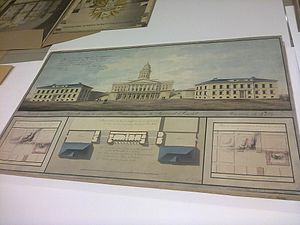 Another of Engel's sketches with accompanying buildings
 -
![Lithograph of the church from 1838, before the side buildings were constructed. The guard building in front of the cathedral was demolished in the 1840s and replaced with the large steps.[7]](//upload.wikimedia.org/wikipedia/commons/thumb/4/4e/Senaatintori_ja_Nikolainkirkko_1838.jpg/302px-Senaatintori_ja_Nikolainkirkko_1838.jpg) Lithograph of the church from 1838, before the side buildings were constructed. The guard building in front of the cathedral was demolished in the 1840s and replaced with the large steps.[7]
Lithograph of the church from 1838, before the side buildings were constructed. The guard building in front of the cathedral was demolished in the 1840s and replaced with the large steps.[7] -
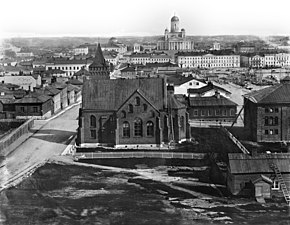 1867 photograph from the south
 -
 1907 service with government officials on the day of the first annual session of the Parliament of Finland
 -
![Snow sculpture version of the old Ulrika Eleonora Church being constructed on the square in 2000 (also done once before in 1997)[17]](//upload.wikimedia.org/wikipedia/commons/thumb/0/05/Pekka_Vyhtinen_-_Snow_sculpture_version_of_the_Ulrika_Eleonora_Church_being_constructed_on_the_Senate_Square%2C_Helsinki_in_2000.jpg/349px-Pekka_Vyhtinen_-_Snow_sculpture_version_of_the_Ulrika_Eleonora_Church_being_constructed_on_the_Senate_Square%2C_Helsinki_in_2000.jpg) Snow sculpture version of the old Ulrika Eleonora Church being constructed on the square in 2000 (also done once before in 1997)[17]
Snow sculpture version of the old Ulrika Eleonora Church being constructed on the square in 2000 (also done once before in 1997)[17]


![Lithograph of the church from 1838, before the side buildings were constructed. The guard building in front of the cathedral was demolished in the 1840s and replaced with the large steps.[7]](/wiki/File:Senaatintori_ja_Nikolainkirkko_1838.jpg)

.jpg)
![Snow sculpture version of the old Ulrika Eleonora Church being constructed on the square in 2000 (also done once before in 1997)[17]](/wiki/File:Pekka_Vyhtinen_-_Snow_sculpture_version_of_the_Ulrika_Eleonora_Church_being_constructed_on_the_Senate_Square,_Helsinki_in_2000.jpg)
In popular culture[edit]
The opening sequence of the music video for "Sandstorm" by Darude was filmed on Senate Square, prominently featuring the Cathedral in the background.[18][19]
Gallery[edit]
-
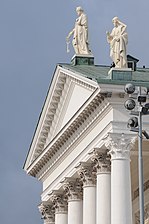 Detailing on the side
 -
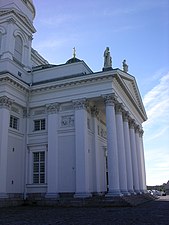 Right side
 -
 The roof going through renovations in 2009
 -
 Bell tower on the left side
 -
 Main dome with a clock
 -
 Tops of domes

.jpg)
.jpg)
_elokuussa_2018_02.jpg)


-
 Saint Peter, carrying Keys of Heaven
 -
 John the Apostle, carrying a cup
 -
 Philip the Apostle, carrying an open book
 -
 Bartholomew the Apostle, carrying a knife because he was skinned alive
 -
 Matthew the Evangelist, carrying writing instruments
 -
 Thomas the Apostle, carrying a square
 -
 Simon the Zealot, carrying a saw
 -
 Saint Matthias, carrying an executioner's axe


-
 Interior, view towards the front
 -
 View towards the back
 -
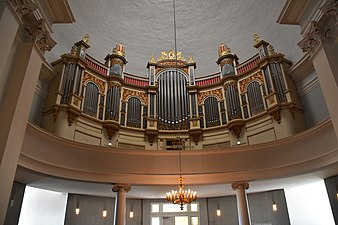 Organ
Organ -
 Plain dome
 -
 Altar, with Carl Timoleon von Neff's painting The Descent of Jesus from the Cross donated by Nicholas I
 -
 Mikael Agricola by Ville Vallgren, 1887
 -

-
 Melanchthon, similar copy of Rietchel
 -
 The crypt below
_(36294114320).jpg)

_(36689458605).jpg)
_(36643361076).jpg)


.jpg)


See also[edit]


- St. John's Church
- Uspenski Cathedral
- St. Henry's Cathedral
- Holy Trinity Church, Helsinki
- Saint Isaac's Cathedral (Saint Petersburg)
- Berlin Cathedral (Berlin)
References[edit]
- ^ Kirkko Helsingissä - Cathedral
- ^ "Helsingin tuomiokirkko". My Helsinki. Retrieved 26 June 2020.
- ^ What to do in Helsinki: Helsinki Cathedral and Senate Square
- ^ "Architecture of Helsinki – Destig". Archived from the original on 20 September 2021. Retrieved 5 March 2021.
- ^ Ikonen, Outi (15 August 2018). "Uspenskin katedraalia alettiin rakentaa suolantuontiveroilla – nyt 150 vuotta täyttävä katedraali on suosittu turistikohde". Kirkko ja kaupunki. Retrieved 27 June 2020.
- ^ "Memorial to the Ulrika Eleonora Church". HAM Helsinki. Retrieved 29 June 2020.
- ^ a b "Kirkon tarina". Helsingin Tuomiokirkko. Retrieved 26 June 2020.
- ^ Perälä, Reijo (12 April 2018). "Helsingin tuomiokirkko nousi vallan symboliksi ja maksoi miljoona ruplaa". Yle. Retrieved 26 June 2020.
- ^ Ruuth, Martti (1952). Helsingin Suurkirkko satavuotias (in Finnish). Helsinki: Helsingin evankelis-luterilaisten seurakunta. p. 7.
- ^ Halonen, Kaisa (1 February 2012). "160-vuotias Helsingin helmi". Kirkko ja kaupunki. Retrieved 26 June 2020.
- ^ "Tuomiokirkko Helsingin sydän" (PDF). Helsingin Seurakunta. Retrieved 26 June 2020.
- ^ "Tilat". Helsingin Tuomiokirkko. Retrieved 26 June 2020.
- ^ Cast by the prominent firm of S. P. Devaranne, Berlin, and set up in 1852, according to Carol A. Grissom, Zinc sculpture in America, 1850–1950 2009:587.
- ^ "Kaksitoista apostolia". HAM Helsinki. Retrieved 26 June 2020.
- ^ "HelsingforsDomkyrka" (in Swedish). Uppslagsverket Finland. Archived from the original on 24 December 2013. Retrieved 19 February 2013.
- ^ "Helsingin tuomiokirkko harkitsee pääsymaksun perimistä". Seurakuntalainen. 28 October 2019. Retrieved 27 June 2020.
- ^ "Minä vuosina Helsingin Senaatintorille rakennettiin lumikirkko?". Kysy. 13 October 2011. Archived from the original on 27 September 2020. Retrieved 29 June 2020.
- ^ "Myrskyisä pako läpi Helsingin katujen" (PDF). Helsingin Sanomat (in Finnish). 16 November 2000. Archived from the original (PDF) on 4 October 2015. Retrieved 10 April 2017.
- ^ Rantanen, Miska (2 May 2019). "Maailman kuuluisin takaa-ajojuoksu". Helsingin Sanomat. Retrieved 5 July 2020.
- ^ Korhonen, Ilari. "Paavali". Tottosaari. Retrieved 25 June 2020.
- ^ Korhonen, Ilari. "Jaakob Vanhempi". Tottosaari. Retrieved 25 June 2020.
- ^ Korhonen, Ilari. "Jaakob Nuorempi". Tottosaari. Retrieved 25 June 2020.
- ^ Korhonen, Ilari. "Andreas". Tottosaari. Retrieved 25 June 2020.
External links[edit]
 Media related to Helsinki Cathedral at Wikimedia Commons
- Official Site (in English)
- Helsinki Cathedral at Helsingin seurakuntayhtymä (in English)
- Panoramic view of Helsinki Cathedral

| Dioceses |  | |
|---|---|---|
| Cathedrals | ||
| Monasteries | ||
| See also | ||
Helsinki Cityscape | |||||
|---|---|---|---|---|---|
| Buildings |  | ||||
| Places of worship |
| ||||
| Monuments & memorials | |||||
| Parks & gardens | |||||
| Islands | |||||
| City squares | |||||
| Tourist attractions | |||||
| Hotels | |||||
| Museums | |||||
| Performing arts |
| ||||
| Other venues |
| ||||
| International | |
|---|---|
| National | |
| Geographic | |
