


Lobos Island
 Map of Fuerteventura showing Lobos | |
  Lobos | |
| Geography | |
|---|---|
| Archipelago | Canary Islands |
| Area | 4.68 km2 (1.81 sq mi) |
| Highest elevation | 127 m (417 ft) |
| Administration | |
| Autonomous Community | Canary Islands |
| Province | Las Palmas |
| Municipality | La Oliva |
| Demographics | |
| Population | 4 (2018) |
Lobos (Spanish: Isla de Lobos,[1] pronounced [ˈisla ðe ˈloβos]) is a small island of the Canary Islands (Spain) located just 2 kilometres (1 mile) north of the island of Fuerteventura. It belongs to the municipality of La Oliva on the island of Fuerteventura. It has an area of 4.68 square kilometres (1.8 sq mi). It has been a nature reserve (Parque Natural del Islote de Lobos) since 1982.[2][3]
The island is accessible to tourists via a short ferry ride from Corralejo, in the north of Fuerteventura. It has day facilities and weekend homes of local fishermen. It offers hiking and snorkelling tours. At the northeastern end of the island is the Punta Martiño Lighthouse, the lighthouse keeper and his family were the last permanent inhabitants of Lobos, until the light was automated in the 1960s.
In 1405, Lobos Island served as resupply base for Jean de Béthencourt's conquest of Fuerteventura.
Origin of name[edit]
Lobos Island (Wolves Island) was named for the large number of sea wolves, also called monk seals, that once lived there. The monk seals were the island's only inhabitants when it was discovered by the Spanish conquerors of the Canaries archipelago in the fifteenth century, but with the arrival of humans, these animals were hunted on a massive scale by sailors and fishermen who saw them as a source of food, fat and skin. As a result of this hunting, the species eventually became extinct on the island and its presence now is only occasional.
History[edit]
Recent archaeological findings have concluded that Ancient Rome established a (possibly seasonal) settlement in the island, related with the obtention of purple dye.[4]
In 1405 Lobos Island served as resupply base for Jean de Béthencourt´s conquest of Fuerteventura. Until 1968 the only inhabitants of the island were the lighthouse keeper and his family, who had the responsibility for operating the Faro de Lobos lighthouse located at Punta Martiño at the northern tip of the island, a prominent local landmark (his name was Antonito; a school in the town of Corralejo was named after him). The island was one of the first natural areas of the Canary Islands to be designated as a natural park in 1982. Later the island was also designated an area of special protection for birds, and many marine species of migratory birds inhabit the island.


Geography[edit]
Lobos Island, like the rest of the Canary Islands, is a volcanic island. Its age is estimated between 6,000 and 8,000 years. The highest point is on the island's volcanic caldera, Montaña La Caldera, 127 metres (417 feet) above sea level. The island includes a small lake, but the low rainfall creates an arid landscape.
Fauna and flora[edit]
Despite being a desert and a volcanic landscape, Lobos Island has a large number of natural habitats. Because of its great ecological diversity the site has been designated as a protected zone, the Parque Natural del Islote de Lobos. There are over 130 plant species, including the siempreviva (Limonium ovalifolium), which is endemic to the island, and the Sea Uvilla (Tetraena fontanesii) which is very attractive because of its shape and color.[5]
Likewise, birds are an important feature of the island: it has a great variety of seabirds that usually nest on cliffs and rocks. Breeding seabirds include Cory's and little shearwaters, European and band-rumped storm petrels, and kentish plovers are resident. The island has been declared a special protection area (SPA) for birds, as well as being recognised as an Important Bird Area (IBA) by BirdLife International.[6]
In addition to birds a great diversity of fish can be spotted in its waters. Of these, abound barracuda, hammerhead shark and bream.
Tourism[edit]
The island is a popular location for day trips for tourists visiting from Fuerteventura who have an interest in flora, fauna and geology.[7] Regular boat services ferry passengers from Corralejo harbour during daylight hours. To protect the natural landscape from human impact, access is limited to restricted areas and to a series of walking trails, marked by directional signs to protect the conservation areas. The paths take visitors from the boat jetty through a varied landscape, including to the lighthouse at Punto Martino and to the top of the caldera. There is a small, sheltered sea lagoon, Playa de la Concha, with a sandy beach for bathing.
Visitors, before 2007, could ask for authorisation from Fuerteventura local government's environment office to camp on the island, for a maximum of three nights, in one permitted location known as "El carpintero". Since 2007 it is prohibited to camp on the island.
Gallery[edit]
-

-
 Lobos Island buildings
 -
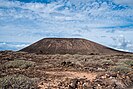 Montaña La Caldera
 -
 Lobos Island's small lagoon, Playa de la Concha
 -
 Lobos Island interior
 -
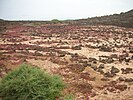 Lobos Island interior detail
 -
 Lobos Island typical soil
 -
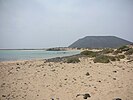 Lobos Island's Playa de la Concha, looking to Punta Saladero


References[edit]
- ^ Literally translating as "Wolves Island", the name refers to the Mediterranean monk seal, which was known locally as lobo marinero ("sea wolf", compare sea-"lion"). These animals are now extinct in the Canaries.
- ^ "Protected Natural Areas". Archived from the original on 2017-05-15. Retrieved 2014-04-24.
- ^ Boletín Oficial de Canarias, pages 9715 and 9851-2
- ^ In Spanish: ¿Llegaron los romanos a las Islas Canarias? (El Diario Montañés)
- ^ "Isla de Lobos - Los Lobos Island - Nature Reserve". Archived from the original on 2018-03-07. Retrieved 2018-03-06.
- ^ "Island of Lobos". BirdLife Data Zone. BirdLife International. 2021. Retrieved 13 February 2021.
- ^ Noel Rochford (2007). Landscapes of Fuerteventura, A Countryside Guide, 4th edition. Sunflower Books.
{{cite book}}:|work=ignored (help)
- R. Pott, J. Hüppe, W. Wildpret de la Torre, Die Kanarischen Inseln. Natur- und Kulturlandschaften, Ulmer Eugen Verlag, 2003, ISBN 9783800132843
- Viajes a vela en las Islas Canarias, España ~ turismo vela: Isla de Lobos. Accessed on October 3, 2010
- Isla de Lobos. Islas Canarias. Fuerteventura. Accessed on October 3, 2010
External links[edit]


 Media related to Isla de Lobos (Spain) at Wikimedia Commons

Islands and provinces of the Canary Islands | ||
|---|---|---|
| Main islands |  | |
| Other islands | ||
| Provinces | ||