


John Napier
John Napier | |
|---|---|
 1616 portrait of Napier | |
| Born | 1 February 1550 |
| Died | 4 April 1617 (aged 67) Edinburgh, Scotland |
| Nationality | Scottish |
| Alma mater | University of St Andrews |
| Known for | Logarithms Napier's bones Decimal notation Spherical trigonometry |
| Scientific career | |
| Fields | Mathematician |

John Napier of Merchiston (/ˈneɪpiər/ NAY-pee-ər;[1] Latinized as Ioannes Neper; 1 February 1550 – 4 April 1617), nicknamed Marvellous Merchiston, was a Scottish landowner known as a mathematician, physicist, and astronomer. He was the 8th Laird of Merchiston.
John Napier is best known as the discoverer of logarithms. He also invented the so-called "Napier's bones" and made common the use of the decimal point in arithmetic and mathematics.
Napier's birthplace, Merchiston Tower in Edinburgh, is now part of the facilities of Edinburgh Napier University. There is a memorial to him at St Cuthbert's at the west side of Edinburgh.[2]
Life
[edit]Napier's father was Sir Archibald Napier of Merchiston Castle, and his mother was Janet Bothwell, daughter of the politician and judge Francis Bothwell,[3] and a sister of Adam Bothwell who became the Bishop of Orkney. Archibald Napier was 16 years old when John Napier was born.[3]

There are no records of Napier's early learning, but many believe that he was privately tutored during early childhood. At age 13, he was enrolled in St Salvator's College, St Andrews. Near the time of his matriculation the quality of the education provided by the university was poor, owing in part to the Reformation's causing strife between those of the old faith and the growing numbers of Protestants. There are no records showing that John Napier completed his education at St Andrews.[4] It is believed he left Scotland to further his education in mainland Europe, following the advice given by his uncle Adam Bothwell in a letter written to John Napier's father on 5 December 1560, saying, "I pray you, sir, to send John to the schools either to France or Flanders, for he can learn no good at home".[5] It is not known which university Napier attended in Europe, but when he returned to Scotland in 1571 he was fluent in Greek, a language that was not commonly taught in European universities at the time. There are also no records showing his enrollment in the premier universities in Paris or Geneva during this time.[6][4]
In 1571, Napier, aged 21, returned to Scotland, and bought a castle at Gartness in 1574. On the death of his father in 1608, Napier and his family moved into Merchiston Castle in Edinburgh, where he resided the remainder of his life. He had a property within Edinburgh city as well on Borthwick's Close off the Royal Mile.[7]

On 7 June 1596 Napier wrote a paper Secret inventions, profitable and necessary in these days for defence of this island. He describes two kinds of burning mirror for use against ships at a distance, a special kind of artillery shot, and a musket-proof metal chariot.[8]
Napier died from the effects of gout at home at Merchiston Castle at the age of 67. He was buried in the kirkyard of St Giles in Edinburgh. Following the loss of the kirkyard of St Giles to build Parliament House, his remains were transferred to an underground vault on the north side of St Cuthbert's Parish Church at the west side of Edinburgh.[2] There is also a wall monument to Napier at St Cuthbert's.[2]
Many mathematicians at the time were acutely aware of the issues of computation and were dedicated to relieving practitioners of the calculation burden. Napier was famous for his devices to assist with these issues of computation. He invented a well-known mathematical artefact, the ingenious numbering rods more quaintly known as "Napier's bones",[9] that offered mechanical means for facilitating computation.
In addition, Napier recognized the potential of the recent developments in mathematics, particularly those of prosthaphaeresis, decimal fractions, and symbolic index arithmetic, to tackle the issue of reducing computation. He appreciated that, for the most part, practitioners who had laborious computations generally did them in the context of trigonometry. Therefore, as well as developing the logarithmic relation, Napier set it in a trigonometric context so it would be even more relevant.
Mathematics
[edit]Napier's Bones
[edit].png)
His work Mirifici Logarithmorum Canonis Descriptio (1614) contained fifty-seven pages of explanatory matter and ninety pages of tables listing the natural logarithms of trigonometric functions.[10]: Ch. III The book also has a discussion of theorems in spherical trigonometry, usually known as Napier's Rules of Circular Parts.
Modern English translations of both Napier's books on logarithms and their description can be found on the web, as well as a discussion of Napier's bones and Promptuary (another early calculating device).[11]
His invention of logarithms was quickly taken up at Gresham College, and prominent English mathematician Henry Briggs visited Napier in 1615. Among the matters they discussed were a re-scaling of Napier's logarithms, in which the presence of the mathematical constant now known as e (more accurately, e times a large power of 10 rounded to an integer) was a practical difficulty. Neither Napier nor Briggs actually discovered the constant e; that discovery was made decades later by Jacob Bernoulli.
Napier delegated to Briggs the computation of a revised table. The computational advance available via logarithms, the inverse of powered numbers or exponential notation, was such that it made calculations by hand much quicker.[12] The way was opened to later scientific advances, in astronomy, dynamics, and other areas of physics.
Napier made further contributions. He improved Simon Stevin's decimal notation, introducing the full stop (.) as the delimiter for the fractional part.[13]: p. 8, archive p. 32) Lattice multiplication, used by Fibonacci, was made more convenient by his introduction of Napier's bones, a multiplication tool using a set of numbered rods.
Napier may have worked largely in isolation, but he had contact with Tycho Brahe who corresponded with his friend John Craig. Craig certainly announced the discovery of logarithms to Brahe in the 1590s (the name itself came later); there is a story from Anthony à Wood, perhaps not well substantiated, that Napier had a hint from Craig that Longomontanus, a follower of Brahe, was working in a similar direction. Craig had notes on a method of Paul Wittich that used trigonometric identities to reduce a multiplication formula for the sine function to additions.[14]
Trigonometry
[edit]
When one of the angles, say C, of a spherical triangle is equal to π/2 the various identities given above are considerably simplified. There are ten identities relating three elements chosen from the set a, b, c, A, B.
Napier[15] provided an elegant mnemonic aid for the ten independent equations: the mnemonic is called Napier's circle or Napier's pentagon (when the circle in the above figure, right, is replaced by a pentagon).
First, write the six parts of the triangle (three vertex angles, three arc angles for the sides) in the order they occur around any circuit of the triangle: for the triangle shown above left, going clockwise starting with a gives aCbAcB. Next replace the parts that are not adjacent to C (that is A, c, B) by their complements and then delete the angle C from the list. The remaining parts can then be drawn as five ordered, equal slices of a pentagram, or circle, as shown in the above figure (right). For any choice of three contiguous parts, one (the middle part) will be adjacent to two parts and opposite the other two parts. The ten Napier's Rules are given by
- sine of the middle part = the product of the tangents of the adjacent parts
- sine of the middle part = the product of the cosines of the opposite parts
The key for remembering which trigonometric function goes with which part is to look at the first vowel of the kind of part: middle parts take the sine, adjacent parts take the tangent, and opposite parts take the cosine. For an example, starting with the sector containing we have:


The full set of rules for the right spherical triangle is (Todhunter,[16] Art.62)
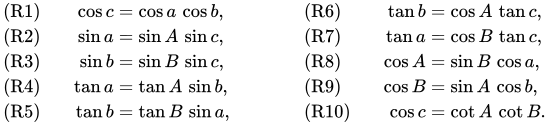

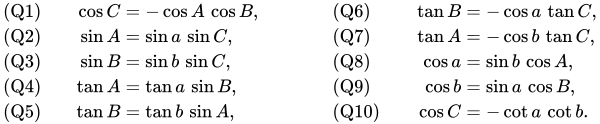
A quadrantal spherical triangle is defined to be a spherical triangle in which one of the sides subtends an angle of π/2 radians at the centre of the sphere: on the unit sphere the side has length π/2. In the case that the side c has length π/2 on the unit sphere the equations governing the remaining sides and angles may be obtained by applying the rules for the right spherical triangle of the previous section to the polar triangle A'B'C' with sides a',b',c' such that A' = π − a, a' = π − A etc. The results are:
Logarithm
Given a positive real number b such that b ≠ 1, the logarithm of a positive real number x with respect to base b is the exponent by which b must be raised to yield x. In other words, the logarithm of x to base b is the unique real number y such that by = x.
The logarithm is denoted "logb x" (pronounced as "the logarithm of x to base b", "the base-b logarithm of x", or most commonly "the log, base b, of x").
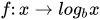
An equivalent and more succinct definition is that the function is the inverse function to the function

Theology
[edit]

Napier had an interest in the Book of Revelation, from his student days at St Salvator's College, St Andrews. Under the influence of the sermons of Christopher Goodman, he developed a strongly anti-papal reading, going as far as to say that the Pope was the Antichrist in some of his writings.[12][17]
Napier regarded A Plaine Discovery of the Whole Revelation of St. John (1593) as his most important work. It was written in English, unlike his other publications, in order to reach the widest audience and so that, according to Napier, "the simple of this island may be instructed".[17] A Plaine Discovery used mathematical analysis of the Book of Revelation to attempt to predict the date of the Apocalypse. Napier identified events in chronological order which he believed were parallels to events described in the Book of Revelation believing that Revelation's structure implied that the prophecies would be fulfilled incrementally.[17] In this work Napier dated the seventh trumpet to 1541, and predicted the end of the world would occur in either 1688 or 1700. Napier did not believe that people could know the true date of the Apocalypse, but claimed that since the Bible contained so many clues about the end, God wanted the Church to know when the end was coming.[17]
In his dedication of the Plaine Discovery to James VI, dated 29 Jan 1594,[18] Napier urged the king to see "that justice be done against the enemies of God's church," and counselled the King "to reform the universal enormities of his country, and first to begin at his own house, family, and court." The volume includes nine pages of Napier's English verse. It met with success at home and abroad. In 1600 Michiel Panneel produced a Dutch translation, and this reached a second edition in 1607. In 1602 the work appeared at La Rochelle in a French version, by Georges Thomson, revised by Napier, and that also went through several editions (1603, 1605, and 1607). A new edition of the English original was called for in 1611, when it was revised and corrected by the author, and enlarged by the addition of With a resolution of certain doubts, moved by some well affected brethren.;[19] this appeared simultaneously at Edinburgh and London. The author stated that he still intended to publish a Latin edition, but it never appeared. A German translation, by Leo de Dromna, of the first part of Napier's work appeared at Gera in 1611, and of the whole by Wolfgang Meyer at Frankfurt-am-Main, in 1615.[12] Among Napier's followers was Matthew Cotterius (Matthieu Cottière).[20]
Interest in the occult
[edit]In addition to his mathematical and religious interests, Napier was often perceived as a magician, and is thought to have dabbled in alchemy and necromancy. It was said that he would travel about with a black spider in a small box, and that his black cockerel was his familiar spirit.[21][22][23]
Some of Napier's neighbours accused him of being a sorcerer and in league with the devil, believing that all of the time he spent in his study was being used to learn the black art. These rumours were stoked when Napier used his black cockerel to catch a thief. Napier told his servants to go into a darkened room and pet the cockerel, claiming the bird would crow if they were the one who stole his property. Unbeknownst to the servants, Napier had covered the bird with soot and when the servants emerged from the room, Napier inspected their hands to find the one who had been too afraid to touch the rooster.[24]
Another act which Napier is reported to have carried out, which may have seemed mystical to the locals, was when Napier removed the pigeons from his estate since they were eating his grain. Napier caught the pigeons by strewing grain laced with alcohol throughout the field and then capturing the pigeons once they were too drunk to fly away.[25]
A contract still exists for a treasure hunt, made between Napier and Robert Logan of Restalrig. Napier was to search Fast Castle for treasure allegedly hidden there, wherein it is stated that Napier should "do his utmost diligence to search and seek out, and by all craft and ingine to find out the same, or make it sure that no such thing has been there."[12][26] This contract was never fulfilled by Napier, and no gold was found when the Edinburgh Archaeological Field society excavated the castle between 1971 and 1986.[26]
Influence
[edit]Among Napier's early followers were the instrument makers Edmund Gunter and John Speidell.[27][28][29] The development of logarithms is given credit as the largest single factor in the general adoption of decimal arithmetic.[30] The Trissotetras (1645) of Thomas Urquhart builds on Napier's work, in trigonometry.[31]
Henry Briggs was an early adopter of the Napierian logarithm. He later computed a new table of logarithms to base 10, accurate to 14 decimal places.[32]
Eponyms
[edit]An alternative unit to the decibel used in electrical engineering, the neper, is named after Napier, as is Edinburgh Napier University in Edinburgh, Scotland.
The crater Neper on the Moon is named after him.[33]
In French, Spanish and Portuguese, the natural logarithm is named after him (respectively, Logarithme Népérien and Logaritmos Neperianos for Spanish and Portuguese). In Finnish and Italian, the mathematical constant e is named after him (Neperin luku and Numero di Nepero).
Family
[edit]In 1572, Napier married 16-year-old Elizabeth, daughter of James Stirling, the 4th Laird of Keir and of Cadder.[34] They had two children. Elizabeth died in 1579, and Napier then married Agnes Chisholm, with whom he had ten more children.
Napier's father-in-law, Sir James Chisholm of Cromlix, was one of many excommunicated by the General Assembly of the Presbyterian party following the Spanish blanks plot. Napier sat on the General Assembly that excommunicated the plotters, and petitioned the King James VI and I to enforce the punishment on the plotters, but was ultimately ignored since the King believed the ministers were acting cruelly, and was in favor of pursuing policies of more appeasement.[17][35]
His half-brother (through his father's remarriage) was Alexander Napier, Lord Laurieston.
List of works
[edit]- (1593) A Plaine Discovery of the Whole Revelation of St. John
- (1614) Mirifici logarithmorum canonis descriptio Archived 27 April 2023 at the Wayback Machine – Edward Wright's English translation was published in 1616.[10]
- (1617) Rabdologiæ seu Numerationis per Virgulas libri duo (Google Books link)(published posthumously) Rabdology (Wikipedia)
- (1619) Mirifici logarithmorum canonis constructio –written before the Descriptio, but published posthumously by his son Robert. Translated into English in 1889.[36]
- (1839) De arte logistica
See also
[edit]- List of colleges and universities named after people
- Location arithmetic
- Napier's analogies
- Napierian logarithm
- Rabdology
Notes
[edit]- ^ "Napier" Archived 5 March 2016 at the Wayback Machine. Random House Webster's Unabridged Dictionary.
- ^ a b c Monuments and monumental inscriptions in Scotland: The Grampian Society, 1871
- ^ a b Chisholm, Hugh, ed. (1911). . Encyclopædia Britannica. Vol. 19 (11th ed.). Cambridge University Press. pp. 171–175.
- ^ a b Rice, Brian; González-Velasco, Enrique; Corrigan, Alexander (2017), "John Napier", The Life and Works of John Napier, Springer International Publishing, p. 12, doi:10.1007/978-3-319-53282-0_1, ISBN 9783319532813
- ^ Napier, Mark, 1798-1879. (1834). Memoirs of John Napier of Merchiston : his lineage, life, and times, with a history of the invention of logarithms. W. Blackwood. p. 67. OCLC 5167671.
{{cite book}}: CS1 maint: multiple names: authors list (link) CS1 maint: numeric names: authors list (link) - ^ Havil, Julian, 1952- (5 October 2014). John Napier : life, logarithms, and legacy. Princeton. pp. 13–17. ISBN 9781400852185. OCLC 889552514.
{{cite book}}: CS1 maint: location missing publisher (link) CS1 maint: multiple names: authors list (link) CS1 maint: numeric names: authors list (link) - ^ Cassell's Old and New Edinburgh vol.II p. 242.
- ^ Thomas Birch, Memoirs of Thomas Birch, vol. 2 (London, 1754), pp. 28-9.
- ^ Caulfield, Michael J. (July 2010). "John Napier: His Life, His Logs, and His Bones - Introduction". Convergence. Washington, D.C.: Mathematical Association of America. Archived from the original on 2 May 2023. Retrieved 10 March 2019.
- ^ a b Napier, John (1614). The Description of the Wonderful Canon of Logarithms (PDF). Translated by Wright, Edward; Bruce, Ian. 17centurymaths.com. Archived (PDF) from the original on 22 April 2023. Retrieved 14 March 2022.
- ^ "17th Century Maths.com". 17centurymaths.com. 25 March 2011. Archived from the original on 17 May 2011. Retrieved 3 April 2022.
- ^ a b c d . Dictionary of National Biography. London: Smith, Elder & Co. 1885–1900.
- ^ Napier, John (1889) [1620]. The Construction of the Wonderful Canon of Logarithms. Translated by Macdonald, William Rae. Edinburgh: Blackwood & Sons – via Internet Archive.
In numbers distinguished thus by a period in their midst, whatever is written after the period is a fraction, the denominator of which is unity with as many cyphers after it as there are figures after the period.
- ^ Molland, George. "Napier, John". Oxford Dictionary of National Biography (online ed.). Oxford University Press. doi:10.1093/ref:odnb/19758. (Subscription or UK public library membership required.)
- ^ Napier, J (1614). Mirifici Logarithmorum Canonis Constructio. p. 50. Archived from the original on 30 April 2013. Retrieved 14 May 2016. An 1889 translation The Construction of the Wonderful Canon of Logarithms is available as en e-book from Abe Books Archived 2020-03-03 at the Wayback Machine
- ^ Todhunter, I. (1886). Spherical Trigonometry (5th ed.). MacMillan. Archived from the original on 14 April 2020. Retrieved 28 July 2013.
- ^ a b c d e Rice, Brian; González-Velasco, Enrique; Corrigan, Alexander (2017), "John Napier", The Life and Works of John Napier, Springer International Publishing, pp. 1–60, doi:10.1007/978-3-319-53282-0_1, ISBN 9783319532813
- ^ "Plaine Discovery of the Whole Revelation of Saint John, work by Napier". Encyclopædia Britannica. Retrieved 12 June 2024.
- ^ A plaine discovery ... Archived 7 February 2015 at the Wayback Machine, Universiteitsbibliotheek Gent
- ^ Arthur H. Williamson, Scottish National Consciousness in the Age of James VI (1979), p. 34.
- ^ Johnston, Ian (14 May 2005). "Scots genius who paved way for Newton's discoveries". The Scotsman. Archived from the original on 27 December 2005. Retrieved 29 March 2011.
- ^ Springer, Will (14 February 2005). "Napier's wizard roots – article about Napier's interest in the occult". The Scotsman. Archived from the original on 21 October 2007. Retrieved 29 March 2011.
- ^ "Napier's bones". National Museums Scotland. Archived from the original on 24 September 2023. Retrieved 23 December 2017.
- ^ Havil, Julian, 1952- (5 October 2014). John Napier : life, logarithms, and legacy. Princeton. p. 21. ISBN 9781400852185. OCLC 889552514.
{{cite book}}: CS1 maint: location missing publisher (link) CS1 maint: multiple names: authors list (link) CS1 maint: numeric names: authors list (link) - ^ Havil, Julian (31 January 2014). John Napier. Princeton: Princeton University Press. p. 20. doi:10.1515/9781400852185. ISBN 9781400852185.
- ^ a b Havil, Julian, 1952- (5 October 2014). John Napier : life, logarithms, and legacy. Princeton. pp. 22, 23. ISBN 9781400852185. OCLC 889552514.
{{cite book}}: CS1 maint: location missing publisher (link) CS1 maint: multiple names: authors list (link) CS1 maint: numeric names: authors list (link) - ^ The London encyclopaedia: or Universal dictionary of science, art, literature, and practical mechanics, comprising a popular view of the present state of knowledge. 1829. p. 498. Retrieved 23 May 2012.
- ^ Florian Cajori (1991). A History of Mathematics. American Mathematical Soc. p. 152. ISBN 978-0-8218-2102-2. Retrieved 23 May 2012.
- ^ Ivor Grattan-Guinness (1 August 2003). Companion Encyclopedia of the History and Philosophy of the Mathematical Sciences. JHU Press. p. 1129. ISBN 978-0-8018-7397-3. Retrieved 23 May 2012.
- ^ David Eugene Smith (1 June 1958). History of Mathematics. Courier Dover Publications. p. 244. ISBN 978-0-486-20430-7. Retrieved 23 May 2012.
- ^ Garrett A. Sullivan; Alan Stewart (1 February 2012). The Encyclopedia of English Renaissance Literature. John Wiley & Sons. p. 995. ISBN 978-1-4051-9449-5. Retrieved 23 May 2012.
- ^ Rice, Brian; González-Velasco, Enrique; Corrigan, Alexander (2017), "John Napier", The Life and Works of John Napier, Springer International Publishing, p. 37, doi:10.1007/978-3-319-53282-0_1, ISBN 9783319532813
- ^ Neper Archived 16 June 2010 at the Wayback Machine Gazetteer of Planetary Nomenclature – USGS Astrogeology
- ^ Rice, Brian; González-Velasco, Enrique; Corrigan, Alexander (2017), "John Napier", The Life and Works of John Napier, Springer International Publishing, pp. 12–14, doi:10.1007/978-3-319-53282-0_1, ISBN 9783319532813
- ^ Clouse, Robert G. (April 1974). "John Napier and Apocalyptic Thought". Sixteenth Century Journal. 5 (1): 105. doi:10.2307/2539589. ISSN 0361-0160. JSTOR 2539589.
- ^ Napier, John (1889) [1619]. The Construction of the Wonderful Canon of Logarithms. Translated by Macdonald, William Rae. Edinburgh: Blackwood & Sons – via Internet Archive.
References
[edit]- O'Connor, John J.; Robertson, Edmund F., "John Napier", MacTutor History of Mathematics Archive, University of St Andrews
- Diploudis, Alexandros. Undusting Napier's Bones. Heriot-Watt University, 1997
- "John Napier." Math & Mathematicians: The History of Math Discoveries around the World. 2 vols. U*X*L, 1999
- John Napier Archived 8 September 2015 at the Wayback Machine The History of Computing Project
- John Napier—Short biography and translation of work on logarithms Archived 28 December 2008 at the Wayback Machine
- Intro to Spherical Trig. Archived 29 March 2006 at the Wayback Machine Includes discussion of The Napier circle and Napier's rules
- EEBO (Early English Books Online) Archived 28 December 2017 at the Wayback Machine has electronic copies of some of his work, in facsimiles of editions of Napier's time (subscription or Athens login required)
- Mirifici logarithmorum canonis descriptio Archived 11 September 2019 at the Wayback Machine Descriptio De Arte Logistica English Translation by Ian Bruce
Attribution
 This article incorporates text from a publication now in the public domain: "Napier, John". Dictionary of National Biography. London: Smith, Elder & Co. 1885–1900.

Further reading
[edit]- Napier, John. – via Wikisource., the 1889 English translation.
- Napier, Mark (1834). Memoirs of John Napier of Merchiston, his lineage, life and times, with a history of the invention of logarithms. Edinburgh: William Blackwood.
External links
[edit] Media related to John Napier (mathematician) at Wikimedia Commons
- Works by or about John Napier at Wikisource
 Quotations related to John Napier at Wikiquote


- 1550 births
- 1617 deaths
- 16th-century apocalypticists
- 16th-century Scottish mathematicians
- 16th-century Scottish writers
- 16th-century Scottish male writers
- 17th-century apocalypticists
- 17th-century writers in Latin
- 17th-century Scottish mathematicians
- 17th-century Scottish writers
- Alumni of the University of St Andrews
- Burials at the kirkyard of St Giles
- Clan Napier
- People associated with Edinburgh Napier University
- Scientists from Edinburgh
- Protestant writers
- Scottish astronomers
- Scottish inventors
- Scottish physicists
- Scottish Protestants
- Writers from Edinburgh