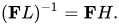
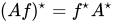
This article is about an involution transform commonly used in classical mechanics and thermodynamics. For the integral transform using Legendre polynomials as kernels, see Legendre transform (integral transform).
The function is defined on the interval . For a given , the difference takes the maximum at . Thus, the Legendre transformation of is .
In mathematics, the Legendre transformation (or Legendre transform), first introduced by Adrien-Marie Legendre in 1787 when studying the minimal surface problem,[1] is an involutivetransformation on real-valued functions that are convex on a real variable. Specifically, if a real-valued multivariable function is convex on one of its independent real variables, then the Legendre transform with respect to this variable is applicable to the function.
In physical problems, the Legendre transform is used to convert functions of one quantity (such as position, pressure, or temperature) into functions of the conjugate quantity (momentum, volume, and entropy, respectively). In this way, it is commonly used in classical mechanics to derive the Hamiltonian formalism out of the Lagrangian formalism (or vice versa) and in thermodynamics to derive the thermodynamic potentials, as well as in the solution of differential equations of several variables.
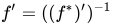
For sufficiently smooth functions on the real line, the Legendre transform of a function can be specified, up to an additive constant, by the condition that the functions' first derivatives are inverse functions of each other. This can be expressed in Euler's derivative notation as
where is an operator of differentiation, represents an argument or input to the associated function, is an inverse function such that ,
The generalization of the Legendre transformation to affine spaces and non-convex functions is known as the convex conjugate (also called the Legendre–Fenchel transformation), which can be used to construct a function's convex hull.
Let be an interval, and a convex function; then the Legendre transformof is the function defined by
where denotes the supremum over , e.g., in is chosen such that is maximized at each , or is such that as a bounded value throughout exists (e.g., when is a linear function).
The transform is always well-defined when is convex. This definition requires to be bounded from above in in order for the supremum to exist.
The function is called the convex conjugate function of . For historical reasons (rooted in analytic mechanics), the conjugate variable is often denoted , instead of . If the convex function is defined on the whole line and is everywhere differentiable, then
The Legendre transformation is an application of the duality relationship between points and lines. The functional relationship specified by can be represented equally well as a set of points, or as a set of tangent lines specified by their slope and intercept values.
Understanding the Legendre transform in terms of derivatives[edit]
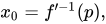
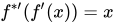
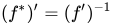
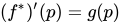
For a differentiable convex function on the real line with the first derivative and its inverse , the Legendre transform of , , can be specified, up to an additive constant, by the condition that the functions' first derivatives are inverse functions of each other, i.e., and .
To see this, first note that if as a convex function on the real line is differentiable and is a critical point of the function of , then the supremum is achieved at (by convexity, see the first figure in this Wikipedia page). Therefore, the Legendre transform of is .
Then, suppose that the first derivative is invertible and let the inverse be . Then for each , the point is the unique critical point of the function (i.e., ) because and the function's first derivative with respect to at is . Hence we have for each . By differentiating with respect to , we find
Since this simplifies to . In other words, and are inverses to each other.
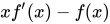
In general, if as the inverse of , then so integration gives . with a constant .
In practical terms, given , the parametric plot of versus amounts to the graph of versus .
In some cases (e.g. thermodynamic potentials, below), a non-standard requirement is used, amounting to an alternative definition of f * with a minus sign,
In analytical mechanics and thermodynamics, Legendre transformation is usually defined as follows: suppose is a function of , then we have
.
performing Legendre transformation on this function means that we take as the independent variable, so that the above expression can be written as
,
and according to Leibniz's rule , then we have
,
and taking , we have , which means
When is a function of variables , then we can perform the Legendre transformation on each one or several variables: we have
where . Then if we want to perform Legendre transformation on, e.g. , then we take together with as independent variables, and with Leibniz's rule we have
.
so for function , we have
.
We can also do this transformation for variables . If we do it to all the variables, then we have
where .
In analytical mechanics, people perform this transformation on variables of the Lagrangian to get the Hamiltonian:
and in thermodynamics, people perform this transformation on variables according to the type of thermodynamic system they want. E.g. starting from the cardinal function of state, the internal energy , we have
,
we can perform Legendre transformation on either or both of yielding
and each of these three expressions has a physical meaning.
This definition of Legendre transformation is the one originally introduced by Legendre in his work in 1787,[1] and still applied by physicists nowadays. Indeed, this definition can be mathematically rigorous if we treat all the variables and functions defined above, e.g. as differentiable functions defined on an open set of or on a differentiable manifold, and their differentials (which are treated as cotangent vector field in the context of differentiable manifold). And this definition is equivalent to the modern mathematicians' definition as long as is differentiable and convex for the variables .
The Legendre transform of a convex function, of which double derivative values are all positive, is also a convex function of which double derivative values are all positive.Proof. Let us show this with a doubly differentiable function with all positive double derivative values and with a bijective (invertible) derivative. For a fixed , let maximize or make the function bounded over . Then the Legendre transformation of is , thus,
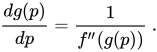
by the maximizing or bounding condition . Note that depends on . (This can be visually shown in the 1st figure of this page above.) Thus where , meaning that is the inverse of that is the derivative of (so ). Note that is also differentiable with the following derivative (Inverse function rule),
Thus, the Legendre transformation is the composition of differentiable functions, hence it is differentiable. Applying the product rule and the chain rule with the found equality yields
giving
so is convex with its double derivatives are all positive.
The Legendre transformation is an involution, i.e., . Proof. By using the above identities as , , and its derivative ,
Note that this derivation does not require the condition to have all positive values in double derivative of the original function .
As shown above, for a convex function , with maximizing or making bounded at each to define the Legendre transform and with , the following identities hold.
Let f(x) = cx2 defined on R, where c > 0 is a fixed constant.
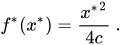
For x* fixed, the function of x, x*x − f(x) = x*x − cx2 has the first derivative x* − 2cx and second derivative −2c; there is one stationary point at x = x*/2c, which is always a maximum.
Thus, I* = R and
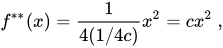
The first derivatives of f, 2cx, and of f *, x*/(2c), are inverse functions to each other. Clearly, furthermore,
For x* fixed, x*x − f(x) is continuous on Icompact, hence it always takes a finite maximum on it; it follows that the domain of the Legendre transform of is I* = R.
The stationary point at x = x*/2 (found by setting that the first derivative of x*x − f(x) with respect to equal to zero) is in the domain [2, 3] if and only if 4 ≤ x* ≤ 6. Otherwise the maximum is taken either at x = 2 or x = 3 because the second derivative of x*x − f(x) with respect to is negative as ; for a part of the domain the maximum that x*x − f(x) can take with respect to is obtained at while for it becomes the maximum at . Thus, it follows that
The function f(x) = cx is convex, for every x (strict convexity is not required for the Legendre transformation to be well defined). Clearly x*x − f(x) = (x* − c)x is never bounded from above as a function of x, unless x* − c = 0. Hence f* is defined on I* = {c} and f*(c) = 0. (The definition of the Legendre transform requires the existence of the supremum, that requires upper bounds.)
One may check involutivity: of course, x*x − f*(x*) is always bounded as a function of x*∈{c}, hence I** = R. Then, for all x one has
Let f(x,y) be a function of two independent variables x and y, with the differential
Assume that the function f is convex in x for all y, so that one may perform the Legendre transform on f in x, with p the variable conjugate to x (for information, there is a relation where is a point in x maximizing or making bounded for given p and y). Since the new independent variable of the transform with respect to f is p, the differentials dx and dy in df devolve to dp and dy in the differential of the transform, i.e., we build another function with its differential expressed in terms of the new basis dp and dy.
We thus consider the function g(p, y) = f − px so that
The function −g(p, y) is the Legendre transform of f(x, y), where only the independent variable x has been supplanted by p. This is widely used in thermodynamics, as illustrated below.
where are coordinates on Rn × Rn, M is a positive real matrix, and
For every q fixed, is a convex function of , while plays the role of a constant.
Hence the Legendre transform of as a function of is the Hamiltonian function,
In a more general setting, are local coordinates on the tangent bundle of a manifold . For each q, is a convex function of the tangent space Vq. The Legendre transform gives the Hamiltonian as a function of the coordinates (p, q) of the cotangent bundle; the inner product used to define the Legendre transform is inherited from the pertinent canonical symplectic structure. In this abstract setting, the Legendre transformation corresponds to the tautological one-form.[further explanation needed]
The strategy behind the use of Legendre transforms in thermodynamics is to shift from a function that depends on a variable to a new (conjugate) function that depends on a new variable, the conjugate of the original one. The new variable is the partial derivative of the original function with respect to the original variable. The new function is the difference between the original function and the product of the old and new variables. Typically, this transformation is useful because it shifts the dependence of, e.g., the energy from an extensive variable to its conjugate intensive variable, which can often be controlled more easily in a physical experiment.
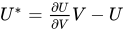
(Subscripts are not necessary by the definition of partial derivatives but left here for clarifying variables.) Stipulating some common reference state, by using the (non-standard) Legendre transform of the internal energy U with respect to volume V, the enthalpyH may be obtained as the following.
To get the (standard) Legendre transform of the internal energy U with respect to volume V, the function is defined first, then it shall be maximized or bounded by V. To do this, the condition needs to be satisfied, so is obtained. This approach is justified because U is a linear function with respect to V (so a convex function on V) by the definition of extensive variables. The non-standard Legendre transform here is obtained by negating the standard version, so .
H is definitely a state function as it is obtained by adding PV (P and V as state variables) to a state function , so its differential is an exact differential. Because of and the fact that it must be an exact differential, .
The enthalpy is suitable for description of processes in which the pressure is controlled from the surroundings.
It is likewise possible to shift the dependence of the energy from the extensive variable of entropy, S, to the (often more convenient) intensive variable T, resulting in the Helmholtz and Gibbsfree energies. The Helmholtz free energy A, and Gibbs energy G, are obtained by performing Legendre transforms of the internal energy and enthalpy, respectively,
The Helmholtz free energy is often the most useful thermodynamic potential when temperature and volume are controlled from the surroundings, while the Gibbs energy is often the most useful when temperature and pressure are controlled from the surroundings.
As another example from physics, consider a parallel conductive plate capacitor, in which the plates can move relative to one another. Such a capacitor would allow transfer of the electric energy which is stored in the capacitor into external mechanical work, done by the force acting on the plates. One may think of the electric charge as analogous to the "charge" of a gas in a cylinder, with the resulting mechanical force exerted on a piston.
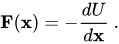
Compute the force on the plates as a function of x, the distance which separates them. To find the force, compute the potential energy, and then apply the definition of force as the gradient of the potential energy function.
where the dependence on the area of the plates, the dielectric constant of the insulation material between the plates, and the separation x are abstracted away as the capacitanceC(x). (For a parallel plate capacitor, this is proportional to the area of the plates and inversely proportional to the separation.)
The force F between the plates due to the electric field created by the charge separation is then
If the capacitor is not connected to any electric circuit, then the electric charges on the plates remain constant and the voltage varies when the plates move with respect to each other, and the force is the negative gradient of the electrostatic potential energy as
where as the charge is fixed in this configuration.
However, instead, suppose that the voltage between the plates V is maintained constant as the plate moves by connection to a battery, which is a reservoir for electric charges at a constant potential difference. Then the amount of chargesis a variable instead of the voltage; and are the Legendre conjugate to each other. To find the force, first compute the non-standard Legendre transform with respect to (also with using ),
This transformation is possible because is now a linear function of so is convex on it. The force now becomes the negative gradient of this Legendre transform, resulting in the same force obtained from the original function ,
The two conjugate energies and happen to stand opposite to each other (their signs are opposite), only because of the linearity of the capacitance—except now Q is no longer a constant. They reflect the two different pathways of storing energy into the capacitor, resulting in, for instance, the same "pull" between a capacitor's plates.
If are i.i.d. random variables, let be the associated random walk and the moment generating function of . For , . Hence, by Markov's inequality, one has for and
where . Since the left-hand side is independent of , we may take the infimum of the right-hand side, which leads one to consider the supremum of , i.e., the Legendre transform of , evaluated at .
Legendre transformation arises naturally in microeconomics in the process of finding the supplyS(P) of some product given a fixed price P on the market knowing the cost functionC(Q), i.e. the cost for the producer to make/mine/etc. Q units of the given product.
A simple theory explains the shape of the supply curve based solely on the cost function. Let us suppose the market price for a one unit of our product is P. For a company selling this good, the best strategy is to adjust the production Q so that its profit is maximized. We can maximize the profit
by differentiating with respect to Q and solving
Qopt represents the optimal quantity Q of goods that the producer is willing to supply, which is indeed the supply itself:
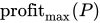
If we consider the maximal profit as a function of price, , we see that it is the Legendre transform of the cost function .
For a strictly convex function, the Legendre transformation can be interpreted as a mapping between the graph of the function and the family of tangents of the graph. (For a function of one variable, the tangents are well-defined at all but at most countably many points, since a convex function is differentiable at all but at most countably many points.)
The equation of a line with slope and -intercept is given by . For this line to be tangent to the graph of a function at the point requires
and
Being the derivative of a strictly convex function, the function is strictly monotone and thus injective. The second equation can be solved for allowing elimination of from the first, and solving for the -intercept of the tangent as a function of its slope where denotes the Legendre transform of
The family of tangent lines of the graph of parameterized by the slope is therefore given by
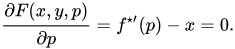
or, written implicitly, by the solutions of the equation
The graph of the original function can be reconstructed from this family of lines as the envelope of this family by demanding
Eliminating from these two equations gives
Identifying with and recognizing the right side of the preceding equation as the Legendre transform of yield
Legendre transformation in more than one dimension[edit]
For a differentiable real-valued function on an open convex subset U of Rn the Legendre conjugate of the pair (U, f) is defined to be the pair (V, g), where V is the image of U under the gradient mapping Df, and g is the function on V given by the formula
where
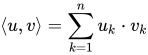
is the scalar product on Rn. The multidimensional transform can be interpreted as an encoding of the convex hull of the function's epigraph in terms of its supporting hyperplanes.[2] This can be seen as consequence of the following two observations. On the one hand, the hyperplane tangent to the epigraph of at some point has normal vector . On the other hand, any closed convex set can be characterized via the set of its supporting hyperplanes by the equations , where is the support function of . But the definition of Legendre transform via the maximization matches precisely that of the support function, that is, . We thus conclude that the Legendre transform characterizes the epigraph in the sense that the tangent plane to the epigraph at any point is given explicitly by
Alternatively, if X is a vector space and Y is its dual vector space, then for each point x of X and y of Y, there is a natural identification of the cotangent spacesT*Xx with Y and T*Yy with X. If f is a real differentiable function over X, then its exterior derivative, df, is a section of the cotangent bundleT*X and as such, we can construct a map from X to Y. Similarly, if g is a real differentiable function over Y, then dg defines a map from Y to X. If both maps happen to be inverses of each other, we say we have a Legendre transform. The notion of the tautological one-form is commonly used in this setting.
When the function is not differentiable, the Legendre transform can still be extended, and is known as the Legendre-Fenchel transformation. In this more general setting, a few properties are lost: for example, the Legendre transform is no longer its own inverse (unless there are extra assumptions, like convexity).
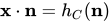
Let be a smooth manifold, let and be a vector bundle on and its associated bundle projection, respectively. Let be a smooth function. We think of as a Lagrangian by analogy with the classical case where , and for some positive number and function .
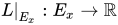
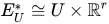
As usual, the dual of is denote by . The fiber of over is denoted , and the restriction of to is denoted by . The Legendre transformation of is the smooth morphism
defined by , where .
In other words, is the covector that sends to the directional derivative .
To describe the Legendre transformation locally, let be a coordinate chart over which is trivial. Picking a trivialization of over , we obtain charts and . In terms of these charts, we have , where
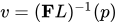
for all . If, as in the classical case, the restriction of to each fiber is strictly convex and bounded below by a positive definite quadratic form minus a constant, then the Legendre transform is a diffeomorphism.[3] Suppose that is a diffeomorphism and let be the "Hamiltonian" function defined by
where . Using the natural isomorphism , we may view the Legendre transformation of as a map . Then we have[3]
The Legendre transformation has the following scaling properties: For a > 0,
It follows that if a function is homogeneous of degree r then its image under the Legendre transformation is a homogeneous function of degree s, where 1/r + 1/s = 1. (Since f(x) = xr/r, with r > 1, implies f*(p) = ps/s.) Thus, the only monomial whose degree is invariant under Legendre transform is the quadratic.
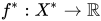
For any function f and its convex conjugate f *Fenchel's inequality (also known as the Fenchel–Young inequality) holds for every x ∈ X and p ∈ X*, i.e., independentx, p pairs,





![{\textstyle [a,b]}](https://wikimedia.org/api/rest_v1/media/math/render/svg/2c780cbaafb5b1d4a6912aa65d2b0b1982097108)










































































![{\displaystyle {\begin{aligned}f^{**}(y)&{}=\left(y\cdot {\bar {p}}-f^{*}({\bar {p}})\right)|_{(f^{*})'({\bar {p}})=y}\\[5pt]&{}=g({\bar {p}})\cdot {\bar {p}}-f^{*}({\bar {p}})\\[5pt]&{}=g({\bar {p}})\cdot {\bar {p}}-({\bar {p}}g({\bar {p}})-f(g({\bar {p}})))\\[5pt]&{}=f(g({\bar {p}}))\\[5pt]&{}=f(y)~.\end{aligned}}}](https://wikimedia.org/api/rest_v1/media/math/render/svg/6e440cae9d7a3bce61655bfea18ef2fdb94db482)























![{\displaystyle x\in [2,3]}](https://wikimedia.org/api/rest_v1/media/math/render/svg/780246b9549fa4b49ad887a22b3dfe211a6dbce2)






![{\displaystyle I^{*}=[-1,1]}](https://wikimedia.org/api/rest_v1/media/math/render/svg/367c2932f7a99ca99111bb44c658a7c850c2b599)








































![{\displaystyle E[e^{\xi S_{n}}]=M(\xi )^{n}}](https://wikimedia.org/api/rest_v1/media/math/render/svg/1e7367ed216a7348373da3bdc1d5fe3e2c9fc8c1)


![{\displaystyle P(S_{n}/n>a)\leq e^{-n\xi a}M(\xi )^{n}=\exp[-n(\xi a-\Lambda (\xi ))]}](https://wikimedia.org/api/rest_v1/media/math/render/svg/0c65b19daa1130ca9c6552e5734f7743dad162a3)