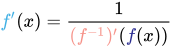
The thick blue curve and the thick red curves are inverse to each other. A thin curve is the derivative of the same colored thick curve. Inverse function rule:
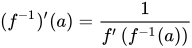
This formula holds in general whenever is continuous and injective on an interval I, with being differentiable at () and where. The same formula is also equivalent to the expression
where denotes the unary derivative operator (on the space of functions) and denotes function composition.
Geometrically, a function and inverse function have graphs that are reflections, in the line . This reflection operation turns the gradient of any line into its reciprocal.[1]
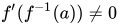
Assuming that has an inverse in a neighbourhood of and that its derivative at that point is non-zero, its inverse is guaranteed to be differentiable at and have a derivative given by the above formula.
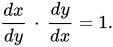
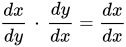
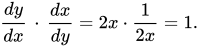
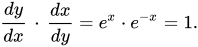
The inverse function rule may also be expressed in Leibniz's notation. As that notation suggests,
This relation is obtained by differentiating the equation in terms of x and applying the chain rule, yielding that:
considering that the derivative of x with respect to x is 1.
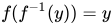
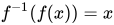
Let be an invertible (bijective) function, let be in the domain of , and let be in the codomain of . Since f is a bijective function, is in the range of . This also means that is in the domain of , and that is in the codomain of . Since is an invertible function, we know that . The inverse function rule can be obtained by taking the derivative of this equation.
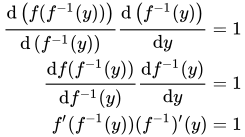
The right side is equal to 1 and the chain rule can be applied to the left side:
Rearranging then gives
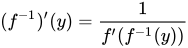
Rather than using as the variable, we can rewrite this equation using as the input for , and we get the following:[2]
At , however, there is a problem: the graph of the square root function becomes vertical, corresponding to a horizontal tangent for the square function.
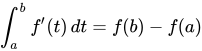
This is only useful if the integral exists. In particular we need to be non-zero across the range of integration.
It follows that a function that has a continuous derivative has an inverse in a neighbourhood of every point where the derivative is non-zero. This need not be true if the derivative is not continuous.
Another very interesting and useful property is the following:
Where denotes the antiderivative of .
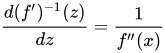
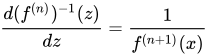
The inverse of the derivative of f(x) is also of interest, as it is used in showing the convexity of the Legendre transform.
Let then we have, assuming :
This can be shown using the previous notation . Then we have:
Therefore:
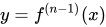
By induction, we can generalize this result for any integer , with , the nth derivative of f(x), and , assuming :
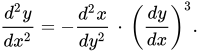
The chain rule given above is obtained by differentiating the identity with respect to x. One can continue the same process for higher derivatives. Differentiating the identity twice with respect to x, one obtains
that is simplified further by the chain rule as
Replacing the first derivative, using the identity obtained earlier, we get










![{\displaystyle \left[f^{-1}\right]'(a)={\frac {1}{f'\left(f^{-1}(a)\right)}}}](https://wikimedia.org/api/rest_v1/media/math/render/svg/662f1be67eb38c8d7ecf30fd8afda594671fbeec)


![{\displaystyle {\mathcal {D}}\left[f^{-1}\right]={\frac {1}{({\mathcal {D}}f)\circ \left(f^{-1}\right)}},}](https://wikimedia.org/api/rest_v1/media/math/render/svg/b71cf74aa5480ff9d43a9823ceb5580914f923a5)


























![{\displaystyle g''(x)={\frac {-f''(g(x))}{[f'(g(x))]^{3}}}}](https://wikimedia.org/api/rest_v1/media/math/render/svg/0c374bf89ec0cde43e6ec3e86cbf86490e55f35d)



