


Abies nordmanniana
| Abies nordmanniana | |
|---|---|

| |
| Nordmann firs in Dombay, Karachay-Cherkessia, Caucasus | |
Scientific classification 
| |
| Kingdom: | Plantae |
| Clade: | Tracheophytes |
| Clade: | Gymnospermae |
| Division: | Pinophyta |
| Class: | Pinopsida |
| Order: | Pinales |
| Family: | Pinaceae |
| Genus: | Abies |
| Species: | A. nordmanniana
|
| Binomial name | |
| Abies nordmanniana (Steven) Spach
| |

| |
| Natural range of A. nordmanniana. Distribution of subspecies A. n. nordmanniana and A. n. bornmuelleriana is in green, and that of A. n. equi-trojani is in brown. | |
Abies nordmanniana, the Nordmann fir or Caucasian fir,[2] is a fir indigenous to the mountains south and east of the Black Sea, in Turkey, Georgia and the Russian Caucasus. It occurs at altitudes of 900–2,200 m on mountains with precipitation of over 1,000 mm.
The current distribution of the Nordmann fir is associated with the forest refugia that existed during the Ice Age at the eastern and southern Black Sea coast. In spite of currently suitable climate, the species is not found in areas of the Eastern Greater Caucasus, which are separated from the Black Sea Coast by more than 400–500 km.[3]
Description
[edit]It is a large evergreen coniferous tree growing to 55–61 m tall and with a trunk diameter of up to 2 m. In the Western Caucasus Reserve, some specimens have been reported to be 78 m (256 ft) and even 85 m (279 ft) tall,[4] the tallest trees in the Caucasus, Anatolia, the Russian Federation and the continent of Europe.[citation needed]
The leaves are needle-like, flattened, 1.8–3.5 cm long and 2 mm wide by 0.5 mm thick, glossy dark green above, and with two blue-white bands of stomata below. The tip of the leaf is usually blunt, often slightly notched at the tip, but can be pointed, particularly on strong-growing shoots on young trees. The cones are 10–20 cm long and 4–5 cm broad, with about 150–200 scales, each scale with an exserted bract and two winged seeds; they disintegrate when mature to release the seeds.
Taxonomy
[edit]The species is named by Christian von Steven after his compatriot, the Finnish zoologist Alexander von Nordmann (1803–1866), who was the director of the Odessa Botanical Gardens.
Subspecies
[edit]There are two subspecies (treated as distinct species by some botanists), intergrading where they meet in northern Turkey at about 36°E longitude:
- Caucasian fir (Abies nordmanniana subsp. nordmanniana). Native to the Caucasus mountains and eastern Pontic Mountains of northeastern Turkey west to about 36°E. Shoots often pubescent (hairy).
- Turkish fir (Abies nordmanniana subsp. equi-trojani). Native to northwestern Turkey, including the western Pontic Mountains as well as Uludağ and other mountains southeast of the Sea of Marmara. Often treated as a separate species, Abies bornmuelleriana.[5] In Turkey this subspecies is treated as a distinct species (Abies equi-trojani Asch. & Sint. ex Bois.). It is endemic to a single location on Kaz Dağı (Mount Ida) in Balıkesir Province, northwestern Turkey.[6] This subspecies occupies an area of only 164 km2 and is assessed as "Endangered".[7] Its shoots are usually glabrous (hairless).[5]
Uses
[edit]The Nordmann fir is one of the most important species grown for Christmas trees, being favoured for its attractive foliage, with needles that are not sharp and do not drop readily when the tree dries out.[citation needed]
It is also a popular ornamental tree in parks and large gardens, and along with the cultivar 'Golden Spreader'[8] has gained the Royal Horticultural Society's Award of Garden Merit.[9][10]
In Europe, the tree has also been used for reforestation as a way to mitigate expected forest decline caused by climate changes.[6]
The wood is soft and white, and is used for general construction, paper, etc.
Gallery
[edit]-

-
-
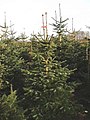
 Foliage


References
[edit]- ^ Knees, S.; Gardner, M. (2011). "Abies nordmanniana". IUCN Red List of Threatened Species. 2011: e.T42293A10679078. doi:10.2305/IUCN.UK.2011-2.RLTS.T42293A10679078.en. Retrieved 19 November 2021.
- ^ BSBI List 2007 (xls). Botanical Society of Britain and Ireland. Archived from the original (xls) on 2015-06-26. Retrieved 2014-10-17.
- ^ Tarkhnishvili D, Gavashelishvili A, Mumladze L (2012). "Palaeoclimatic models help to understand current distribution of Caucasian forest species". Biol. J. Linn. Soc. 105 (105): 231–248. doi:10.1111/j.1095-8312.2011.01788.x.
- ^ "Western Caucasus WHA, IUCN Technical Evaluation" (PDF).
- ^ a b Kaya, Zeki, A. Skaggs, David Brian Neale (2008). "Genetic Differentiation of Abies equi-trojani (Asch. & Sint. ex Boiss) Mattf. Populations from Kazdağı, Turkey and the Genetic Relationship between Turkish Firs belonging to the Abies nordmanniana Spach Complex". Turkish Journal of Botany 32 (2008) 1-10
- ^ a b Alizoti, P.G.; Fady, B.; Prada, M.A.; Vendramin, G.G (2009). "Mediterranean firs - Abies spp." (PDF). EUFORGEN Technical Guidelines for Genetic Conservation and Use. Archived from the original (PDF) on 2016-10-20. Retrieved 2016-10-19.
- ^ Knees, S.; Gardner, M. (2011). "Abies nordmanniana subsp. equi-trojani". IUCN Red List of Threatened Species. 2011: e.T31325A9626365. doi:10.2305/IUCN.UK.2011-2.RLTS.T31325A9626365.en. Retrieved 19 November 2021.
- ^ "RHS Plant Selector Abies nordmanniana 'Golden Spreader' AGM / RHS Gardening". Apps.rhs.org.uk. Archived from the original on 2013-11-05. Retrieved 2013-11-05.
- ^ "RHS Plant Selector Abies nordmanniana AGM / RHS Gardening". Apps.rhs.org.uk. Archived from the original on 2013-11-05. Retrieved 2013-11-05.
- ^ "AGM Plants - Ornamental" (PDF). Royal Horticultural Society. July 2017. p. 1. Retrieved 14 August 2019.
External links
[edit]
- theplantlist.org: Abies nordmanniana (Steven) Spach
- Knees, S.; Gardner, M. (2011). "Abies nordmanniana subsp. equi-trojani". IUCN Red List of Threatened Species. 2011: e.T31325A9626365. doi:10.2305/IUCN.UK.2011-2.RLTS.T31325A9626365.en. Retrieved 19 November 2021.
- Gymnosperm Database: Abies nordmanniana
- conifersaroundtheworld.com: Abies nordmanniana NBG Belgium Meise
- rhs.org.uk: Abies nordmanniana
- Abies nordmanniana. Distribution map, genetic conservation units and related resources. European Forest Genetic Resources Programme (EUFORGEN)
