


Partition of unity
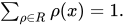
In mathematics, a partition of unity of a topological space is a set of continuous functions from to the unit interval [0,1] such that for every point :


- there is a neighbourhood of where all but a finite number of the functions of are 0, and
- the sum of all the function values at is 1, i.e.,


Partitions of unity are useful because they often allow one to extend local constructions to the whole space. They are also important in the interpolation of data, in signal processing, and the theory of spline functions.
Existence[edit]
The existence of partitions of unity assumes two distinct forms:
- Given any open cover of a space, there exists a partition indexed over the same set such that supp Such a partition is said to be subordinate to the open cover
- If the space is locally-compact, given any open cover of a space, there exists a partition indexed over a possibly distinct index set such that each has compact support and for each , supp for some .


Thus one chooses either to have the supports indexed by the open cover, or compact supports. If the space is compact, then there exist partitions satisfying both requirements.
A finite open cover always has a continuous partition of unity subordinated to it, provided the space is locally compact and Hausdorff.[1] Paracompactness of the space is a necessary condition to guarantee the existence of a partition of unity subordinate to any open cover. Depending on the category to which the space belongs, it may also be a sufficient condition.[2] The construction uses mollifiers (bump functions), which exist in continuous and smooth manifolds, but not in analytic manifolds. Thus for an open cover of an analytic manifold, an analytic partition of unity subordinate to that open cover generally does not exist. See analytic continuation.
If and are partitions of unity for spaces and , respectively, then the set of all pairs is a partition of unity for the cartesian product space . The tensor product of functions act as





Example[edit]
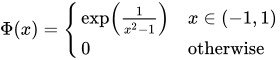
We can construct a partition of unity on by looking at a chart on the complement of a point sending to with center . Now, let be a bump function on defined by




Variant definitions[edit]
Sometimes a less restrictive definition is used: the sum of all the function values at a particular point is only required to be positive, rather than 1, for each point in the space. However, given such a set of functions one can obtain a partition of unity in the strict sense by dividing by the sum; the partition becomes where , which is well defined since at each point only a finite number of terms are nonzero. Even further, some authors drop the requirement that the supports be locally finite, requiring only that for all .[3]




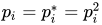
In the field of operator algebras, a partition of unity is comprised of projections[4] . In the case of -algebras, it can be shown that the entries are pairwise-orthogonal:[5]


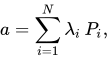
If is a normal element of a unital -algebra , and has finite spectrum , then the projections in the spectral decomposition:



In the field of compact quantum groups, the rows and columns of the fundamental representation of a quantum permutation group form partitions of unity.[8]


Applications[edit]
A partition of unity can be used to define the integral (with respect to a volume form) of a function defined over a manifold: one first defines the integral of a function whose support is contained in a single coordinate patch of the manifold; then one uses a partition of unity to define the integral of an arbitrary function; finally one shows that the definition is independent of the chosen partition of unity.
A partition of unity can be used to show the existence of a Riemannian metric on an arbitrary manifold.
Method of steepest descent employs a partition of unity to construct asymptotics of integrals.
Linkwitz–Riley filter is an example of practical implementation of partition of unity to separate input signal into two output signals containing only high- or low-frequency components.
The Bernstein polynomials of a fixed degree m are a family of m+1 linearly independent polynomials that are a partition of unity for the unit interval .
![{\displaystyle [0,1]}](https://wikimedia.org/api/rest_v1/media/math/render/svg/738f7d23bb2d9642bab520020873cccbef49768d)
Partitions of unity are used to establish global smooth approximations for Sobolev functions in bounded domains.[9]
See also[edit]
References[edit]
- ^ Rudin, Walter (1987). Real and complex analysis (3rd ed.). New York: McGraw-Hill. p. 40. ISBN 978-0-07-054234-1.
- ^ Aliprantis, Charalambos D.; Border, Kim C. (2007). Infinite dimensional analysis: a hitchhiker's guide (3rd ed.). Berlin: Springer. p. 716. ISBN 978-3-540-32696-0.
- ^ Strichartz, Robert S. (2003). A guide to distribution theory and Fourier transforms. Singapore: World Scientific Pub. Co. ISBN 981-238-421-9. OCLC 54446554.
- ^ Conway, John B. A Course in Functional Analysis (2nd ed.). Springer. p. 54. ISBN 0-387-97245-5.
- ^ Freslon, Amaury (2023). Compact matrix quantum groups and their combinatorics. Cambridge University Press.
- ^ Fritz, Tobias. "Pairwise orthogonality for partitions of unity in a *-algebra". Mathoverflow. Retrieved 7 February 2024.
- ^ Murphy, Gerard J. (1990). C*-Algebras and Operator Theory. Academic Press. p. 66. ISBN 0-12-511360-9.
- ^ Banica, Teo (2023). Introduction to Quantum Groups. Springer. ISBN 978-3-031-23816-1.
- ^ Evans, Lawrence (2010-03-02), "Sobolev spaces", Partial Differential Equations, Graduate Studies in Mathematics, vol. 19, American Mathematical Society, pp. 253–309, doi:10.1090/gsm/019/05, ISBN 9780821849743
- Tu, Loring W. (2011), An introduction to manifolds, Universitext (2nd ed.), Berlin, New York: Springer-Verlag, doi:10.1007/978-1-4419-7400-6, ISBN 978-1-4419-7399-3, see chapter 13
External links[edit]
- General information on partition of unity at [Mathworld]