


Neighbourhood (mathematics)


In topology and related areas of mathematics, a neighbourhood (or neighborhood) is one of the basic concepts in a topological space. It is closely related to the concepts of open set and interior. Intuitively speaking, a neighbourhood of a point is a set of points containing that point where one can move some amount in any direction away from that point without leaving the set.
Definitions[edit]
Neighbourhood of a point[edit]
If is a topological space and is a point in then a neighbourhood[1] of is a subset of that includes an open set containing ,



This is equivalent to the point belonging to the topological interior of in


The neighbourhood need not be an open subset of When is open (resp. closed, compact, etc.) in it is called an open neighbourhood[2] (resp. closed neighbourhood, compact neighbourhood, etc.). Some authors[3] require neighbourhoods to be open, so it is important to note their conventions.

A set that is a neighbourhood of each of its points is open since it can be expressed as the union of open sets containing each of its points. A closed rectangle, as illustrated in the figure, is not a neighbourhood of all its points; points on the edges or corners of the rectangle are not contained in any open set that is contained within the rectangle.
The collection of all neighbourhoods of a point is called the neighbourhood system at the point.
Neighbourhood of a set[edit]
If is a subset of a topological space , then a neighbourhood of is a set that includes an open set containing ,



In a metric space[edit]


In a metric space a set is a neighbourhood of a point if there exists an open ball with center and radius such that



is called a uniform neighbourhood of a set if there exists a positive number such that for all elements of



Under the same condition, for the -neighbourhood of a set is the set of all points in that are at distance less than from (or equivalently, is the union of all the open balls of radius that are centered at a point in ):

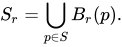
It directly follows that an -neighbourhood is a uniform neighbourhood, and that a set is a uniform neighbourhood if and only if it contains an -neighbourhood for some value of

Examples[edit]

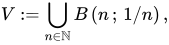
Given the set of real numbers with the usual Euclidean metric and a subset defined as


Topology from neighbourhoods[edit]
The above definition is useful if the notion of open set is already defined. There is an alternative way to define a topology, by first defining the neighbourhood system, and then open sets as those sets containing a neighbourhood of each of their points.
A neighbourhood system on is the assignment of a filter of subsets of to each in such that


- the point is an element of each in
- each in contains some in such that for each in is in


One can show that both definitions are compatible, that is, the topology obtained from the neighbourhood system defined using open sets is the original one, and vice versa when starting out from a neighbourhood system.
Uniform neighbourhoods[edit]
In a uniform space is called a uniform neighbourhood of if there exists an entourage such that contains all points of that are -close to some point of that is, for all


![{\displaystyle U[x]\subseteq V}](https://wikimedia.org/api/rest_v1/media/math/render/svg/fbd6df283595f95cc2ab148e959168c2984b25d2)

Deleted neighbourhood[edit]
A deleted neighbourhood of a point (sometimes called a punctured neighbourhood) is a neighbourhood of without For instance, the interval is a neighbourhood of in the real line, so the set is a deleted neighbourhood of A deleted neighbourhood of a given point is not in fact a neighbourhood of the point. The concept of deleted neighbourhood occurs in the definition of the limit of a function and in the definition of limit points (among other things).[4]





See also[edit]
- Isolated point – Point of a subset S around which there are no other points of S
- Neighbourhood system – (for a point x) collection of all neighborhoods for the point x
- Region (mathematics) – Connected open subset of a topological space
- Tubular neighbourhood – neighborhood of a submanifold homeomorphic to that submanifold’s normal bundle
Notes[edit]
- ^ Willard 2004, Definition 4.1.
- ^ Dixmier, Jacques (1984). General Topology. Undergraduate Texts in Mathematics. Translated by Sterling K. Berberian. Springer. p. 6. ISBN 0-387-90972-9.
According to this definition, an open neighborhood of is nothing more than an open subset of that contains
- ^ Engelking 1989, p. 12.
- ^ Peters, Charles (2022). "Professor Charles Peters" (PDF). University of Houston Math. Retrieved 3 April 2022.


References[edit]
- Bredon, Glen E. (1993). Topology and geometry. New York: Springer-Verlag. ISBN 0-387-97926-3.
- Engelking, Ryszard (1989). General Topology. Heldermann Verlag, Berlin. ISBN 3-88538-006-4.
- Kaplansky, Irving (2001). Set Theory and Metric Spaces. American Mathematical Society. ISBN 0-8218-2694-8.
- Kelley, John L. (1975). General topology. New York: Springer-Verlag. ISBN 0-387-90125-6.
- Willard, Stephen (2004) [1970]. General Topology. Mineola, N.Y.: Dover Publications. ISBN 978-0-486-43479-7. OCLC 115240.