


Paul Rudolph (architect)
Paul Rudolph | |
|---|---|
.jpg) | |
| Born | October 23, 1918 Elkton, Kentucky, US |
| Died | August 8, 1997 (aged 78) New York City, US |
| Alma mater | Auburn University Harvard Graduate School of Design |
| Occupation | Architect |
| Buildings | Yale Art and Architecture Building |
Paul Marvin Rudolph (October 23, 1918 – August 8, 1997) was an American architect and the chair of Yale University's Department of Architecture for six years, known for his use of reinforced concrete and highly complex floor plans. His most famous work is the Yale Art and Architecture Building (A&A Building), a spatially-complex Brutalist concrete structure. He is one of the modernist architects considered an early practitioner of the Sarasota School of Architecture.
Early life, education, and personal life
[edit]Paul Marvin Rudolph was born October 23, 1918, in Elkton, Kentucky. His father, Keener L. Rudolph, was an itinerant Methodist preacher, and through their travels the son was exposed to the architecture of the American South. His mother, Eurye (Stone) Rudolph, had artistic interests.[1] Rudolph also showed early talent at painting and music.[2]: 26
Rudolph earned his bachelor's degree in architecture at Auburn University (then known as Alabama Polytechnic Institute) in 1940, and then moved to the Harvard Graduate School of Design to study with Bauhaus founder Walter Gropius.[1] After three years, he left to serve as an officer in the United States Naval Reserve at Brooklyn Navy Yard for three years during WWII, working on design and construction of merchant marine ships.[1] He then resumed studies at Harvard, where his classmates included I.M. Pei and Philip Johnson.[1] Rudolph was awarded his master's degree in 1947.[1][2]: 26
Paul Rudolph was gay, though not openly, due to the political and societal climate of the time. He lived in his Beekman Street apartment with his partner, Ernst Wagner.[3][4]
Work
[edit]Sarasota, Florida
[edit].jpg)
.jpg)
Following his studies at Harvard, Rudolph moved to Sarasota, Florida, and partnered with Ralph Twitchell for four years, until he started his own practice in 1952. Rudolph's Sarasota time is now part of the period labeled Sarasota School of Architecture in his career.
Notable for its appearance in the 1958 book Masters of Modern Architecture, the W. R. Healy Guest House – nicknamed "The Cocoon House" – was a one-story guest house built in 1950 on Siesta Key, Sarasota, Florida. The roof was concave and was constructed using a built-up spray-on process that Rudolph had seen used to cocoon disused ships during his time in the US Navy (hence, the house's nickname). In addition, Rudolph used jalousie windows, which enabled the characteristic breezes to and from Sarasota Bay to flow through the house.
His first independent work, post Twitchell, was the Walker Guest House, a sparse exoskeleton structure built in the sand dunes and scrub of Sanibel Island in 1953. It was Rudolph's most clearly articulated and rigorously geometric residential project in Florida.[2]: 96–100 Rudolph considered the guesthouse to be one of his favorite projects, exhibiting pure architectural ideals suited to its environment.[5]: 65 [2]: 133
Other Sarasota landmarks by Rudolph include the Riverview High School, built in 1957 as his first large-scale project. In 2006, there was a great deal of controversy in Sarasota when many members of the community appealed for the retention of the historic building after the decision reached by the county school board to demolish the structure. As Charles Gwathmey, the architect overseeing renovation of Art and Architecture Building at Yale, said: "Riverview High School is a fantastic prototype of what today we call green architecture. He was so far ahead of his time, experimenting with sun screens and cross-ventilation. If it's torn down, I feel badly for architecture."[6] However, in June 2009, Riverview High School was demolished.[7]
Another school building design in Sarasota was Rudolph's 1960 addition to Sarasota High School, a concrete structure that utilized large overhanging sunshades and "internal" yet outside corridors with natural ventilation. This building, along with a gymnasium structure built at the same time, has recently undergone a renovation by the Sarasota County School Board that reinstated the building's original exterior appearance, but contains a completely new interior layout.[8] A portion of the original architecture has been incorporated into the adjacent Sarasota Art Museum.
Yale and Brutalism
[edit]In the late 1950s, Paul Rudolph's Florida houses began to attract attention outside of the architectural community and he started receiving commissions for larger works such as the Jewett Arts Center (1955) at Wellesley College and the Blue Cross Building (1956) in Boston.[1] He then took the chairmanship of the Yale Department of Architecture in 1958, shortly after designing the Yale Art & Architecture Building. Rudolph stayed at Yale for six years until he returned to private practice. He designed the Temple Street Parking Garage, also in New Haven, in 1961.[9]
While chair of the Department of Architecture at Yale, Rudolph taught Muzharul Islam, Norman Foster, and Richard Rogers, all attending the Master's course as scholarship students. Foster in particular has noted the significant influence that Rudolph had upon him.[3] Rudolph was invited to Bangladesh by Muzharul Islam and designed Bangladesh Agricultural University.
He worked on the Milam Residence, which was designed and constructed between 1959 and 1961.
It still stands today on Florida's eastern coast, outside Jacksonville in the suburb of Ponte Vedra Beach. For the Milam Home, the only dimensional control was the size of standard concrete blocks that were used (8 x 8 x 16 in), fair-faced, for structural and partition walls alike. The large blocks provide shade for the windows, allowing the Florida home to be easily cooled. This house's seaside facade of stacked rectangles exemplifies the sculptural nature of Rudolph's work during this period. From inside the structure, Rudolf wanted the inhabitants to locate themselves according to mood, so the large two-story window in the living room contrasts other areas of the home which feel more cave-like and secluded. Rudolph's fascination with European Modernism and the neo-Classical theory made this a difficult building to construct. Rudolph had to show concern for multiple influences as well as his own style. At the time, Rudolph was working independently and would later become an icon in European Modernism. Architectural Record named it House of the Year in 1963, and it's considered a pivotal work in Rudolph's career.[10]
In 1958, Rudolph was commissioned to create a master plan for Tuskegee Institute in Tuskegee, Alabama. He later collaborated with graduates of Tuskegee's architecture school on the design of a new chapel building, completed in 1969.
He also designed the Endo Pharmaceuticals Building in Garden City, New York (1964), the Dana Arts Center (1969) at Colgate University, the Boston Government Service Center (1971), First Church in Boston (1972), and the Burroughs Wellcome headquarters (1972, demolished 2021) in North Carolina.[11]
The main campus of University of Massachusetts Dartmouth (originally known as Southeastern Massachusetts Technological Institute, and later as the Southeastern Massachusetts University) was a continuing focus of his work. His association started in 1963, and continued in various capacities through the 1980s. He personally designed several buildings, but his overall architectural vision guided the development of the entire campus for decades.[12]
His Shoreline apartments in Buffalo, completed in 1974, were pioneering low income housing, designed as part of a larger masterplan for the city's waterfront that was never completed.[13]
Later years
[edit]
Rudolph left Yale in 1965, and his career had declined gradually during the 1970s.[1] While the Brutalist style fell out of favor in the US during the 1970s,[14] Rudolph's work evolved, and he became more successful with international projects.[1]
In a departure from his monolithic concrete works, Rudolph designed reflective glass office towers such as the City Center Towers in Fort Worth, Texas. Rudolph continued working on projects in Singapore, where he designed The Concourse office tower with its ribbon windows and interweaving floors, as well as projects in other Asian countries through the last years of his life. The Lippo Centre, completed in 1987, is located near Admiralty station of MTR in Hong Kong, and is a culmination of Rudolph's ideas in reflective glass. In Indonesia, Rudolph-designed buildings can be found in Jakarta (Wisma Dharmala Sakti) and Surabaya (Wisma Dharmala Sakti 2).
His personal residence at 23 Beekman Place in the midtown east neighborhood of Manhattan became internationally famous. Over the years, he built an idiosyncratic exterior addition, and modified the interior with multiple levels and his own flair for decoration and display of art.[1]
Death and legacy
[edit]Rudolph's last years were shadowed by cancer, which ravaged his body.[1] He died on August 8, 1997, at the age of seventy-eight in New York City from peritoneal mesothelioma, a disease primarily associated with asbestos.[15] It is believed that during his work at the Brooklyn Navy Yard during WWII, he and many other workers were exposed to high levels of asbestos contamination.[1]
Paul Rudolph donated his personal archive,[16] spanning his entire career, to the Library of Congress, as well as donating all intellectual property rights to the American people. His bequest also helped to establish the Center for Architecture, Design, and Engineering[17] at the Library of Congress.
The Paul Rudolph Penthouse & Apartments (1977–82), at 23 Beekman Place in Manhattan, was designated a New York City Landmark in 2010.[18]
The John and Alice Fullam House is an obscure commission designed in 1957, and built in 1959. It was never published in the Rudolph portfolio at the request of the owners, John and Alice Fullam. In 2004, when they were contemplating moving, the owners became concerned over preservation of the house, reading that many Rudolph buildings were being destroyed. In 2007, the residence was sold to preservationist owners who did a major restoration addressing many of the modern code issues. In 2017 the third bay of the structure, part of the original 1957 design, was completed.[19]
Notable designs
[edit]
.jpg)
- Revere Quality House (1948)
- Healy Guest House (1950, as partner with Ralph Twitchell)
- Hiss Residence (1952)
- Sanderling Beach Club (1952)
- Walker Guest House (1953)
- Jewett Arts Center at Wellesley College (1955)
- Blue Cross-Blue Shield Headquarters in Boston (1956)
- John and Alice Fullam House (1957)
- Riverview High School (1957)
- Yale Art & Architecture Building (1958)
- Tuskegee Institute master plan (1958)
- Sarasota High School addition (1960)
- Lake Region Yacht & Country Club with Gene Leedy (1960)
- Milam Residence (1961)
- Boston Government Service Center (1962)
- Crawford Manor (1962)
- Endo Pharmaceuticals Building (1962)
- Orange County Government Center (1963)
- University of Massachusetts Dartmouth campus (1963-1980s)
- J. W. Chorley Elementary School (1964)
- Bass Residence (1966)
- Tuskegee University Chapel (1969)
- Dana Arts Center at Colgate University (1969)
- First Church in Boston (1972)
- Claire T. Carney Library (1972)
- Burroughs Wellcome headquarters (1972)
- Louis Micheels House (1972)
- Tracey Towers (1972)
- Niagara Falls Public Library (1974)
- 23 Beekman Place renovations and penthouse (1977)
- City Center Towers Complex (1980s)
- The Concourse redesign (1987)
- Lippo Centre (1987)
- Modulightor Building (1989)
Gallery
[edit]-
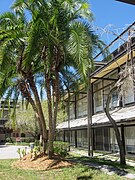 Riverview High School (1957–2009)
 -
 Jewett Arts Center (1958), Wellesley College
 -
 Milam Residence (1961)
 -
 Tuskegee University Chapel (1969)
 -
 First Church in Boston (1972)
 -
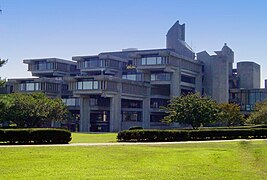 Claire T. Carney Library (1972)
 -
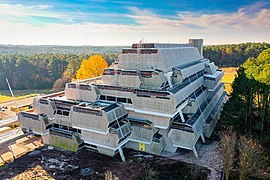 Burroughs Wellcome headquarters (1972–2021), Research Triangle Park, North Carolina
 -
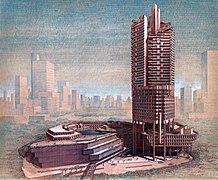 Early design for The Concourse
 -
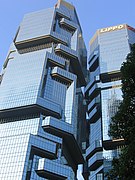 Lippo Centre (1987)

.jpg)
.jpg)


See also
[edit]References
[edit]- ^ a b c d e f g h i j k "Introduction". Paul Rudolph & His Architecture. University of Massachusetts Dartmouth Library. Retrieved March 6, 2022.
- ^ a b c d King, Joseph, and Domin, Christopher (2002). Paul Rudolph: The Florida Houses. New York, NY: Princeton Architectural Press. ISBN 9781568982663.
{{cite book}}: CS1 maint: multiple names: authors list (link) - ^ a b Sudjic, Deyan (2010). Norman Foster: A Life in Architecture. Overlook Press. ISBN 9781468302769.
- ^ David Colman (October 2011). "Master Builder: Architect Paul Rudolph's career was as dramatic as his buildings". Elle Decor. "Other issues contributed to Rudolph's loss of status: the rise of postmodernism, which he hated; the end of enthusiasm for the ambitious government buildings he loved; the fact that he was gay in a predominantly straight industry."
- ^ Howey, John (1995). The Sarasota School of Architecture : 1941–1966. Cambridge, MA: MIT Press. ISBN 978-0262082402.
- ^ "Time Is Running Out for a Celebrated Building" by David Hay, page A19, June 21, 2008 The New York Times.
- ^ "Rudolph's Riverview High School Demolished," [1] DoCoMoMo (International working party for documentation and conservation of building sites and neighborhoods of the modern movement), July 11, 2009.
- ^ Rehab would alter Sarasota High's open-air interior by Harold Bubil February 8, 2013 Herald-Tribune
- ^ New Haven Preservation Trust. "Temple Street Garage, 21 Temple Street". New Haven Modern Architecture.
- ^ Behar, Rena (October 4, 2017). "'Mind-Blowing' Milam House Is a Modernist Marvel on the Beach". Realtor.com. Retrieved March 29, 2023.
- ^ Cummings, Alex Sayf (June 13, 2016). "Into the Spaceship: A Visit to the Old Burroughs Wellcome Building". Tropics of Meta historiography for the masses. Retrieved November 25, 2019.
- ^ "Introduction of Paul Rudolph Projects at SMTI/UMD". Paul Rudolph & His Architecture. University of Massachusetts Dartmouth Library. Retrieved March 6, 2022.
- ^ Miller, Nick (November 5, 2013). "Five Paul Rudolph Buildings Under Threat in Buffalo". Architects Newspaper.
- ^ "Architects: Brutalism". Circa Design.
- ^ Muschamp, Herbert (August 9, 1997). "Paul Rudolph Is Dead at 78; Modernist Architect of the 60's". The New York Times. Retrieved January 8, 2019.
- ^ Paul Rudolph Archive. Library of Congress, Prints and Photographs Division
- ^ Center for Architecture, Design, and Engineering. Library of Congress, Prints and Photographs Division
- ^ "2390.pdf" (PDF). Archived from the original (PDF) on December 9, 2010. Retrieved January 22, 2013.
- ^ Squier, Anna (May 11, 2018). "A Paul Rudolph-Designed Midcentury Is Rescued From Obscurity and Finally Completed". Dwell. Retrieved April 13, 2019.
Bibliography
[edit]- Bell, Eugenia (2019). Paul Rudolph: Inspiration and Process in Architecture. Princeton Architectural Press. ISBN 9781616898656.
- Rohan, Timothy M. (2014). The Architecture of Paul Rudolph. Yale University Press. ISBN 978-0300149395.
- De Alba, Roberto (2003). Paul Rudolph: The Late Work. Princeton Architectural Press. ISBN 1-56898-401-4.
- Domin, Christopher; King, Joseph (2005). Paul Rudolph: The Florida Houses. Princeton Architectural Press. ISBN 1-56898-551-7.
- Moholy-Nagy, Sibyl (1970). The Architecture of Paul Rudolph. Praeger. ISBN 0-500-09057-2.
- Monk, Tony (1999). The Art and Architecture of Paul Rudolph. Wiley-Academy. ISBN 0-471-99778-1.
- Mottalini, Chris (2013). After You Left They Took It Apart: Demolished Paul Rudolph Homes (1st ed.). Chicago, Illinois: Columbia College Chicago Press. ISBN 978-1-935195-45-0.
External links
[edit]

- The Paul Rudolph Institute for Modern Architecture
- Paul Marvin Rudolph Papers, Yale University Library
| Commercial buildings | .jpg) | |
|---|---|---|
| Public buildings | ||
| Residential buildings | ||
| Homes | ||
| Key terms | ||
| Key people | ||


| International | |
|---|---|
| National | |
| Academics | |
| Artists | |
| People | |
| Other | |

- Modernist architects from the United States
- Brutalist architects
- 1918 births
- 1997 deaths
- Paul Rudolph buildings
- Architects from Connecticut
- LGBT architects
- LGBT people from Kentucky
- Yale School of Architecture faculty
- Auburn University alumni
- Harvard Graduate School of Design alumni
- Deaths from cancer in New York (state)
- Deaths from mesothelioma in the United States
- People from Elkton, Kentucky
- 20th-century American architects
- Architects from Kentucky
- Military personnel from Kentucky
- 20th-century American LGBT people