


Poincaré inequality
In mathematics, the Poincaré inequality[1] is a result in the theory of Sobolev spaces, named after the French mathematician Henri Poincaré. The inequality allows one to obtain bounds on a function using bounds on its derivatives and the geometry of its domain of definition. Such bounds are of great importance in the modern, direct methods of the calculus of variations. A very closely related result is Friedrichs' inequality.
Statement of the inequality[edit]
The classical Poincaré inequality[edit]
Let p, so that 1 ≤ p < ∞ and Ω a subset bounded at least in one direction. Then there exists a constant C, depending only on Ω and p, so that, for every function u of the Sobolev space W01,p(Ω) of zero-trace (a.k.a. zero on the boundary) functions,

Poincaré–Wirtinger inequality[edit]
Assume that 1 ≤ p ≤ ∞ and that Ω is a bounded connected open subset of the n-dimensional Euclidean space with a Lipschitz boundary (i.e., Ω is a Lipschitz domain). Then there exists a constant C, depending only on Ω and p, such that for every function u in the Sobolev space W1,p(Ω),


The necessity to subtract the average value can be seen by considering constant functions for which the derivative is zero while, without subtracting the average, we can have the integral of the function as large as we wish. There are other conditions instead of subtracting the average that we can require in order to deal with this issue with constant functions, for example, requiring trace zero, or subtracting the average over some proper subset of the domain. The constant C in the Poincare inequality may be different from condition to condition. Also note that the issue is not just the constant functions, because it is the same as saying that adding a constant value to a function can increase its integral while the integral of its derivative remains the same. So, simply excluding the constant functions will not solve the issue.
Generalizations[edit]
In the context of metric measure spaces, the definition of a Poincaré inequality is slightly different. One definition is: a metric measure space supports a (q,p)-Poincare inequality for some if there are constants C and λ ≥ 1 so that for each ball B in the space,



Whether a space supports a Poincaré inequality has turned out to have deep connections to the geometry and analysis of the space. For example, Cheeger has shown that a doubling space satisfying a Poincaré inequality admits a notion of differentiation.[3] Such spaces include sub-Riemannian manifolds and Laakso spaces.
There exist other generalizations of the Poincaré inequality to other Sobolev spaces. For example, consider the Sobolev space H1/2(T2), i.e. the space of functions u in the L2 space of the unit torus T2 with Fourier transform û satisfying
![{\displaystyle [u]_{H^{1/2}(\mathbf {T} ^{2})}^{2}=\sum _{k\in \mathbf {Z} ^{2}}|k|\left|{\hat {u}}(k)\right|^{2}<+\infty .}](https://wikimedia.org/api/rest_v1/media/math/render/svg/b51d6b61b6a3472f08fef12865146a04d49439d3)
![{\displaystyle \int _{\mathbf {T} ^{2}}|u(x)|^{2}\,\mathrm {d} x\leq C\left(1+{\frac {1}{\operatorname {cap} (E\times \{0\})}}\right)[u]_{H^{1/2}(\mathbf {T} ^{2})}^{2},}](https://wikimedia.org/api/rest_v1/media/math/render/svg/fb7b7898203fab641ced10619eb0be05c70c4e6e)

Yet another generalization involves weighted Poincaré inequalities where the Lebesgue measure is replaced by a weighted version.
The Poincaré constant[edit]
The optimal constant C in the Poincaré inequality is sometimes known as the Poincaré constant for the domain Ω. Determining the Poincaré constant is, in general, a very hard task that depends upon the value of p and the geometry of the domain Ω. Certain special cases are tractable, however. For example, if Ω is a bounded, convex, Lipschitz domain with diameter d, then the Poincaré constant is at most d/2 for p = 1, for p = 2,[5][6] and this is the best possible estimate on the Poincaré constant in terms of the diameter alone. For smooth functions, this can be understood as an application of the isoperimetric inequality to the function's level sets.[7] In one dimension, this is Wirtinger's inequality for functions.

However, in some special cases the constant C can be determined concretely. For example, for p = 2, it is well known that over the domain of unit isosceles right triangle, C = 1/π ( < d/π where ).[8]

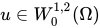
Furthermore, for a smooth, bounded domain Ω, since the Rayleigh quotient for the Laplace operator in the space is minimized by the eigenfunction corresponding to the minimal eigenvalue λ1 of the (negative) Laplacian, it is a simple consequence that, for any ,


Poincaré inequality on metric-measure spaces[edit]
Since the 90s there have been several fruitful ways to make sense of Sobolev functions on general metric measure spaces (metric spaces equipped with a measure that is often compatible with the metric in certain senses). For example, the approach based on "upper gradients" leads to Newtonian-Sobolev space of functions. Thus, it makes sense to say that a space "supports a Poincare inequality".
It turns out that whether a space supports any Poincare inequality and if so, the critical exponent for which it does, is tied closely to the geometry of the space. For example, a space that supports a Poincare inequality must be path connected. Indeed, between any pair of points there must exist a rectifiable path with length comparable to the distance of the points. Much deeper connections have been found, e.g. through the notion of modulus of path families. A good and rather recent reference is the monograph "Sobolev Spaces on Metric Measure Spaces, an approach based on upper gradients" written by Heinonen et al.
Sobolev Slobodeckji Spaces and Poincaré Inequality[edit]
Given and , the Sobolev Slobodeckji space is defined as the set of all functions such that and the seminorm is finite. The seminorm is defined by:


![{\displaystyle [u]_{s,p}}](https://wikimedia.org/api/rest_v1/media/math/render/svg/a789e14fad2e55cb234cfb09311ef41af4b03124)
![{\displaystyle [u]_{s,p}=\left(\int _{\Omega }\int _{\Omega }{\frac {|u(x)-u(y)|^{p}}{|x-y|^{n+sp}}}\,dx\,dy\right)^{1/p}}](https://wikimedia.org/api/rest_v1/media/math/render/svg/843ece3e9c44c80932c55972b14b0e81aa699d0d)
The Poincaré Inequality in this context can be generalized as follows:
![{\displaystyle \|u-u_{\Omega }\|_{L^{p}(\Omega )}\leq C[u]_{s,p}}](https://wikimedia.org/api/rest_v1/media/math/render/svg/5c82f5a2c9e3c2950fb0c6ebac3459d2f2640096)
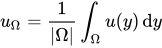
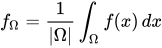
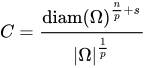
where is the average of over and is a constant dependent on , and . This inequality holds for every bounded .


Proof of the Poincaré Inequality[edit]
The proof follows that of Irene Drelichman and Ricardo G. Durán.[9] Let . By applying Jensen's inequality, we obtain:


By exploiting the boundedness of and further estimates:
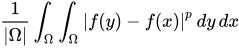

It follows that the constant is given as , however, the reference[10] with Theorem 1 indicates that this is not the optimal constant.
See also[edit]
References[edit]
- ^ Poincaré, H. (1890). "Sur les Equations aux Dérivées Partielles de la Physique Mathématique". American Journal of Mathematics. 12 (3). Equation (11) page 253. doi:10.2307/2369620. ISSN 0002-9327. JSTOR 2369620.
- ^ Heinonen, J.; Koskela, P. (1998). "Quasiconformal maps in metric spaces with controlled geometry". Acta Mathematica. 181: 1–61. doi:10.1007/BF02392747. ISSN 1871-2509.
- ^ Cheeger, J. (1 August 1999). "Differentiability of Lipschitz functions on metric measure spaces". Geometric and Functional Analysis. 9 (3): 428–517. doi:10.1007/s000390050094. S2CID 120149485.
- ^ Garroni, Adriana; Müller, Stefan (2005). "Γ-limit of a phase-field model of dislocations". SIAM J. Math. Anal. 36 (6): 1943–1964 (electronic). doi:10.1137/S003614100343768X. MR2178227
- ^ Acosta, Gabriel; Durán, Ricardo G. (2004). "An optimal Poincaré inequality in L1 for convex domains". Proc. Amer. Math. Soc. 132 (1): 195–202 (electronic). doi:10.1090/S0002-9939-03-07004-7.
- ^ Payne, L. E.; Weinberger, H. F. (1960). "An optimal Poincaré inequality for convex domains". Archive for Rational Mechanics and Analysis. 5 (1): 286–292. Bibcode:1960ArRMA...5..286P. doi:10.1007/BF00252910. ISSN 0003-9527. S2CID 121881343.
- ^ Alger, Nick. "L1 Poincare Inequality". Archived from the original on March 3, 2012.
- ^ Kikuchi, Fumio; Liu, Xuefeng (2007), "Estimation of interpolation error constants for the P0 and P1 triangular finite elements", Comput. Methods. Appl. Mech. Engrg., 196 (37–40): 3750–3758, Bibcode:2007CMAME.196.3750K, doi:10.1016/j.cma.2006.10.029 MR2340000
- ^ Irene Drelichman, Ricardo G. Durán (May 11, 2017). "Improved Poincaré inequalities in fractional Sobolev spaces". arXiv. Retrieved 2024-05-05.
- ^ Jean Bourgain, Haïm Brezis, Petru Mironescu (2002). "Limiting embedding theorems for when s ↑ 1 and applications". Journal d'Analyse Mathématique. 87: 77–101. doi:10.1007/BF02868470.
{{cite journal}}: CS1 maint: multiple names: authors list (link)

- Evans, Lawrence C. (1998), Partial differential equations, Providence, RI: American Mathematical Society, ISBN 0-8218-0772-2
- Leoni, Giovanni (2009), A First Course in Sobolev Spaces, Graduate Studies in Mathematics, American Mathematical Society, pp. xvi+607 ISBN 978-0-8218-4768-8, MR2527916, Zbl 1180.46001, MAA