


Koenigia davisiae
| Koenigia davisiae | |
|---|---|

| |
Scientific classification 
| |
| Kingdom: | Plantae |
| Clade: | Tracheophytes |
| Clade: | Angiosperms |
| Clade: | Eudicots |
| Order: | Caryophyllales |
| Family: | Polygonaceae |
| Genus: | Koenigia |
| Species: | K. davisiae
|
| Binomial name | |
| Koenigia davisiae | |
| Synonyms[1] | |
| |
Koenigia davisiae is a flowering plant in the knotweed family[1] that is known by the common names Davis' knotweed or Newberry knotweed.
Distribution[edit]
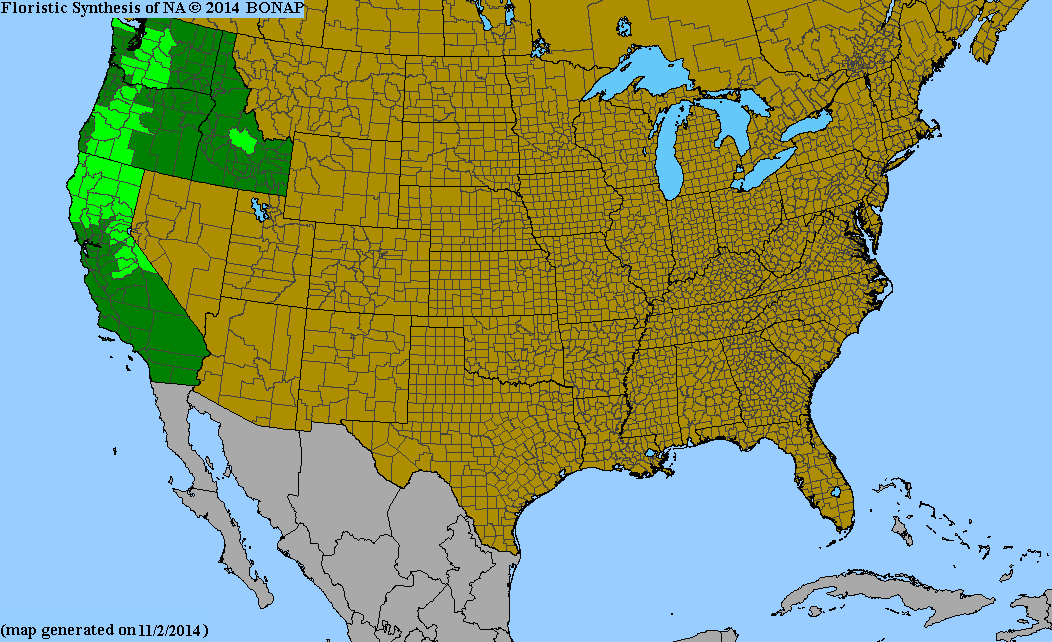
Koenigia davisiae is native to the western United States from Washington, Oregon, and central and northern California (northern Coast Ranges and northern Sierra Nevada). There are also isolated populations in central Idaho. It grows in high mountain habitat, such as talus and fellfields.[2][3]
Description[edit]
Koenigia davisiae is a deciduous perennial herb producing a decumbent or upright stem from a woody caudex, growing to a maximum erect height near 40 centimeters (3 feet). Stems may be pale green to red in color. The leaves are oval and pointed or widely-lance-shaped to somewhat triangular, yellowish or pale green and waxy, slightly hairy, or smooth in texture. Leaf edges are entire or minutely toothed. At the base of each leaf is a thin reddish sheath formed from the leaf's stipules which is known as the ochrea.[4] In late summer to autumn, the leaves turn orange to red.[5]
Flowers occur in clusters of 2 to 5 in the leaf axils. The flowers are yellowish, greenish, or purple-tinged and just a few millimeters wide.[4]
References[edit]
- ^ a b c "Koenigia davisiae (W.H.Brewer ex A.Gray) T.M.Schust. & Reveal". Plants of the World Online. Royal Botanic Gardens, Kew. Retrieved 2019-02-24.
- ^ Biota of North America Program 2014 county distribution map
- ^ Calflora taxon report, University of California, Aconogonon davisiae (W. H. Brewer ex A. Gray) Soják, Davis knotweed
- ^ a b Flora of North America, Aconogonon davisiae (W. H. Brewer ex A. Gray) Soják, 1974. Davis's knotweed
- ^ "Koenigia davisiae". iNaturalist. Retrieved 2022-10-14.
External links[edit]
- Jepson Manual Treatment - Polygonum davisiae
- United States Department of Agriculture Plants Profile; Polygonum davisiae
- Polygonum davisiae - Calphotos Photo gallery, University of California
 | This Polygonaceae article is a stub. You can help Wikipedia by expanding it. |