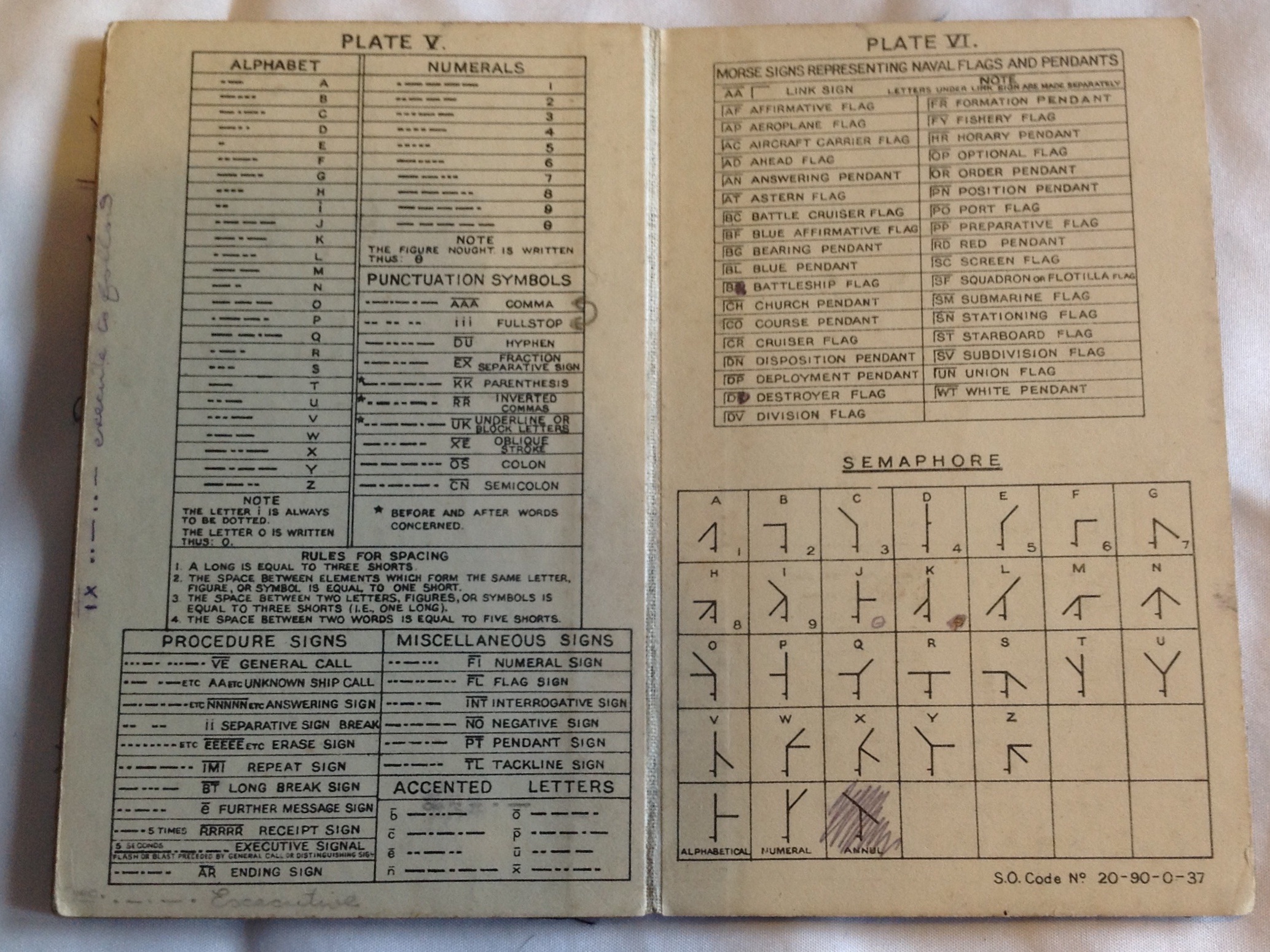
Prosigns for Morse code

Procedural signs or prosigns are shorthand signals used in Morse code telegraphy, for the purpose of simplifying and standardizing procedural protocols for landline and radio communication. The procedural signs are distinct from conventional Morse code abbreviations, which consist mainly of brevity codes that convey messages to other parties with greater speed and accuracy. However, some codes are used both as prosigns and as single letters or punctuation marks, and for those, the distinction between a prosign and abbreviation is ambiguous, even in context.
Overview[edit]
In the broader sense prosigns are just standardised parts of short form radio protocol, and can include any abbreviation. Examples would be K for "okay, heard you, continue" or R for "message, received".[1][2] In a more restricted sense, "prosign" refers to something analogous to the nonprinting control characters in teleprinter and computer character sets, such as Baudot and ASCII. Different from abbreviations, those are universally recognizable across language barriers as distinct and well-defined symbols.
At the coding level, prosigns admit any form the Morse code can take, unlike abbreviations which have to be sent as a sequence of individual letters, like ordinary text. On the other hand, most prosigns codes are much longer than typical codes for letters and numbers. They are individual and indivisible code points within the broader Morse code, fully at par with basic letters and numbers.
The development of prosigns began in the 1860s for wired telegraphy. Since telegraphy preceded voice communications by several decades, many of the much older Morse prosigns have acquired precisely equivalent prowords for use in more recent voice protocols.
Not all prosigns used by telegraphers are standard: There are regional and community-specific variations of the coding convention used in certain radio networks to manage transmission and formatting of messages, and many unofficial prosign conventions exist; some of which might be redundant or ambiguous. One typical example of something which is not an officially recognized prosign, but is yet fairly often used in Europe, is one or two freely timed dits at the end of a message, I I or ▄ ▄ ▄ ▄ ; it is equivalent to the proword OUT, meaning "I'm done; go ahead". However the official prosign with the same meaning is AR, or ▄ ▄▄▄ ▄ ▄▄▄ ▄ , which takes a little longer to send.[3][2]
Representation in printed material[edit]
Even though represented as strings of letters, prosigns are rendered without the intercharacter commas or pauses that would occur between the letters shown, if the representation were (mistakenly) sent as a sequence of letters: In printed material describing their meaning and use, prosigns are shown either as a sequence of dots and dashes for the sound of a telegraph, or by an overlined sequence of letters from the International Morse Code, which when sent without the usual spacing, sounds like the prosign symbol.
The best-known example of the convention is the standard distress call preamble: SOS. As a prosign it is not really composed of the three separate letters S, O, and S, (in International Morse: ▄ ▄ ▄ ▄▄▄ ▄▄▄ ▄▄▄ ▄ ▄ ▄ ) but is run together as a single symbol ▄ ▄ ▄ ▄▄▄ ▄▄▄ ▄▄▄ ▄ ▄ ▄ , which is a sign in its own right.
History[edit]
In the early decades of telegraphy, many efficiency improvements were incorporated into operations. Each of the early versions of Morse code was an example of that: With only one glaring exception (Intl. Morse O), they all encoded more common characters into shorter keying sequences, and the rare ones into longer, thus effecting online data compression. The introduction of Morse symbols called procedural signs or prosigns was then just a logical progression. They were not defined by the developers of Morse code, but were gradually introduced by telegraph operators to improve the speed and accuracy of high-volume message handling, especially those sent over that era's problematic long distance communication channels, such as transoceanic cables and later longwave wireless telegraphy.
Among other prosign uses, improvement in the legibility of written messages sent by telegraph (telegrams) using white space formatting was supported by the procedural symbols. To become an efficient telegraph operator it was important to master the Morse code prosigns, as well as the many standard abbreviations used to facilitate checking and re-sending sections of text.
Notation and representations[edit]
There are at least three methods used to represent Morse prosign symbols:
- Unique dot/dash sequences, e.g. ▄▄▄ ▄ ▄ ▄ ▄▄▄
- Unique audible sounds, e.g. dah di di di dah
- Non-unique printed or written overlined character groups,[a] e.g. BT
Although some of the prosigns as-written appear to be simply two adjacent letters, most prosigns are transmitted as digraphs that have no pauses between the patterns that represent the "combined" letters, and are most commonly written with a single bar over the merged letters (if more than one single character) to indicate this.[4] The only difference between what is transmitted for the Morse code prosign vs. the separate letter signs is the presence or absence of an inter-letter space between the two "dit" / "dah" sequences. Although the difference in the transmission is subtle, but the difference in meaning is gross:
- For example, the unofficial prosign AA ( ▄ ▄▄▄ ▄ ▄▄▄ ) indicates that the receiving Morse operator should begin a new line,[b] but the two separate letter sign or abbreviation AA ( ▄ ▄▄▄ ▄ ▄▄▄ ) indicates either the voice procedure words ALL AFTER, used to indicate what part of the previously transmitted message needs to be re-transmitted.[c]
Because no letter boundaries are transmitted with the codes counted as prosigns, their representation by two letters is usually arbitrary, and may be done in multiple equivalent ways. Normally, one particular form is used by convention, but some prosigns have multiple forms in common use:
- For example, AA ( ▄ ▄▄▄ + ▄ ▄▄▄ ) is exactly equivalent to EK ( ▄ + ▄▄▄ ▄ ▄▄▄ ) and RT ( ▄ ▄▄▄ ▄ + ▄▄▄ ).
- Although the well-known calling prosign for emergency messages SOS is always represented by the three letters "SOS", it could just as well be written VZE ( ▄ ▄ ▄ ▄▄▄ + ▄▄▄ ▄▄▄ ▄ ▄ + ▄ ), VGI ( ▄ ▄ ▄ ▄▄▄ + ▄▄▄ ▄▄▄ ▄ + ▄ ▄ ), or even 3B ( ▄ ▄ ▄ ▄▄▄ ▄▄▄ + ▄▄▄ ▄ ▄ ▄ ); all of these render the same single code ▄ ▄ ▄ ▄▄▄ ▄▄▄ ▄▄▄ ▄ ▄ ▄ .
Many Morse code prosigns do not have written or printed textual character representations in the original source information, even if they do represent characters in other contexts. For example, when embedded in text the Morse code sequence ▄▄▄ ▄ ▄ ▄ ▄▄▄ represents the "double hyphen" character (normally "=", but also "– –").[1] When the same code appears alone it indicates the action of spacing down two lines on a page in order to create the white space indicating the start of a new paragraph[2] or new section in a message heading.[1] When used as a prosign, there is no actual written or printed character representation or symbol for a new paragraph (i.e. no symbol corresponding to "¶"), other than the two-line white space itself.
Some prosigns are in unofficial use for special characters in languages other than English, for example AA is used unofficially for both the "next line" prosign[2] and for "Ä",[6][7] neither of which is in the international standard.[1] Other prosigns are officially designated for both characters and prosigns, such as AR equiv. "+", which marks the end of a message.[d][1] Some genuinely have only one use, such as CT or the equivalent KA ( ▄▄▄ ▄ ▄▄▄ ▄ ▄▄▄ ), the International Morse prosign that marks the start of a new transmission[1] or new message.[2]
International Morse code[edit]
The procedure signs below are compiled from the official specification for Morse Code, ITU-R M.1677, International Morse Code,[1] while others are defined the International Radio Regulations for Mobile Maritime Service, including ITU-R M.1170,[8] ITU-R M.1172,[4] and the Maritime International Code of Signals,[5] with a few details of their usage appearing in ACP 131,[9] which otherwise defines operating signals, not procedure signals.
Prosigns[edit]
The following table of prosigns includes K and R, which could be considered either abbreviations (for "okay, go ahead", and for "received") or prosigns that are also letters. All of the rest of the symbols are not letters, but in some cases are also used as punctuation.
| Prosign | Matching voice procedure word | Code symbol | Reference | Explanation |
|---|---|---|---|---|
| AA | UNKNOWN STATION | ▄ ▄▄▄ ▄ ▄▄▄ | [5] | This meaning is only used for directional signal lights.[5] It has no official use in radio telegraphy,[1] where it is unofficially used to represent an accented letter Ä or Á,[6][7] or the prosign for "next line", and then only when it is embedded inside a heading section in amateur traffic.[2] |
| R | ROGER | ▄ ▄▄▄ ▄ | [4][2] | Means the last transmission has been received, but does not necessarily indicate the message was understood or will be complied with. |
| K | OVER | ▄▄▄ ▄ ▄▄▄ | [1][2] | Invitation to transmit after terminating the call signal. (e.g. ▄ ▄▄▄ ▄ ▄▄▄ ▄ ▄▄▄ ▄ ▄▄▄ ). |
| AR | OUT | ▄ ▄▄▄ ▄ ▄▄▄ ▄ | [4][1][2] | End of transmission / End of message / End of telegram.[d] (Same as EC "end copy", and character +.)[e] |
| AS | WAIT | ▄ ▄▄▄ ▄ ▄ ▄ | [8][4][1][2] | "I must pause for a few minutes."[f]
Also means "I am engaged in a contact with another station [that you may not hear]; please wait quietly." |
| AS AR | WAIT OUT | ▄ ▄▄▄ ▄ ▄ ▄ ▄ ▄▄▄ ▄ ▄▄▄ ▄ |
[11] | I must pause for more than a few minutes. |
| VE | VERIFIED | ▄ ▄ ▄ ▄▄▄ ▄ | [1][2] | Message is verified. |
| ? | SAY AGAIN? | ▄ ▄ ▄▄▄ ▄▄▄ ▄ ▄ | [1][11] | When standing alone, a note of interrogation or request for repetition of the immediate prior transmission that was not understood.
When ? is placed after a coded signal, modifies the code to be a question or request. |
| INT | INTERROGATIVE | ▄ ▄ ▄▄▄ ▄ ▄▄▄ | [11][9][12] | Military replacement for the ? prosign; equivalent to Spanish ¿ punctuation mark. When placed before a signal, modifies the signal to be a question/request.[13][g] |
| HH ... | CORRECTION (kor-rek-shun) |
▄ ▄ ▄ ▄ ▄ ▄ ▄ ▄ | [1][2] | Preceding text was in error. The following is the corrected text. (Same as IIII or EEEEEEEE.) |
| HH AR | DISREGARD THIS TRANSMISSION OUT | ▄ ▄ ▄ ▄ ▄ ▄ ▄ ▄ ▄ ▄▄▄ ▄ ▄▄▄ ▄ |
The entire message just sent is in error, disregard it. (Same as EEEEEEEE AR.)[h] | |
| BT | BREAK | ▄▄▄ ▄ ▄ ▄ ▄▄▄ | [4][1][2] | Start new section of message. Same as character = or rarely – –. |
| KA | ATTENTION | ▄▄▄ ▄ ▄▄▄ ▄ ▄▄▄ | [4][1][2] | Message begins / Start of work / New message (Starting signal that precedes every transmission session. Sometimes written as CT.) |
| SK | OUT | ▄ ▄ ▄ ▄▄▄ ▄ ▄▄▄ | [4][1][2] | End of contact / End of work / Line is now free / Frequency no longer in use (Ending signal that follows every transmission session. Occasionally written VA.) |
Abbreviations for message handling[edit]
The following table of abbreviations are strictly used as strings of one to several letters, never as digraph symbols, and have standard meanings used for the management of sending and receiving messages. Dots following indicate that in use, the abbreviation is always followed by more information.
| Abbrev. | Matching voice procedure word | Code symbol | Reference | Explanation |
|---|---|---|---|---|
| DE ... | [THIS IS] FROM | ▄▄▄ ▄ ▄ ▄ | [4][1][2] | Used to precede the name or other identification of the station sending the transmission (Morse abbreviation). |
| NIL | NOTHING HEARD | ▄▄▄ ▄ ▄ ▄ ▄ ▄▄▄ ▄ ▄ | General-purpose response to any request or inquiry for which the answer is "nothing" or "none" or "not available" (Morse abbr.). Also means "I have no messages for you." | |
| CL | CLOSING | ▄▄▄ ▄ ▄▄▄ ▄ ▄ ▄▄▄ ▄ ▄ | [4][2] | Announcing station shutdown (Morse abbr.). |
| CQ | CALLING | ▄▄▄ ▄ ▄▄▄ ▄ ▄▄▄ ▄▄▄ ▄ ▄▄▄ | [4][2] | General call to any station (Morse abbr.). |
| CP ... ... | CALLING FOR | ▄▄▄ ▄ ▄▄▄ ▄ ▄ ▄▄▄ ▄▄▄ ▄ | [4] | Specific call to two or more named stations (Morse abbr.). |
| CS ... | CALLING STATION | ▄▄▄ ▄ ▄▄▄ ▄ ▄ ▄ ▄ | [4] | Specific call to exactly one named station (Morse abbr.). |
| CS ? | WHO ? | ▄▄▄ ▄ ▄▄▄ ▄ ▄ ▄ ▄ ▄ ▄ ▄▄▄ ▄▄▄ ▄ ▄ | [4] | What is the name or identity signal of your station? (Morse abbr.) In many contexts, the question mark is optional. |
| WA ... | WORD AFTER | ▄ ▄▄▄ ▄▄▄ ▄ ▄▄▄ | [4][2] | (Morse abbr.) |
| WB ... | WORD BEFORE | ▄ ▄▄▄ ▄▄▄ ▄▄▄ ▄ ▄ ▄ | [4][2] | (Morse abbr.) |
| AA ... | ALL AFTER | ▄ ▄▄▄ ▄ ▄▄▄ | [4][2] | The portion of the message to which I refer is all that follows the text ... (Morse abbr.) |
| AB ... | ALL BEFORE | ▄ ▄▄▄ ▄▄▄ ▄ ▄ ▄ | [4][2] | The portion of the message to which I refer is all that precedes the text ... (Morse abbr.) |
| BN ... ... | ALL BETWEEN | ▄▄▄ ▄ ▄ ▄ ▄▄▄ ▄ | [4][2] | The portion of the message to which I refer is all that falls between ... and ... (Morse abbr.) |
| C | CORRECT / YES / AFFIRMATIVE / CONFIRM | ▄▄▄ ▄ ▄▄▄ ▄ | [4][2] | Answer to prior question is "yes". (Morse abbr.) |
| N | NO / NEGATIVE | ▄▄▄ ▄ | [5][9] | Answer to prior question is "no". (Morse abbr.)[i] |
| ZWF ... | WRONG | ▄▄▄ ▄▄▄ ▄ ▄ ▄ ▄▄▄ ▄▄▄ ▄ ▄ ▄▄▄ ▄ | [9] | Your last transmission was wrong. The correct version is ... |
| QTR ? | REQUEST TIME CHECK | ▄▄▄ ▄▄▄ ▄ ▄▄▄ ▄▄▄ ▄ ▄▄▄ ▄ ▄ ▄ ▄▄▄ ▄▄▄ ▄ ▄ |
[9] | Time-check request. / What is the correct time? (Time is always UTC, unless explicitly requested otherwise, e.g. QTR HST ?) |
| QTR ... | TIME IS | ▄▄▄ ▄▄▄ ▄ ▄▄▄ ▄▄▄ ▄ ▄▄▄ ▄ | [9] | The following is the correct UTC in HHMM 24 hour format |
| BK | BREAK-IN | ▄▄▄ ▄ ▄ ▄ ▄▄▄ ▄ ▄▄▄ | [4][2] | Signal used to interrupt a transmission already in progress (Morse abbr.). NATO nets use AX.[9] Some military networks use ▄▄▄▄▄▄▄▄▄▄▄ ≈ TTTT instead. |
| CFM | CONFIRM / I ACKNOWLEDGE | ▄▄▄ ▄ ▄▄▄ ▄ ▄ ▄ ▄▄▄ ▄ ▄▄▄ ▄▄▄ | [4][2] | Message received (Morse abbr.). (Same as R.) |
| WX ... | WEATHER IS | ▄ ▄▄▄ ▄▄▄ ▄▄▄ ▄ ▄ ▄▄▄ | [4][2] | Weather report follows (Morse abbr.). |
| INTERCO | INTERCO
(in-tur-ko) |
▄ ▄ ▄▄▄ ▄ ▄▄▄ ▄ ▄ ▄▄▄ ▄ ▄▄▄ ▄ ▄▄▄ ▄ ▄▄▄ ▄▄▄ ▄▄▄ |
[5][4] | Groups of abbreviations from the International Code of Signals[5] follow (Morse abbr.). |
Amateur radio National Traffic System[edit]
For the special purpose of exchanging ARRL Radiograms during National Traffic System nets, the following prosigns and signals can be used, most of which are an exact match with ITU-R and Combined Communications Electronics Board (military) standards; a few have no equivalent in any other definition of Morse code procedure signals or abbreviations.
| Prosign | Code symbol | Meaning | Comments | Verbalization | As text |
|---|---|---|---|---|---|
| AA | ▄ ▄▄▄ ▄ ▄▄▄ | Start new line | Space down one line; typewritten as Carriage Return, Line Feed (CR-LF). Only used instead of BT in ARRL batched messages, where BT would prematurely start a pending next section.[2] Also written RT. | di dah di dah | Ä, Á[j] |
| AR | ▄ ▄▄▄ ▄ ▄▄▄ ▄ | Message separator, start new message / telegram.[1][3][2] | New Page, space down several lines.[3] Decoder software may show "+".[1] Alternative for "Break" in conversational Morse.[2] Also written RN. | di dah di dah dit | +[1] |
| AS | ▄ ▄▄▄ ▄ ▄ ▄ | Wait[1][3] | Respond with: SN, or characters "R" (Received) or "C" (Confirmed).[3][1] | di dah di di dit | &[k] |
| BT | ▄▄▄ ▄ ▄ ▄ ▄▄▄ | Start new section[1] / new paragraph.[3][2] | Space down two lines; typewritten CR-LF-LF. Decoder software may show "=".[1] | dah di di di dah | =, – – [1] |
| CT | ▄▄▄ ▄ ▄▄▄ ▄ ▄▄▄ | Start of transmission[1] Start of new message.[3][2] | Attention[3][2] commencing transmission. Also written KA. | dah di dah di dah | |
| HH ... | ▄ ▄ ▄ ▄ ▄ ▄ ▄ ▄ | Error / correction[1][3] | Always followed by correct text.[3] Equivalent to both IIII and EEEEEEEE . Sometimes transcribed as "???". | di di di di di di di dit | |
| K | ▄▄▄ ▄ ▄▄▄ | Invitation for any station to transmit[1][3][2] | Lone alphabetic character "K" at the end of a transmission.[3] | dah di dah | K[1] |
| X | ▄▄▄ ▄ ▄ ▄▄▄ | Full stop[3] | Lone alphabetic character "X" surrounded by word spaces.[3][2] Substitute for period AAA in ARRL batched messages. |
dah di di dah | X[1] |
| ? | ▄ ▄ ▄▄▄ ▄▄▄ ▄ ▄ | Please say again[1][3][2] | Lone question mark "?" from the receiving station in response to a transmission; possibly followed by AA ... or AB ... .[3] | di di dah dah di dit | ?[1][3] |
| KN | ▄▄▄ ▄ ▄▄▄ ▄▄▄ ▄ | Invitation for named station to transmit[3] | Go ahead, specific named station.[3] Decoder software may show equivalent character "(".[1] | dah di dah dah dit | ( [1] |
| NJ | ▄▄▄ ▄ ▄ ▄▄▄ ▄▄▄ ▄▄▄ | Shift to Wabun code | Shift from Morse code to Wabun code Kana characters. Also written XM. | dah di di dah dah dah | |
| SK | ▄ ▄ ▄ ▄▄▄ ▄ ▄▄▄ | End of contact[3][2] / End of work[1] | Also written VA. | di di di dah di dah | |
| SN | ▄ ▄ ▄ ▄▄▄ ▄ | Understood.[3] Verify / verified.[1] | Message received and checks okay. Alternatively shift from Wabun to Morse code. "SN?" verification requested. Also written VE. | di di di dah dit | Š, Ś[j] |
| SOS | ▄ ▄ ▄ ▄▄▄ ▄▄▄ ▄▄▄ ▄ ▄ ▄ | Start of distress signal[1][3] | Only used by the original distressed station, and only for imminent danger to life or property.[1] (ⓘ) | di di di dah dah dah di di dit | |
| DDD | ▄▄▄ ▄ ▄ ▄▄▄ ▄ ▄ ▄▄▄ ▄ ▄ | Start of a distress signal relayed from another station | Used to forward a copy of a received "SOS". | dah di di dah di di dah di dit | |
| BK | ▄▄▄ ▄ ▄ ▄ ▄▄▄ ▄ ▄▄▄ | Break in conversation[3] | Morse abbreviation for "back-to you" (Morse abbr.).[3] In conversational Morse some use any of AR, BT, KN, or "K" instead. | dah di di dit da di dah | BK |
| CL | ▄▄▄ ▄ ▄▄▄ ▄ ▄ ▄▄▄ ▄ ▄ | Closing down[3][2] | Abbreviation for "closing station" (Morse abbr.). | dah di dah dit di dah di dit | CL |
Obsolete prosigns[edit]
| Prosign | Matching voice procedure word | Former code symbol | Explanation | Reference |
|---|---|---|---|---|
| CQD | Distress call | ▄▄▄ ▄ ▄▄▄ ▄ ▄▄▄ ▄▄▄ ▄ ▄▄▄ ▄▄▄ ▄ ▄ | Obsolete code used to call all stations during distress (see CQ). Replaced by SOS in 1906 (see above). | |
| VE | General call | ▄ ▄ ▄ ▄▄▄ ▄ | Code re-used for "Message verified" or "Message understood" (see SN above).[1] Replaced by CQ (see above).[1] | 1937 Royal Navy Signal Card[14][15] |
| NNNNN | Answering sign | ▄▄▄ ▄ ▄▄▄ ▄ ▄▄▄ ▄ ▄▄▄ ▄ ▄▄▄ ▄ | Dropped. | |
| i i | Separative sign break | ▄ ▄ ▄ ▄ | Generally replaced by BT, although it is still used in MARS CW operations,[12] and other military standards.[11] Later re-used for both a "ditto" mark and to represent the warning "I repeat" before a duplicated transmission. | |
| EEEEE | Digit 5 | ▄ ▄ ▄ ▄ ▄ | Exactly five dits (code for digit 5[1]). Replaced by HH[1] (exactly eight dits, EEEEEEEE[1]). | |
| RRRRR | Receipt sign | ▄▄▄▄▄▄▄▄▄▄▄▄▄▄▄▄▄▄▄▄▄▄▄▄▄▄▄▄▄▄▄▄▄▄▄▄▄▄▄▄▄▄ | Replaced by R.[1] | |
| É (printed as e) | Further message sign | ▄ ▄ ▄▄▄ ▄ ▄ | Re-purposed original ITU symbol for É[1] not used in English. |
See also[edit]
Notes[edit]
- ^ When overlining is not available, the same characters can be written in <angle brackets> or underlined, hence BT ( ▄▄▄ ▄ ▄ ▄ ▄▄▄ ) is equivalent to both <BT> and BT.
- ^
The prosign AA is only used for multi-line addresses inside message headings of ARRL batched message format, where sending the more common BT prosign would prematurely terminate the heading.[2]
- ^ Only when sent with ship-to-ship signal lights does the abbreviation AA have the same meaning as the voice procedure word UNKNOWN STATION.[5]
- ^ a b AR was used to mark the end of individual telegrams within a batched-message.
- ^ As of 2017 the is a proposal that (perhaps inadvertently) changes AR protocol.[10]
- ^ AS may optionally be followed by the estimated number of minutes of waiting time.
- ^ 1945 procedural use: "The correctness of a short portion of a message may be questioned directly by the receiving operator using the interrogatory prosign INT, but this method should not be used to question a part of a message for which a receipt has been given.[13]
- ^ The prowords HH AR may not be used to cancel a message after it has already been completely transmitted, and receipt acknowledged.[citation needed]
- ^ When Morse was still being used in aeronautics, the entire word NO ( ▄▄▄ ▄ ▄▄▄ ▄▄▄ ▄▄▄ ) was sent instead of the abbreviation N.
- ^ a b Non-ITU Code adopted nationally for languages with letters not used in Latin, English, or Italian.
- ^ Proposed double-use as punctuation ampersand; non-standard. Abbreviation "E S" is typically used instead.
References[edit]
- ^ a b c d e f g h i j k l m n o p q r s t u v w x y z aa ab ac ad ae af ag ah ai aj ak al am an ao ap aq ar as at au
International Morse Code. Radiocommunication Sector (international standard). ITU Recommendation. Geneva, CH: International Telecommunication Union. October 2009. ITU-R M.1677-1. - ^ a b c d e f g h i j k l m n o p q r s t u v w x y z aa ab ac ad ae af ag ah ai aj ak al am an
"Chapter 3: Sending messages in CW" (PDF). ARRL Network Reference Manual (procedure manual). Newington, CT: American Radio Relay League. 25 September 2002. - ^ a b c d e f g h i j k l m n o p q r s t u v w x y z
ARRL Operating Manual (textbook) (10th ed.). Newington, CT: American Radio Relay League. 8 October 2012. ISBN 978-0872595965. - ^ a b c d e f g h i j k l m n o p q r s t u v w x
Miscellaneous Abbreviations and Signals to be used for Radiocommunications in the Maritime Mobile Service. Radiocommunication Sector (international standard). ITU Recommendation. Geneva, CH: International Telecommunication Union. ITU-R M.1172 – via ITU.int. - ^ a b c d e f g
International Code of Signals (PDF) (Report). Maritime Safety Information Division (United States ed.). Bethesda, MD: National Imagery and Mapping Agency. 2003 [1855, 1969]. pub 102 – via SeaSources.net. - ^ a b
[No title cited] (Report) (in German). Deutsch-Österreichischer Telegraphenverein (German-Austrian Telegraph Union). 1851.
The Deutsch-Österreichischer Telegraphenverein officially adopted Gerke's redaction / revision of Morse code in 1851.
[full citation needed] - ^ a b Annual Report of the Board of Regents of the Smithsonian Institution for the Year 1878 (Report). Washington, DC: Smithsonian Institution. 1879. pp. 358–360. Retrieved 2021-03-17 – via Archive.org.
- ^ a b Morse Telegraphy Procedures in the Maritime Mobile Service (PDF). Radiocommunication Sector (international standard). ITU Recommendation. Geneva, CH: International Telecommunication Union. March 2012. ITU-R M.1170-1 – via ITU.int.
- ^ a b c d e f g
Communications Instructions Operating Signals (PDF) (military manual). NATO Combined Communications Electronics Board. April 2009. ACP 131(F). Archived from the original (PDF) on 2013-02-15 – via jcs.dtic.mil.- Also, see article ACP 131.
- ^
Benediktsson, Kristjan, (TF3KB); Kjartansson, Villi; et al. (Iceland Radio Association) (21–27 September 2014). Resolution on conflicting CW procedure (PDF). International Amateur Radio Union Region 1 2014 General Conference. Varna-Albena, Bulgaria. paper VA14 C3 40.
{{cite conference}}: CS1 maint: multiple names: authors list (link) CS1 maint: numeric names: authors list (link) - ^ a b c d Communication Instructions Radio Telegraph Procedure (PDF) (military manual). ACP 124 – via Navy-Radio.
- ^ a b Knight, David; Ryan, Jerry, eds. (May 2009). Radiotelegraph Operations Guide (PDF) (military procedure manual). MARS Training Manual. United States Air Force – via QSL.net.
- ^ a b Radio Operator's Manual (military field manual). United States War Department. Fort Monroe, VA: Army Field Printing Plant, CAS. 1945. FM24-6.
- ^ Signal Card (military reference). UK: Royal Navy. 1937.
- ^ Signal Card (image). UK: Royal Navy. 1937.