


Puggle
 | This article may require cleanup to meet Wikipedia's quality standards. The specific problem is: Page fails to meet the standard of other breed articles. Article seems to meet notability criteria. (January 2024) |
| Puggle | |||||||||||||
|---|---|---|---|---|---|---|---|---|---|---|---|---|---|
 An adult puggle | |||||||||||||
| Foundation stock | Beagle & Pug | ||||||||||||
| |||||||||||||
| Dog (domestic dog) | |||||||||||||
A puggle is a dog crossbred from a Pug and a Beagle. The breed originated in the 1990s in the United States.[1][2]
History[edit]
The puggle originated from accidental matings, the first planned cross between a pug and a beagle took place in Oklahoma in the 1990s.[2] The portmanteau "puggle" started appearing in 2002.[3] The puggle has subsequently become a popular designer dog crossbreeds in the United States, where it has attracted a number of celebrity owners. In 2005, the puggle was named the "Hottest Dog of 2005" and, in 2006, puggle sales accounted for more than 50% of all crossbreed dog sales in that country.[2][4][5]
Characteristics[edit]
Appearance[edit]
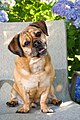
The puggle being a designer dog can often vary in appearance, but usually has the wrinkled forehead, black mask, and curled tail of the Pug.[2][5]
Behaviour[edit]
The puggle is less likely to inherit the energy, scent drive, and howl of the beagle; but because of the unpredictable nature of crossing two established breeds, puggles may still inherit both behaviour of either breed and health issues belonging to either breed.[2][6]
Health[edit]
The puggle usually has a snout longer than the Pug which reduces breathing problems and other health issues.[2] Issues common in puggles include eye diseases, luxating patella, hip dysplasia, and Legg-Calvé-Perthes disease.[2] Prolapsed nictitating membrane gland is also common in puggles despite not being prevalent in either Pugs or Beagles.[7]
Gallery[edit]

-

-

-
-
 Puggle showing off a mix of pug and beagle traits.
 -

-
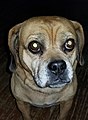 Older puggle.


See also[edit]
- List of dog crossbreeds
- It's Bruno! TV show featuring a puggle
References[edit]
- ^ Oxford University Press (2019). "Puggle". Oxford Dictionary. Lexico.com. Archived from the original on 29 June 2020. Retrieved 1 June 2020.
- ^ a b c d e f g Woolf, Norma Bennet (2007). Hot dogs: fourteen of the top designer dogs. Hauppauge, New York: B.E.S. Publishing. pp. 98–101. ISBN 978-0-7641-3512-5.
- ^ "Puggle Etymology". Oxford English Dictionary. Oxford University. Retrieved 2 January 2024.
- ^ Mooallem, Jon (4 February 2007), "The Modern Kennel Conundrum", The New York Times Magazine, retrieved 29 June 2020
- ^ a b DK Publishing (2013). The dog encyclopedia: the definitive visual guide. New York: Dorling Kindersley Limited. p. 297. ISBN 978-1-4654-0844-0.
- ^ Flaim, Denise (1 November 2007), "Designer dogs: The huggable, trouble-full, dumpable puggle", The Seattle Times, Frank Blethen, retrieved 29 June 2020
- ^ O'Neill DG, Yin Y, Tetas Pont R, Brodbelt DC, Church DB, Pegram C; et al. (2022). "Breed and conformational predispositions for prolapsed nictitating membrane gland (PNMG) in dogs in the UK: A VetCompass study". PLOS ONE. 17 (1): e0260538. Bibcode:2022PLoSO..1760538O. doi:10.1371/journal.pone.0260538. PMC 8791520. PMID 35081121.
{{cite journal}}: CS1 maint: multiple names: authors list (link)

 | This dog-related article is a stub. You can help Wikipedia by expanding it. |