


Richardson extrapolation

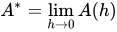
In numerical analysis, Richardson extrapolation is a sequence acceleration method used to improve the rate of convergence of a sequence of estimates of some value . In essence, given the value of for several values of , we can estimate by extrapolating the estimates to . It is named after Lewis Fry Richardson, who introduced the technique in the early 20th century,[1][2] though the idea was already known to Christiaan Huygens in his calculation of .[3] In the words of Birkhoff and Rota, "its usefulness for practical computations can hardly be overestimated."[4]


Practical applications of Richardson extrapolation include Romberg integration, which applies Richardson extrapolation to the trapezoid rule, and the Bulirsch–Stoer algorithm for solving ordinary differential equations.
General formula[edit]
Notation[edit]
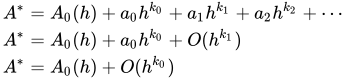
Let be an approximation of (exact value) that depends on a positive step size h with an error formula of the form







Note that by simplifying with Big O notation, the following formulae are equivalent:
Purpose[edit]
Richardson extrapolation is a process that finds a better approximation of by changing the error formula from to Therefore, by replacing with the truncation error has reduced from to for the same step size . The general pattern occurs in which is a more accurate estimate than when . By this process, we have achieved a better approximation of by subtracting the largest term in the error which was . This process can be repeated to remove more error terms to get even better approximations.




Process[edit]
Using the step sizes and for some constant , the two formulas for are:


|
|
(1)
|

|
|
(2)
|

To improve our approximation from to by removing the first error term, we multiply equation 2 by and subtract equation 1 to give us

![{\displaystyle (t^{k_{0}}-1)A^{*}={\bigg [}t^{k_{0}}A_{0}\left({\frac {h}{t}}\right)-A_{0}(h){\bigg ]}+{\bigg (}t^{k_{0}}a_{1}{\bigg (}{\frac {h}{t}}{\bigg )}^{k_{1}}-a_{1}h^{k_{1}}{\bigg )}+{\bigg (}t^{k_{0}}a_{2}{\bigg (}{\frac {h}{t}}{\bigg )}^{k_{2}}-a_{2}h^{k_{2}}{\bigg )}+O(h^{k_{3}}).}](https://wikimedia.org/api/rest_v1/media/math/render/svg/19b25b95b91704eb7e01dfaaf4c48340a3e797f8)
![{\textstyle {\big [}t^{k_{0}}A_{0}\left({\frac {h}{t}}\right)-A_{0}(h){\big ]}}](https://wikimedia.org/api/rest_v1/media/math/render/svg/c7f6f6af8dfee9731f1a82d585d8aafbd9e6b08e)

![{\displaystyle A^{*}={\frac {{\bigg [}t^{k_{0}}A_{0}\left({\frac {h}{t}}\right)-A_{0}(h){\bigg ]}}{t^{k_{0}}-1}}+{\frac {{\bigg (}t^{k_{0}}a_{1}{\bigg (}{\frac {h}{t}}{\bigg )}^{k_{1}}-a_{1}h^{k_{1}}{\bigg )}}{t^{k_{0}}-1}}+{\frac {{\bigg (}t^{k_{0}}a_{2}{\bigg (}{\frac {h}{t}}{\bigg )}^{k_{2}}-a_{2}h^{k_{2}}{\bigg )}}{t^{k_{0}}-1}}+O(h^{k_{3}})}](https://wikimedia.org/api/rest_v1/media/math/render/svg/b94fc3de185aafd0ca33309bef066449a7bdb0d6)


Recurrence relation[edit]
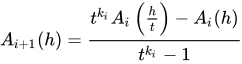
A general recurrence relation can be defined for the approximations by


Properties[edit]
The Richardson extrapolation can be considered as a linear sequence transformation.
Additionally, the general formula can be used to estimate (leading order step size behavior of Truncation error) when neither its value nor is known a priori. Such a technique can be useful for quantifying an unknown rate of convergence. Given approximations of from three distinct step sizes , , and , the exact relationship





As , if and is chosen so that , this approximate relation reduces to a quadratic equation in , which is readily solved for in terms of and .


Example of Richardson extrapolation[edit]
Suppose that we wish to approximate , and we have a method that depends on a small parameter in such a way that

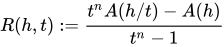
Let us define a new function

Then



Very often, it is much easier to obtain a given precision by using R(h) rather than A(h′) with a much smaller h′. Where A(h′) can cause problems due to limited precision (rounding errors) and/or due to the increasing number of calculations needed (see examples below).
Example pseudocode for Richardson extrapolation[edit]
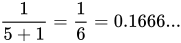
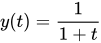
The following pseudocode in MATLAB style demonstrates Richardson extrapolation to help solve the ODE , with the Trapezoidal method. In this example we halve the step size each iteration and so in the discussion above we'd have that . The error of the Trapezoidal method can be expressed in terms of odd powers so that the error over multiple steps can be expressed in even powers; this leads us to raise to the second power and to take powers of in the pseudocode. We want to find the value of , which has the exact solution of since the exact solution of the ODE is . This pseudocode assumes that a function called Trapezoidal(f, tStart, tEnd, h, y0) exists which attempts to compute y(tEnd) by performing the trapezoidal method on the function f, with starting point y0 and tStart and step size h.


Note that starting with too small an initial step size can potentially introduce error into the final solution. Although there are methods designed to help pick the best initial step size, one option is to start with a large step size and then to allow the Richardson extrapolation to reduce the step size each iteration until the error reaches the desired tolerance.
tStart = 0          % Starting time
tEnd = 5            % Ending time
f = -y^2            % The derivative of y, so y' = f(t, y(t)) = -y^2
                    % The solution to this ODE is y = 1/(1 + t)
y0 = 1              % The initial position (i.e. y0 = y(tStart) = y(0) = 1)
tolerance = 10^-11  % 10 digit accuracy is desired

% Don't allow the iteration to continue indefinitely
maxRows = 20
% Pick an initial step size
initialH = tStart - tEnd
% Were we able to find the solution to within the desired tolerance? not yet.
haveWeFoundSolution = false

h = initialH

% Create a 2D matrix of size maxRows by maxRows to hold the Richardson extrapolates
% Note that this will be a lower triangular matrix and that at most two rows are actually
% needed at any time in the computation.
A = zeroMatrix(maxRows, maxRows)

% Compute the top left element of the matrix.
% The first row of this (lower triangular) matrix has now been filled.
A(1, 1) = Trapezoidal(f, tStart, tEnd, h, y0)

% Each row of the matrix requires one call to Trapezoidal
% This loops starts by filling the second row of the matrix,
% since the first row was computed above
for i = 1 : maxRows - 1 % Starting at i = 1, iterate at most maxRows - 1 times
    % Halve the previous value of h since this is the start of a new row.
    h = h/2

    % Starting filling row i+1 from the left by calling
    % the Trapezoidal function with this new smaller step size
    A(i + 1, 1) = Trapezoidal(f, tStart, tEnd, h, y0)

    % Go across this current (i+1)-th row until the diagonal is reached
    for j = 1 : i
        % To compute A(i + 1, j + 1), which is the next Richardson extrapolate,
        % use the most recently computed value (i.e. A(i + 1, j))
        % and the value from the row above it (i.e. A(i, j)).

        A(i + 1, j + 1) = ((4^j).*A(i + 1, j) - A(i, j))/(4^j - 1);
    end

    % After leaving the above inner loop, the diagonal element of row i + 1 has been computed
    % This diagonal element is the latest Richardson extrapolate to be computed.
    % The difference between this extrapolate and the last extrapolate of row i is a good
    % indication of the error.
    if (absoluteValue(A(i + 1, i + 1) - A(i, i)) < tolerance)  % If the result is within tolerance
        % Display the result of the Richardson extrapolation
        print("y = ", A(i + 1, i + 1))
        haveWeFoundSolution = true
        % Done, so leave the loop
        break
    end
end

% If we were not able to find a solution to within the desired tolerance
if (not haveWeFoundSolution)
    print("Warning: Not able to find solution to within the desired tolerance of ", tolerance);
    print("The last computed extrapolate was ", A(maxRows, maxRows))
end
See also[edit]
References[edit]
- ^ Richardson, L. F. (1911). "The approximate arithmetical solution by finite differences of physical problems including differential equations, with an application to the stresses in a masonry dam". Philosophical Transactions of the Royal Society A. 210 (459–470): 307–357. doi:10.1098/rsta.1911.0009.
- ^ Richardson, L. F.; Gaunt, J. A. (1927). "The deferred approach to the limit". Philosophical Transactions of the Royal Society A. 226 (636–646): 299–349. doi:10.1098/rsta.1927.0008.
- ^ Brezinski, Claude (2009-11-01), "Some pioneers of extrapolation methods", The Birth of Numerical Analysis, WORLD SCIENTIFIC, pp. 1–22, doi:10.1142/9789812836267_0001, ISBN 978-981-283-625-0
- ^ Page 126 of Birkhoff, Garrett; Gian-Carlo Rota (1978). Ordinary differential equations (3rd ed.). John Wiley and sons. ISBN 0-471-07411-X. OCLC 4379402.
- Extrapolation Methods. Theory and Practice by C. Brezinski and M. Redivo Zaglia, North-Holland, 1991.
- Ivan Dimov, Zahari Zlatev, Istvan Farago, Agnes Havasi: Richardson Extrapolation: Practical Aspects and Applications, Walter de Gruyter GmbH & Co KG, ISBN 9783110533002 (2017).
External links[edit]
- Fundamental Methods of Numerical Extrapolation With Applications, mit.edu
- Richardson-Extrapolation
- Richardson extrapolation on a website of Robert Israel (University of British Columbia)
- Matlab code for generic Richardson extrapolation.
- Julia code for generic Richardson extrapolation.