


Roosevelt elk
| Roosevelt Elk | |
|---|---|

| |
| Male (bull) at Northwest Trek, Washington, US | |

| |
| Female (cow) at Prairie Creek Redwoods State Park, California, US | |
Scientific classification 
| |
| Domain: | Eukaryota |
| Kingdom: | Animalia |
| Phylum: | Chordata |
| Class: | Mammalia |
| Order: | Artiodactyla |
| Family: | Cervidae |
| Genus: | Cervus |
| Species: | |
| Subspecies: | C. c. roosevelti
|
| Trinomial name | |
| Cervus canadensis roosevelti Merriam, 1897
| |
| Synonyms | |
|
Cervus elaphus roosevelti | |
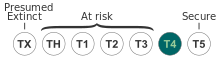
The Roosevelt elk (Cervus canadensis roosevelti), also known commonly as the Olympic elk and Roosevelt's wapiti, is the largest of the four surviving subspecies of elk (Cervus canadensis) in North America by body mass.[2] Mature bulls weigh from 700 to 1,200 lb (320 to 540 kg). with very rare large bulls weighing more.[3] Its geographic range includes temperate rainforests of the Pacific Northwest including parts of northern California. It was introduced to Alaska's Afognak, Kodiak, and Raspberry Islands in 1928[4][5][6] and reintroduced to British Columbia's Sunshine Coast from Vancouver Island in 1986.[4]
Naming and protection
[edit]In December 1897, mammalogist C. Hart Merriam named the subspecies after his friend Theodore Roosevelt, then Assistant Secretary of the US Navy.[7]: 589 The desire to protect the Roosevelt elk was one of the primary forces behind the establishment of the Mount Olympus National Monument in 1909 by President Theodore Roosevelt. Later in 1937, President Franklin D. Roosevelt visited the region and saw the elk named after his relative.[8] The following year he created Olympic National Park.
Description
[edit]The Roosevelt elk grows to around 6–10 ft (1.8–3.0 m) in length and stands 2.5–5.6 ft (0.76–1.71 m)[9] tall at the withers.[6] Roosevelt elk bulls generally weigh between 700 and 1,100 pounds (320 and 500 kg), while cows weigh 575–625 lb (261–283 kg).[2] Some mature bulls from Raspberry Island in Alaska have weighed nearly 1,300 lb (590 kg).[2]
Although the largest elk subspecies by body mass, by antler size both the Boone and Crockett (rifle)[10] and Pope and Young (bow)[11] records have Rocky Mountain elk being larger; none of the top 10 Roosevelt elk would score in the top 20 of Pope and Young's Rocky Mountain elk.[citation needed]
Diet
[edit]From late spring to early fall, the Roosevelt elk feeds upon herbaceous plants, such as grasses and sedges.[6] During winter months, it feeds on woody plants, including highbush cranberry, elderberry, devil's club, and newly planted seedlings (Douglas fir and western redcedar).[6] The Roosevelt elk is also known to eat ferns, blueberries, mushrooms, lichens, and salmonberries.[6]
Longevity
[edit]In the wild, the Roosevelt elk rarely lives beyond 12 to 15 years, but in captivity it has been known to live over 25 years.[6] In 2018, the New York State Zoo had a Roosevelt elk named Rosie die in August of that year at the age of 26, which means it was one of the oldest at that time.
Reintroduction
[edit]This elk subspecies, Cervus canadensis roosevelti, was reintroduced to British Columbia's Sunshine Coast from Vancouver Island in 1986.[4]
See also
[edit]References
[edit]- ^ "Cervus elaphus roosevelti". NatureServe Explorer. 2 August 2024. Retrieved 7 September 2024.
- ^ a b c Robb, Bob (January 2001). The Ultimate Guide to Elk Hunting. The Lyons Press. ISBN 1-58574-180-9.
- ^ Dr. Mike Jenkins, 2005
- ^ a b c "Guided Roosevelt Elk Hunting in BC". Coastal Inlet Adventures. 17 December 2019. Retrieved 26 July 2021.
- ^ Nancy Gates, ed. (November 2006). The Alaska Almanac: Facts about Alaska 30th Anniversary Edition. Alaska Northwest Books. ISBN 0-88240-652-3.
- ^ a b c d e f Rennick, Penny (November 1996). Mammals of Alaska. Alaska Geographic Society. ISBN 1-56661-034-6.
- ^ Morris, Edmund (1979). "The Hot Weather Secretary". The Rise of Theodore Roosevelt. New York: Coward, McCann & Geoghegan, Inc. pp. 565–590. ISBN 0-698-10783-7.
- ^ Houston, Douglas; Jenkins, Kurt. "Roosevelt Elk Ecology". Archived from the original on 27 May 2010. Retrieved 2007-12-28.
- ^ Arsenault, Anthony Alan (2008). Saskatchewan Elk (Cervus elaphus) Management Plan - Update", "1.1.2 - Physical Description", Fish and Wildlife Technical Report 2008-03. Saskatchewan Ministry of Environment, Fish, and Wildlife Branch. p. 2.
- ^ "B&C World's Record". Boone and Crockett Club.
- ^ "World's Records[sic]". Pope and Young Club.
Further reading
[edit]- Merriam CH (1897). "Cervus roosevelti, a New Elk from the Olympics". Proceedings of the Biological Society of Washington 11: 271–275. (Cervus roosevelti, new species, "Roosevelt's Wapiti").
External links
[edit]
| Authority control databases: National |
|---|
