


Phaseolus coccineus
| Phaseolus coccineus | |
|---|---|

| |
Scientific classification 
| |
| Kingdom: | Plantae |
| Clade: | Tracheophytes |
| Clade: | Angiosperms |
| Clade: | Eudicots |
| Clade: | Rosids |
| Order: | Fabales |
| Family: | Fabaceae |
| Subfamily: | Faboideae |
| Genus: | Phaseolus |
| Species: | P. coccineus
|
| Binomial name | |
| Phaseolus coccineus | |
| Synonyms[1] | |
|
List
| |
Phaseolus coccineus, known as runner bean,[2] scarlet runner bean,[2] or multiflora bean,[2] is a plant in the legume family, Fabaceae. Another common name is butter bean,[3][4][5] which, however, can also refer to the lima bean, a different species.
It is grown both as a food plant and an ornamental plant.
Description[edit]

This species originated in the mountains of Central America. It was most likely cultivated in the highlands of Mexico and Guatemala around 2000 BC.[7] Most varieties have red flowers and multicolored seeds (though some have white flowers and white seeds) and are often grown as ornamental plants. The vine can grow to 3 metres (9.8 ft) or more in length,[8] its pods can get to 25 centimetres (9.8 in), and its beans can be up to 2.5 centimetres (0.98 in) or more.[9]
It differs from the common bean (P. vulgaris) in several respects: the cotyledons stay in the ground during germination, and the plant is a perennial vine with tuberous roots (though it is frequently treated as an annual in colder climates).
The knife-shaped pods are normally green; however, there are very rare varieties bred by amateurs that have very unusual purple pods. An example of such a purple-podded runner bean is 'Aeron Purple Star'.[10]
Runner beans have also been called "Oregon lima bean",[11] and in Nahuatl ayocotl or in Spanish ayocote. Runner beans, like all beans, contain the toxic protein phytohaemagglutinin and thus should be cooked well before eating.[12]
Usage[edit]
Runner beans were grown as food plants in North America and Europe from the 1600s, and also as ornamentals for their attractive flowers. However, they came to be used primarily as a garden ornamental plant in North America, including for temporary screening. The flowers attract hummingbirds, bees and other insects. In the UK and other European countries – where the vegetable is a popular choice for kitchen gardens and allotments – the flowers came to be ignored, or treated as an attractive bonus to cultivating the plant for the beans.[13][14]
The seeds of the plant can be used fresh or as dried beans. The pods are eaten whole while young and not yet fibrous, though they tend to have a rougher surface than the common bean. The starchy roots of this perennial are eaten in Mesoamerica.[13]
The beans are used in many cuisines. It is a popular side vegetable in British cuisine. A variety named 'Judión de la Granja' producing large, white, edible beans is cultivated in San Ildefonso, Spain.[15] It is the basis of a Segovian regional dish also named Judiones de la Granja, in which the beans are mixed with pig's ears, pig's trotters, and chorizo, amongst other ingredients.[16]
In Greece, cultivars of the runner bean with white blossom and white beans are known as fasolia gigantes (φασόλια γίγαντες). They are grown under protective law in the north of Greece within the regions of Kato Nevrokopi, Florina and Kastoria.[17] The beans have an important role in Greek cuisine, appearing in many dishes (such as Gigantes plaki). In English, they are sometimes colloquially referred to as elephant beans.[18][19] In Austria the coloured versions are cultivated and served as "Käferbohnen" ("beetle-bean"), a dish made of the dry beans with pumpkin seed oil. It is considered a typical dish of regional Austrian cuisine, but dried runner beans are also consumed to a small extent in Germany. In Turkey, runner beans are the main ingredient in bean Pilaki and Piyaz.
Greece and northern Africa are the sources of pods of the runner beans sold as "green beans" in European markets during the cold period. The pods can be identified by their big size and the rougher surface.
- 'Aeron Purple Star' (not available commercially)[10]
- 'Black Runner'
- 'Butler'
- 'Case Knife'
- 'Fasolia gigantes', a white bean which originated in Greece.
- 'Hammond's Dwarf'
- 'Japanese Runner', sold in Canada and USA under the names of "Akahana"[21] or "Shinshu runner"[22]
- 'Painted Lady'
- 'Pickwick Dwarf'
- 'Polestar'
- 'Scarlet Runner'
- 'White Dutch Runner'
P. coccineus subsp. darwinianus is a cultivated subspecies, commonly referred to as the botil bean in Mexico.
The related species considered most useful for interbreeding with P. coccineus to increase its genetic diversity are P. dumosus and P. vulgaris.[23]
-
 Runner (stick) beans for sale on a UK market stall
 -
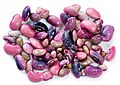 Seeds of 'Scarlet Emperor'
 -
 Spanish variety Judión de la Granja
 -
 Austrian "Käferbohnen salad" that contains pumpkin seed oil and sliced onions
 -

-
 Giant beans, a Mediterranean side dish: cooked runner beans in tomato sauce.


.jpg)
References[edit]
- ^ "The Plant List: A Working List of All Plant Species".
- ^ a b c "Phaseolus coccineus". Germplasm Resources Information Network. Agricultural Research Service, United States Department of Agriculture. Retrieved 16 December 2017.
- ^ M. Brink; G. Belay, eds. (2006). Cereals and Pulses. Vol. Plant Resources of Tropical Africa 1. PROTA. p. 139. ISBN 90-5782-170-2.
- ^ "Phaseolus coccineus L.". Strand Memorial Herbarium. University of Minnesota. 2016. Retrieved September 27, 2017.
- ^ "Phaseolus coccineus (runner bean)". Invasive Species Compendium. CABI. Retrieved September 26, 2017.
- ^ No Coast Seeds. "Bean - Shinshu Runner". nocoastseeds.ca. Retrieved 16 April 2023. The website shows a side-by-side picture of the Scarlet runner and the Japanese runner.
- ^ Pearman, Georgina (2005). Prance, Ghillean; Nesbitt, Mark (eds.). The Cultural History of Plants. Routledge. p. 146. ISBN 0415927463.
- ^ Scarlet Runner Beans – GROWS 10' TALL!! Ancient Beans for Cool Weather. YouTube. 18 August 2012.
- ^ "Phaseolus coccineus - Runner Beans". Retrieved 2023-11-18.www.gardenia.net
- ^ a b "Aeron Purple Star Runner Bean Seeds". Retrieved 2014-09-13.
- ^ "The Beekeeping Resource Leader – Bee Culture Magazine". Bee Culture. Archived from the original on 2011-07-07. Retrieved 2010-08-16.
- ^ "Beans! Beans! The Poisonous Fruit! - Dave's Garden". davesgarden.com. Retrieved 2018-07-24.
- ^ a b Mahr, Susan. "Scarlet Runner Bean, Phaseolus coccineus". Wisconsin Horticulture. University of Wisconsin - Madison. Retrieved 16 November 2022.
- ^ Dove, Helena; McHale, Ellen. "Bountiful beans". Royal Botanic Garden Kew. Retrieved 16 November 2022.
- ^ "Judiones". Judiones de la Granja. 7 September 2008. Retrieved 8 November 2008.
- ^ "Judiones de La Granja recipe". Judiones de la Granja. 22 June 2008. Retrieved 8 November 2008.
- ^ "DOOR". europa.eu.
- ^ "Greek Elephant Beans". Men's Health. 2016-03-31. Retrieved 2016-12-26.
- ^ "Baked elephant beans | Toronto Star". The Toronto Star. 3 March 2010. Retrieved 2016-12-26.
- ^ Phaseolus coccineus. FloriData.
- ^ Vegetable Varieties for Gardeners. "'Akahana Fujimame' Beans". vegvariety.cce.cornell.edu/. Cornell Garden Based Learning, Cornell University College of Agriculture & Life Sciences, Horticulture Section. Retrieved 16 April 2023. "Japanese hyacinth pole bean. Vines bear red flowers and flat, thick and curved pods".
- ^ No Coast Seeds. "Bean - Shinshu Runner". nocoastseeds.ca. Retrieved 16 April 2023.
- ^ "The Harlan and de Wet Crop Wild Relative Inventory – chapter: Phaseolus coccineus". Global Crop Diversity Trust, the Millennium Seed Bank of the Royal Botanic Gardens Kew, and the Government of Norway. Retrieved 12 Sep 2013.
External links[edit]
 Definitions from Wiktionary
 Media from Commons
 News from Wikinews
 Quotations from Wikiquote
 Texts from Wikisource
 Textbooks from Wikibooks
 Resources from Wikiversity


 Data related to Phaseolus coccineus at Wikispecies
 Food portal
 Agriculture portal
 Botany portal


