


Russian roulette

Russian roulette (Russian: Русская рулетка, romanized: Russkaya ruletka) is a potentially lethal game of chance in which a player places a single round in a revolver, spins the cylinder, places the muzzle against the head or body (of the opponent or themselves), and pulls the trigger. If the loaded chamber aligns with the barrel, the weapon will fire, killing or severely injuring the player.
Origin[edit]
According to Andrew Clarke, the first trace of Russian roulette can be found in the short story "The Fatalist", which was written in 1840 and was part of the collection A Hero of Our Time by Mikhail Lermontov, a Russian poet and writer.[1] In the story, which is set in a Cossack village, the protagonist, Grigory Alexandrovich Pechorin, claims that there is no predestination and proposes a bet in order to prove it, laying about twenty gold pieces onto a table. A lieutenant of the dragoons of the Tsar, Vulič, a man of Serbian origins with a passion for gambling, accepts the challenge and randomly takes one of a number of pistols of various calibres from its nail, cocks it and pours gunpowder onto the pan. Nobody knows if the pistol is loaded or not. "Gentlemen! Who will pay 20 gold pieces for me?", Vulič asks, putting the muzzle of the pistol to his forehead. He then asks Grigory to throw a playing card in the air, and when the card lands, he pulls the trigger. The weapon fails to fire, but when Vulič cocks the pistol again and aims it at a service cap hanging over the window, a shot rings out and smoke fills the room.[2]
Etymology[edit]
The term Russian roulette was possibly first used in a 1937 short story of the same name by Georges Surdez, published in the January 30, 1937, edition of Collier's magazine:
'Did you ever hear of Russian Roulette?' When I said I had not, he told me all about it. When he was with the Russian army in Rumania [sic], around 1917, and things were cracking up, so that their officers felt that they were not only losing prestige, money, family, and country, but were being also dishonored before their colleagues of the Allied armies, some officer would suddenly pull out his revolver, anywhere, at the table, in a café, at a gathering of friends, remove a cartridge from the cylinder, spin the cylinder, snap it back in place, put it to his head and pull the trigger. There were five chances to one that the hammer would set off a live cartridge and blow his brains all over the place.[3]
References to the term in the context of the Collier's story appeared in some newspapers during 1937.[4] The first independent appearances of the term in newspapers began in 1938 with the reports of young men being killed while playing it. The earliest instance appears to have been the death of a 21-year-old former journalism student in Austin, Texas, appearing in The Austin Statesman and some other Texas newspapers on January 8, 1938.[5][6] At least four other deaths were attributed to Russian roulette during the year: a 34-year-old policeman in Peoria, Illinois,[7][8] a 20-year-old in Houston,[9] an 18-year-old in Saratoga Springs, New York,[10] and a 16-year-old in Los Angeles.[11]
Subsequently, the term became a metaphor for taking foolhardy risks and its usage steadily increased in reportage of diplomacy, politics, economics, medicine and sports.
Probability[edit]
 | This section relies largely or entirely upon a single source. (October 2021) |

Math in this section is based on the use of a six-shot revolver with a single chamber loaded. Abnormal factors, such as the possibility of a dud round, are not included.
Variant: revolver re-spun after each trigger pull[edit]
With this variant, turn order is essential, because the probability of losing decreases the later one's turn is.
Given a six-shot revolver, for any given single trial (pull), the probability of losing is . However, since all players only come into the game if and when each of the players before them has caught an empty chamber, the all-game loss probability for player (starting from 0) is reduced to . The all-game loss probabilities for each of the six players are hence, in order, , , , , , and to one decimal place. More generally, for a revolver with chambers, player 's all-game loss probability is .


The probability of the revolver having fired after six pulls is , or about . More generally, for a revolver with chambers, the probability of the revolver having fired after pulls is , as this would be an instance of a geometric distribution where the success probability is .


The average number of pulls for the gun to fire is in this variant (six pulls, for a six-shot revolver).
Variant: revolver only spun once at the start[edit]
With this variant, turn order has no effect on the all-game loss probability, which remains the same for all players, but influences the single-pull probability, which increases with each pull.
Given a six-shot revolver, at pull (starting from 0), the fact that all previously tested chambers were empty reduces the total number of possible locations of the bullet to , and the loss probability is therefore . The single-pull loss probabilities for each of the six players are hence, in order, , , , , , and to 1 decimal place.[12] More generally, for a revolver with chambers, the loss probability at pull (starting from 0) is .


However, since, like in the re-spinning variant, all players only come into the game if and when each of the players before them has caught an empty chamber, the all-game loss probability for player is

for and for . Hence, the all-game loss probability for all players is to 1 decimal place.

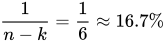

The probability of the revolver having fired after six pulls is or in this variant (meaning the revolver will fire within six trigger pulls). And, more generally, after pulls, it is .


The average number of pulls for the gun to fire is in this variant (3.5 pulls, for a six-shot revolver).

Notable incidents[edit]
- An American Institute of Physics profile of William Shockley, co-inventor of the transistor and winner of the Nobel Prize for Physics, claims that he attempted suicide by playing a solo game of Russian roulette.[13]
- In a 1946 U.S. legal case, Commonwealth v. Malone, 47 A.2d 445 (1946), a Pennsylvania teenager's conviction for murder in the second degree as a result of shooting a friend was upheld by the Pennsylvania Supreme Court. In this case, the teenagers involved played a modified version of Russian roulette, called Russian poker, in which they took turns aiming and pulling the trigger of the revolver at each other, rather than at their own heads. The court ruled that "When an individual commits an act of gross recklessness without regard to the probability that death to another is likely to result, that individual exhibits the state of mind required to uphold a conviction of manslaughter even if the individual did not intend for death to ensue."[14]
- On 25 December 1954, American blues musician Johnny Ace killed himself in Texas, after a gun he pointed at his own head discharged. A report in The Washington Post attributed this to Russian roulette, but this was disputed by two witnesses.[15]
- Graham Greene related in his first autobiography, A Sort of Life (1971), that he played Russian roulette, alone, a few times as a teenager.[16]
- Malcolm X, in his 1965 autobiography, recalls an incident during his burglary career when he once played Russian roulette, pulling the trigger three times in a row to convince his partners in crime that he was not afraid to die. In the epilogue to the book, Alex Haley states that Malcolm X revealed to him that he palmed the round.[17] The incident is portrayed in Spike Lee’s 1992 film adaptation of the autobiography.
- In 1972, under the influence of alcohol and cocaine, the French singer and actor Johnny Hallyday played multiple games of Russian roulette with his mistress, the American singer and actress Nanette Workman.[18] Laeticia Smet, his last wife, revealed in 2018 that he "has done this several times. But that was a long time ago ... At the time, he was playing with his destiny".[19]
- On 24 July 1973, Dallas Police Officer Darrell L. Cain murdered Santos Rodriguez, a 12-year-old Mexican-American child, while interrogating him and his brother about a burglary. Cain shot Rodriguez after spinning the cylinder of his revolver, Russian roulette-style, in an effort to force a confession.[20][21]
- On 10 September 1976, Finnish magician Aimo Leikas killed himself in front of a crowd while performing his Russian roulette act in Hartola. He had been performing the act for about a year, selecting six bullets from a box of assorted live and dummy ammunition.[22][23]
- The 1978 film The Deer Hunter depicts captured South Vietnamese and American soldiers being forced to play Russian roulette as their Viet Cong captors bet on who will survive. Several teen deaths following the movie's release caused both police and the media to accuse the film of inspiring the youths.[24]
- John Hinckley Jr., who attempted to assassinate President Ronald Reagan in 1981, was known to have played Russian roulette, alone, on two occasions.[25] Hinckley also took a picture of himself in 1980 in which he pointed a gun at his head.[26]
- On 12 October 1984, while waiting for filming to resume on Cover Up (1985), actor Jon-Erik Hexum played Russian roulette with a .44 Magnum revolver loaded with a blank. The blast fractured his skull and caused massive cerebral hemorrhaging when bone fragments were forced through his brain. He was rushed to Beverly Hills Medical Center, where he was pronounced brain-dead.[27]
- On 10 July 1993, former French rugby union player Armand Vaquerin died during a “demonstration” of Russian roulette in the Béziers bar “le bar des Amis” on avenue Gambetta.[28]
- On 5 October 2003, psychological illusionist Derren Brown appeared to take part in a game of Russian roulette live on UK television. Two days later, a statement by the police said they had been informed of the arrangements in advance, and were satisfied that "There was no live ammunition involved and at no time was anyone at risk."[29]
- The BBC program Who Do You Think You Are?, on 13 September 2010, featured the actor Alan Cumming investigating his grandfather Tommy Darling, who he discovered had died playing Russian roulette while serving as a police officer in British Malaya. The family had previously believed he had died accidentally while cleaning his gun.[30]
- On 11 June 2016, MMA fighter Ivan "JP" Cole apparently killed himself by playing Russian roulette.[31]
Drinking games[edit]
There is a drinking game based on Russian roulette. The game involves six shot glasses filled by a non-player: five are filled with water, but the sixth with vodka. Among some groups, low quality vodka is preferred, as it makes the glass representing the filled chamber less desirable. The glasses are arranged in a circle, and players take turns choosing a glass to take a shot from at random.[32]
There is also a game called "Beer Hunter" (titled after the Russian roulette scenes in the film The Deer Hunter). In this game, six cans of beer are placed between the participants: one can is vigorously shaken, and the cans are scrambled. The participants take turns opening the cans of beer right under their noses; the person who opens the shaken can (and thus sprays beer up their nose) is deemed the loser.[33]
Both are non-lethal compared to the game with the firearm which is almost always lethal.
See also[edit]
References[edit]
- ^ "The Deer Hunter Roberto Leoni Movie Reviews". YouTube. Archived from the original on 11 December 2021. Retrieved 13 October 2019.
- ^ "The Fatalist. Mikhail Lermontov. English Translation". LiveJournal.com. 18 October 2017. Retrieved 13 October 2019.
- ^ Surdez, Georges (30 January 1937). Chenery, William L. (ed.). "Russian Roulette" (PDF). Collier's. Crowell Publishing Company. pp. 16, 57. Archived (PDF) from the original on 1 October 2018. Retrieved 16 July 2019.
- ^ "'Tween Lines". Omaha World-Herald. 13 June 1937. p. 11-E. Retrieved 28 February 2023 – via newspapers.com.
- ^ "Death Laid to 'Gun Roulette'". The Austin Statesman. 8 January 1938. p. 1. Retrieved 28 February 2023 – via newspapers.com.
- ^ "Russian Roulette Test Fatal to Austin Writer". El Paso Herald-Post. United Press. 8 January 1938. p. 3. Retrieved 28 February 2023 – via newspapers.com.
- ^ "Police Officer Is Latest Victim Of Dangerous 'Russian Roulette'". The Austin Statesman. INS. 6 July 1938. p. 1. Retrieved 28 February 2023 – via newspapers.com.
- ^ "Dies as he Snaps 'Empty' Pistol at Head as Joke". St. Louis Star-Times. INS. 6 July 1938. p. 7. Retrieved 1 March 2023 – via newspapers.com.
- ^ "Russian Roulette Thrills Houston Youth to Death". The Austin Statesman. United Press. 8 July 1938. p. 3. Retrieved 28 February 2023 – via newspapers.com.
- ^ "Another Life Taken by 'Russian Roulette'". Springfield Leader & Press. Springfield, Missouri. AP. 23 July 1938. p. 1. Retrieved 28 February 2023 – via newspapers.com.
- ^ "Boy's Triple Death Gamble Told by Chum at Inquest". Los Angeles Times. 22 November 1938. p. 7. Retrieved 28 February 2023 – via newspapers.com.
- ^ "Abnormal risks". Statistical Ideas. 1 June 2015. Archived from the original on 6 November 2019. Retrieved 21 June 2017.
- ^ "Bill Shockley, Part 2 of 3". American Institute of Physics. 1999 – via PBS.org.
- ^ "Commonwealth v. Malone". casebriefs.com. Retrieved 26 July 2014.
- ^ Himes, Geoffrey (25 December 1998). "Really Old School". Washington Post.
- ^ Gallagher, Paul (12 December 2013). "Novelist Graham Greene Played Russian Roulette as a Teenager". dangerousminds.net. Retrieved 1 March 2023.
- ^ Rothstein, Edward (19 May 2005). "The Personal Evolution of a Civil Rights Giant". The New York Times. Retrieved 21 June 2017.
- ^ "Roulette russe, paradis artificiels, 'déglingue' : la relation survoltée de Johnny Hallyday et sa maîtresse Nanette Workman". www.programme-tv.net (in French). 1 April 2022.
- ^ "Quand Johnny Hallyday jouait à la roulette russe". www.parismatch.com (in French). 13 April 2018.
- ^ "State Rests Case In Cain Murder Trial". Lubbock Avalanche-Journal. UPI. 14 November 1973. p. 15. Retrieved 28 February 2023 – via newspapers.com.
- ^ "Dallas Policeman". The Boston Globe. 17 November 1973. p. 2. Retrieved 28 February 2023 – via newspapers.com.
- ^ "In Memoriam" (PDF). The Circus Report. Vol. 5, no. 38. 20 September 1976. p. 2. Archived from the original (PDF) on 3 September 2012. Retrieved 3 June 2013.
- ^ "Russian Roulette Act Misfires, Finnish Circus Performer Killed". Toledo Blade. 10 September 1976. p. 11. Retrieved 21 June 2017 – via Google News.
- ^ "The Deer Hunter Suicides". Snopes. 16 August 2007. Retrieved 26 April 2013.
- ^ Garbus, Martin (17 September 2002) [2002]. Courting Disaster: The Supreme Court and the Unmaking of American Law (hardcover ed.). Times Books. p. 135. ISBN 978-0-8050-6918-1.
- ^ "Photograph of Hinckley". Archived from the original on 22 November 2008. Retrieved 11 December 2008 – via University of Missouri Kansas City School of Law.
- ^ "Jon-Erik Hexum's Fatal Joke". Entertainment Weekly. 14 October 1994. Retrieved 5 February 2013.
- ^ "Podcast : les derniers mystères sur la mort du rugbyman Armand Vaquerin" [Podcast: the latest mysteries about the death of rugby player Armand Vaquerin] (in French). Télérama. 4 June 2022. Retrieved 7 November 2023.
- ^ "Roulette gun stunt 'a hoax'". BBC News. 7 October 2003. Retrieved 2 September 2007.
- ^ Jarvis, David (12 September 2010). "Alan Cumming's hero grandad died playing Russian roulette". Daily Express. Retrieved 1 March 2023.
- ^ Boult, Adam (13 June 2016). "MMA fighter 'killed himself playing Russian roulette'". The Telegraph. Archived from the original on 12 January 2022. Retrieved 13 June 2016.
- ^ "Drinking Roulette Fun Game". roulettegamesvariety.com. Retrieved 21 June 2017.
- ^ "The Beer Hunter". Modern Drunkard Magazine. Archived from the original on 9 December 2014.

