


Sciacca
 | This article has multiple issues. Please help improve it or discuss these issues on the talk page. (Learn how and when to remove these template messages)
|


Sciacca | |
|---|---|
| Comune di Sciacca | |
_-_Sicily.jpg) | |
 Coat of arms | |
Location of Sciacca  | |
  Sciacca Location of Sciacca in Italy  Sciacca Sciacca (Sicily) | |
| Coordinates: 37°30′33″N 13°5′20″E / 37.50917°N 13.08889°E | |
| Country | Italy |
| Region | Sicily |
| Province | Agrigento (AG) |
| Frazioni | Lazzarino |
| Government | |
| • Mayor | Fabio Termine |
| Area | |
| • Total | 191.67 km2 (74.00 sq mi) |
| Elevation | 60 m (200 ft) |
| Population (31 August 2022)[2] | |
| • Total | 38,912 |
| • Density | 200/km2 (530/sq mi) |
| Demonym(s) | Saccensi, Sciacchitani |
| Time zone | UTC+1 (CET) |
| • Summer (DST) | UTC+2 (CEST) |
| Postal code | 92019 |
| Dialing code | 0925 |
| Patron saint | Holy Mary of Soccorso |
| Saint day | 2 February |
| Website | Official website |
Sciacca (Italian and Sicilian: [ˈʃakka]; Greek: Θέρμαι; Latin: Thermae Selinuntinae, Thermae Selinuntiae, Thermae, Aquae Labrodes and Aquae Labodes) is a town and comune in the province of Agrigento on the southwestern coast of Sicily, southern Italy. It has views of the Mediterranean Sea.
History[edit]
Thermae was founded in the 5th century BC by the Greeks, as its name suggests, as a thermal spa for Selinunte, 30 km distant, whose citizens came there to bathe in the sulphurous springs, still much valued for their medical properties, of Mount San Calogero which rises up behind the town. There is no account of the existence of a town on the site during the period of the independence of Selinunte, though the thermal waters would always have attracted some population to the spot. It seems to have been much frequented in the time of the Romans. At a later period they were called the Aquae Labodes or Larodes, under which name they appear in the Itineraries.[3] Pliny was most likely mistaken in assigning the rank of a colonia to the southern, rather than northern, town of the same name. Strabo mentions the waters (τὰ ὕδατα τὰ Σελινούντια.[4])
The origin of the town's name has been much debated, with Latin "ex acqua", as a reference to the springs of thermal water of the area, or Arabic "Syac", meaning bath, and al Saqquah, dating back to the cult of the Syrian god "Shai al Quaaum", as possibilities.
The city walls, the bastions and the Old Castle owe their existence to Roger the Great Count.
A royal city that had remained faithful to Manfred of Sicily during the Angevine invasion, by 1268 A.D. Sciacca was besieged by Charles I of Anjou and surrendered the following year. After the Sicilian Vespers, it established itself as a free commune. During the War of the Sicilian Vespers, the city was besieged numerous times; the final engagement of the 20-year war took place in 1302, when a French army failed to capture the city.[5]
Following the Vespers era, the Peralta family took possession of it and obtained from the king of Sicily the right to mint coins. In the following centuries, the town was at the center of bloody feuds between rival baronial families (the Luna, of Aragonese origin, and the Perollo, of Norman stock), which nearly halved its population. In 1647, the impoverished town was the seat of an anti-Spanish rebellion.
During World War II, the Italian Regia Aeronautica (Royal Air Force) had a base near Sciacca.
Geography[edit]
Overview[edit]
The municipality borders Caltabellotta, Menfi, Ribera and Sambuca di Sicilia.[6]
Climate[edit]
Sciacca has a Mediterranean climate (Köppen climate classification: Csa),[7] with short, mild and moderately rainy winters and long, hot and dry summers. The city receives around 450 millimeters (17.7 inches) of rain per year, experiencing a peak of 72.3 millimeters (2.8 inches) in November and a minimum of 2.5 millimeters (0.1 inch) in July.
| Climate data for Sciacca, Italy | |||||||||||||
|---|---|---|---|---|---|---|---|---|---|---|---|---|---|
| Month | Jan | Feb | Mar | Apr | May | Jun | Jul | Aug | Sep | Oct | Nov | Dec | Year |
| Mean daily maximum °C (°F) | 15 (59) |
15 (59) |
17 (63) |
19 (66) |
23 (73) |
27 (81) |
30 (86) |
30 (86) |
28 (82) |
24 (75) |
19 (66) |
16 (61) |
22 (71) |
| Mean daily minimum °C (°F) | 8 (46) |
8 (46) |
9 (48) |
10 (50) |
13 (55) |
17 (63) |
19 (66) |
20 (68) |
18 (64) |
15 (59) |
12 (54) |
9 (48) |
13 (56) |
| Average rainfall mm (inches) | 56 (2.2) |
46 (1.8) |
45 (1.8) |
37 (1.5) |
17 (0.7) |
5 (0.2) |
2 (0.1) |
9 (0.4) |
42 (1.7) |
61 (2.4) |
65 (2.6) |
65 (2.6) |
450 (18) |
| Mean daily sunshine hours | 4 | 5 | 6 | 7 | 9 | 10 | 11 | 10 | 9 | 7 | 5 | 4 | 7 |
| Source: Meteo Italia (ilmeteo.it)[8] | |||||||||||||
Main sites[edit]
Sciacca still retains much of its medieval layout, which divided the town into quarters, each laid out on a strip of rock descending toward the sea. Sciacca has several points of interest, including:
- Cathedral of Maria SS. del Soccorso (12th century, rebuilt in 1685)
- Castle of the Counts Luna; scarce remains can be still seen
- Church of Santa Margherita
- Chiesa del Carmine
- Church of San Michele (1371, rebuilt in the 17th century)
- Church of Santa Maria delle Giummare
- Palazzo Steripinto
- Palazzo Tagliavia (11th century), in neogothic style
- Palazzo Perollo (15th century)
Culture[edit]
Sciacca's festivals include the Carnival, celebrated during the week before the beginning of Lent (February). The highlight of the festival is the parade of bizarre figures mounted on floats, famous throughout Sicily for their gaudy expressions. The local television stations are TRS Tele Radio Sciacca and RMK Tele Radio Monte Kronio.
Diaspora[edit]
Starting around the turn of the 20th century, a number of residents of the Sciacca area emigrated to Norristown, Pennsylvania and the North End of Boston.
The Boston-based descendants of Sciacca, especially those from fishing families, have celebrated the Festival of the Madonna del Soccorso since 1910.
The Norristown-based descendants of Sciacca, through the local M.S.S. Club, maintain both traditions and devotions to the Madonna del Soccorso. The M.S.S. holds a communion breakfast in February and a large festival (often called simply "The Feast") in August in celebration of the miracles performed by the Madonna herself in Sciacca.
Economy[edit]
The economy of Sciacca is mainly based on agriculture, fishing and related food industries, as well as tourism.
Gallery[edit]
-
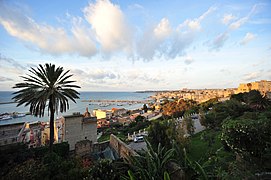 View from Piazza Scandaliato
 -

-
 Beach of Timpi
_View_from_Piazza_Scandaliato.jpg)

_spiaggia_di_Timpi_russi-_Sicily.jpg)
Sister cities[edit]
 Salvador, Brazil, since 2001
 Kırşehir, Turkey, since 2011
- Mustafakemalpaşa, Turkey, since 2011


People[edit]
- Cataldo Amodei (1649–1693), baroque composer
- Giuseppe Mario Bellanca (1886–1960), airplane designer who created the first monoplane in the United States with an enclosed cabin
- Johnny Dundee (1893–1965), world featherweight and super featherweight champion
- Tommaso Fazello (1498–1570), authored the first printed history of Sicily
- Giovanni Antonio Medrano (1703–1760), Major Royal Governor of Mathematics of the Kingdom of Naples, chief engineer of the kingdom, royal architect, brigadier, and teacher of Charles III of Spain and his brothers the infantes. He is the architect who designed the San Carlo opera house and Palace of Capodimonte in Naples.
- Andrea Tummiolo (born 1984), footballer
See also[edit]
References[edit]
- ^ "Superficie di Comuni Province e Regioni italiane al 9 ottobre 2011". Italian National Institute of Statistics. Retrieved 16 March 2019.
- ^ "Popolazione Residente al 1° Gennaio 2018". Italian National Institute of Statistics. Retrieved 16 March 2019.
- ^ Itin. Ant. p. 89; Tabula Peutingeriana
- ^ Strabo, vi. p. 275
- ^ Stanton, Charles D. “ENDGAME (SPRING 1301–SUMMER 1302).” In Roger of Lauria (c.1250-1305): “Admiral of Admirals,” NED-New edition., 289–301. Boydell & Brewer, 2019. doi:10.2307/j.ctvd58tqg.24.
- ^ 39255 Sciacca on OpenStreetMap
- ^ "World Map of Köppen−Geiger Climate Classification". Archived from the original on 2010-09-06.
- ^ "Climate, temperatures and weather in Sciacca". www.thetraveller.co.uk. Retrieved 2020-06-18.
External links[edit]

 Sciacca travel guide from Wikivoyage
- Guide to Sciacca (in Italian)

| International | |
|---|---|
| National | |
| Geographic | |
