A representative disc is a three-dimensionalvolume element of a solid of revolution. The element is created by rotating a line segment (of lengthw) around some axis (located r units away), so that a cylindricalvolume of πr2w units is enclosed.
Two common methods for finding the volume of a solid of revolution are the disc method and the shell method of integration. To apply these methods, it is easiest to draw the graph in question; identify the area that is to be revolved about the axis of revolution; determine the volume of either a disc-shaped slice of the solid, with thickness δx, or a cylindrical shell of width δx; and then find the limiting sum of these volumes as δx approaches 0, a value which may be found by evaluating a suitable integral. A more rigorous justification can be given by attempting to evaluate a triple integral in cylindrical coordinates with two different orders of integration.
The disc method is used when the slice that was drawn is perpendicular to the axis of revolution; i.e. when integrating parallel to the axis of revolution.
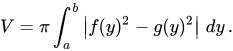
The volume of the solid formed by rotating the area between the curves of f(y) and g(y) and the lines y = a and y = b about the y-axis is given by
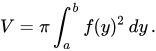
If g(y) = 0 (e.g. revolving an area between the curve and the y-axis), this reduces to:
The method can be visualized by considering a thin horizontal rectangle at y between f(y) on top and g(y) on the bottom, and revolving it about the y-axis; it forms a ring (or disc in the case that g(y) = 0), with outer radius f(y) and inner radius g(y). The area of a ring is π(R2 − r2), where R is the outer radius (in this case f(y)), and r is the inner radius (in this case g(y)). The volume of each infinitesimal disc is therefore πf(y)2dy. The limit of the Riemann sum of the volumes of the discs between a and b becomes integral (1).
Assuming the applicability of Fubini's theorem and the multivariate change of variables formula, the disk method may be derived in a straightforward manner by (denoting the solid as D):
The shell method (sometimes referred to as the "cylinder method") is used when the slice that was drawn is parallel to the axis of revolution; i.e. when integrating perpendicular to the axis of revolution.
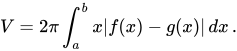
The volume of the solid formed by rotating the area between the curves of f(x) and g(x) and the lines x = a and x = b about the y-axis is given by
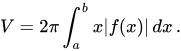
If g(x) = 0 (e.g. revolving an area between curve and y-axis), this reduces to:
The method can be visualized by considering a thin vertical rectangle at x with height f(x) − g(x), and revolving it about the y-axis; it forms a cylindrical shell. The lateral surface area of a cylinder is 2πrh, where r is the radius (in this case x), and h is the height (in this case f(x) − g(x)). Summing up all of the surface areas along the interval gives the total volume.
This method may be derived with the same triple integral, this time with a different order of integration:
Solid of revolution demonstration
The shapes at rest
The shapes in motion, showing the solids of revolution formed by each
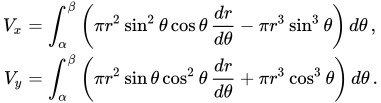
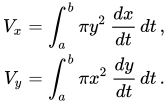
When a curve is defined by its parametric form (x(t),y(t)) in some interval [a,b], the volumes of the solids generated by revolving the curve around the x-axis or the y-axis are given by[1]
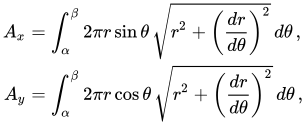
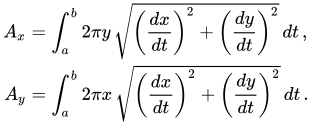
Under the same circumstances the areas of the surfaces of the solids generated by revolving the curve around the x-axis or the y-axis are given by[2]
This can also be derived from multivariable integration. If a plane curve is given by then its corresponding surface of revolution when revolved around the x-axis has Cartesian coordinates given by with . Then the surface area is given by the surface integral













![{\displaystyle A_{x}=\iint _{S}dS=\iint _{[a,b]\times [0,2\pi ]}\left\|{\frac {\partial \mathbf {r} }{\partial t}}\times {\frac {\partial \mathbf {r} }{\partial \theta }}\right\|\ d\theta \ dt=\int _{a}^{b}\int _{0}^{2\pi }\left\|{\frac {\partial \mathbf {r} }{\partial t}}\times {\frac {\partial \mathbf {r} }{\partial \theta }}\right\|\ d\theta \ dt.}](https://wikimedia.org/api/rest_v1/media/math/render/svg/9b6e20c212de99b253a52f3442b8f74ea73d61ac)




![{\displaystyle {\begin{aligned}A_{x}&=\int _{a}^{b}\int _{0}^{2\pi }\left\|{\frac {\partial \mathbf {r} }{\partial t}}\times {\frac {\partial \mathbf {r} }{\partial \theta }}\right\|\ d\theta \ dt\\[1ex]&=\int _{a}^{b}\int _{0}^{2\pi }\left\|y\left\langle y\cos(\theta ){\frac {dx}{dt}},y\sin(\theta ){\frac {dx}{dt}},y{\frac {dy}{dt}}\right\rangle \right\|\ d\theta \ dt\\[1ex]&=\int _{a}^{b}\int _{0}^{2\pi }y{\sqrt {\cos ^{2}(\theta )\left({\frac {dx}{dt}}\right)^{2}+\sin ^{2}(\theta )\left({\frac {dx}{dt}}\right)^{2}+\left({\frac {dy}{dt}}\right)^{2}}}\ d\theta \ dt\\[1ex]&=\int _{a}^{b}\int _{0}^{2\pi }y{\sqrt {\left({\frac {dx}{dt}}\right)^{2}+\left({\frac {dy}{dt}}\right)^{2}}}\ d\theta \ dt\\[1ex]&=\int _{a}^{b}2\pi y{\sqrt {\left({\frac {dx}{dt}}\right)^{2}+\left({\frac {dy}{dt}}\right)^{2}}}\ dt\end{aligned}}}](https://wikimedia.org/api/rest_v1/media/math/render/svg/67ad143220b39defd5b72caa82d8beb7b47d4946)