


Stefan–Boltzmann law


The Stefan–Boltzmann law, also known as Stefan's law, describes the intensity of the thermal radiation emitted by matter in terms of that matter's temperature. It is named for Josef Stefan, who empirically derived the relationship, and Ludwig Boltzmann who derived the law theoretically.
For an ideal absorber/emitter or black body, the Stefan–Boltzmann law states that the total energy radiated per unit surface area per unit time (also known as the radiant exitance) is directly proportional to the fourth power of the black body's temperature, T:

The constant of proportionality, , is called the Stefan–Boltzmann constant. It has the value

In the general case, the Stefan–Boltzmann law for radiant exitance takes the form: where is the emissivity of the surface emitting the radiation. The emissivity is generally between zero and one. An emissivity of one corresponds to a black body.


Detailed explanation
[edit]The radiant exitance (previously called radiant emittance), , has dimensions of energy flux (energy per unit time per unit area), and the SI units of measure are joules per second per square metre (J⋅s−1⋅m−2), or equivalently, watts per square metre (W⋅m−2).[2] The SI unit for absolute temperature, T, is the kelvin (K).

To find the total power, , radiated from an object, multiply the radiant exitance by the object's surface area, :



Matter that does not absorb all incident radiation emits less total energy than a black body. Emissions are reduced by a factor , where the emissivity, , is a material property which, for most matter, satisfies . Emissivity can in general depend on wavelength, direction, and polarization. However, the emissivity which appears in the non-directional form of the Stefan–Boltzmann law is the hemispherical total emissivity, which reflects emissions as totaled over all wavelengths, directions, and polarizations.[3]: 60

The form of the Stefan–Boltzmann law that includes emissivity is applicable to all matter, provided that matter is in a state of local thermodynamic equilibrium (LTE) so that its temperature is well-defined.[3]: 66n, 541 (This is a trivial conclusion, since the emissivity, , is defined to be the quantity that makes this equation valid. What is non-trivial is the proposition that , which is a consequence of Kirchhoff's law of thermal radiation.[4]: 385 )

A so-called grey body is a body for which the spectral emissivity is independent of wavelength, so that the total emissivity, , is a constant.[3]: 71 In the more general (and realistic) case, the spectral emissivity depends on wavelength. The total emissivity, as applicable to the Stefan–Boltzmann law, may be calculated as a weighted average of the spectral emissivity, with the blackbody emission spectrum serving as the weighting function. It follows that if the spectral emissivity depends on wavelength then the total emissivity depends on the temperature, i.e., .[3]: 60 However, if the dependence on wavelength is small, then the dependence on temperature will be small as well.

Wavelength- and subwavelength-scale particles,[5] metamaterials,[6] and other nanostructures[7] are not subject to ray-optical limits and may be designed to have an emissivity greater than 1.
In national and international standards documents, the symbol is recommended to denote radiant exitance; a superscript circle (°) indicates a term relate to a black body.[2] (A subscript "e" is added when it is important to distinguish the energetic (radiometric) quantity radiant exitance, , from the analogous human vision (photometric) quantity, luminous exitance, denoted .[8]) In common usage, the symbol used for radiant exitance (often called radiant emittance) varies among different texts and in different fields.


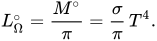
The Stefan–Boltzmann law may be expressed as a formula for radiance as a function of temperature. Radiance is measured in watts per square metre per steradian (W⋅m−2⋅sr−1). The Stefan–Boltzmann law for the radiance of a black body is:[9]: 26 [10]
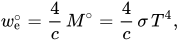
The Stefan–Boltzmann law expressed as a formula for radiation energy density is:[11] where is the speed of light.

History
[edit]In 1864, John Tyndall presented measurements of the infrared emission by a platinum filament and the corresponding color of the filament.[12][13][14][15] The proportionality to the fourth power of the absolute temperature was deduced by Josef Stefan (1835–1893) in 1877 on the basis of Tyndall's experimental measurements, in the article Über die Beziehung zwischen der Wärmestrahlung und der Temperatur (On the relationship between thermal radiation and temperature) in the Bulletins from the sessions of the Vienna Academy of Sciences.[16]
A derivation of the law from theoretical considerations was presented by Ludwig Boltzmann (1844–1906) in 1884, drawing upon the work of Adolfo Bartoli.[17] Bartoli in 1876 had derived the existence of radiation pressure from the principles of thermodynamics. Following Bartoli, Boltzmann considered an ideal heat engine using electromagnetic radiation instead of an ideal gas as working matter.
The law was almost immediately experimentally verified. Heinrich Weber in 1888 pointed out deviations at higher temperatures, but perfect accuracy within measurement uncertainties was confirmed up to temperatures of 1535 K by 1897.[18] The law, including the theoretical prediction of the Stefan–Boltzmann constant as a function of the speed of light, the Boltzmann constant and the Planck constant, is a direct consequence of Planck's law as formulated in 1900.
Stefan–Boltzmann constant
[edit]The Stefan–Boltzmann constant, σ, is derived from other known physical constants: where k is the Boltzmann constant, the h is the Planck constant, and c is the speed of light in vacuum.[19][4]: 388

As of the 2019 revision of the SI, which establishes exact fixed values for k, h, and c, the Stefan–Boltzmann constant is exactly: Thus,[20]
![{\displaystyle \sigma =\left[{\frac {2\pi ^{5}\left(1.380\ 649\times 10^{-23}\right)^{4}}{15\left(2.997\ 924\ 58\times 10^{8}\right)^{2}\left(6.626\ 070\ 15\times 10^{-34}\right)^{3}}}\right]\,{\frac {\mathrm {W} }{\mathrm {m} ^{2}{\cdot }\mathrm {K} ^{4}}}}](https://wikimedia.org/api/rest_v1/media/math/render/svg/7dd1c952cd56974a4064968da353ec8a84590fe9)
Prior to this, the value of was calculated from the measured value of the gas constant.[21]
The numerical value of the Stefan–Boltzmann constant is different in other systems of units, as shown in the table below.
| Context | Value | Units |
|---|---|---|
| SI | 5.670374419...×10−8 | W⋅m−2⋅K−4 |
| CGS | 5.670374419...×10−5 | erg⋅cm−2⋅s−1⋅K−4 |
| US customary units | 1.713441...×10−9 | BTU⋅hr−1⋅ft−2⋅°R−4 |
| Thermochemistry | 1.170937...×10−7 | cal⋅cm−2⋅day−1⋅K−4 |
Examples
[edit]Temperature of the Sun
[edit]
With his law, Stefan also determined the temperature of the Sun's surface.[23] He inferred from the data of Jacques-Louis Soret (1827–1890)[24] that the energy flux density from the Sun is 29 times greater than the energy flux density of a certain warmed metal lamella (a thin plate). A round lamella was placed at such a distance from the measuring device that it would be seen at the same angular diameter as the Sun. Soret estimated the temperature of the lamella to be approximately 1900 °C to 2000 °C. Stefan surmised that 1/3 of the energy flux from the Sun is absorbed by the Earth's atmosphere, so he took for the correct Sun's energy flux a value 3/2 times greater than Soret's value, namely 29 × 3/2 = 43.5.
Precise measurements of atmospheric absorption were not made until 1888 and 1904. The temperature Stefan obtained was a median value of previous ones, 1950 °C and the absolute thermodynamic one 2200 K. As 2.574 = 43.5, it follows from the law that the temperature of the Sun is 2.57 times greater than the temperature of the lamella, so Stefan got a value of 5430 °C or 5700 K. This was the first sensible value for the temperature of the Sun. Before this, values ranging from as low as 1800 °C to as high as 13000000 °C[25] were claimed. The lower value of 1800 °C was determined by Claude Pouillet (1790–1868) in 1838 using the Dulong–Petit law.[26][27] Pouillet also took just half the value of the Sun's correct energy flux.
Temperature of stars
[edit]The temperature of stars other than the Sun can be approximated using a similar means by treating the emitted energy as a black body radiation.[28] So: where L is the luminosity, σ is the Stefan–Boltzmann constant, R is the stellar radius and T is the effective temperature. This formula can then be rearranged to calculate the temperature: or alternatively the radius:

![{\displaystyle T={\sqrt[{4}]{\frac {L}{4\pi R^{2}\sigma }}}}](https://wikimedia.org/api/rest_v1/media/math/render/svg/7d1680c3b307aa94ff564031f61972d3f4581062)
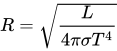
The same formulae can also be simplified to compute the parameters relative to the Sun: where is the solar radius, and so forth. They can also be rewritten in terms of the surface area A and radiant exitance : where and
![{\displaystyle {\begin{aligned}{\frac {L}{L_{\odot }}}&=\left({\frac {R}{R_{\odot }}}\right)^{2}\left({\frac {T}{T_{\odot }}}\right)^{4}\\[1ex]{\frac {T}{T_{\odot }}}&=\left({\frac {L}{L_{\odot }}}\right)^{1/4}\left({\frac {R_{\odot }}{R}}\right)^{1/2}\\[1ex]{\frac {R}{R_{\odot }}}&=\left({\frac {T_{\odot }}{T}}\right)^{2}\left({\frac {L}{L_{\odot }}}\right)^{1/2}\end{aligned}}}](https://wikimedia.org/api/rest_v1/media/math/render/svg/4797c05e38c614f0e052017f3cd0e00858aba55f)


![{\displaystyle {\begin{aligned}L&=AM^{\circ }\\[1ex]M^{\circ }&={\frac {L}{A}}\\[1ex]A&={\frac {L}{M^{\circ }}}\end{aligned}}}](https://wikimedia.org/api/rest_v1/media/math/render/svg/3965582093fa5ba02f03ad8a3d9f99cb207a56fb)


With the Stefan–Boltzmann law, astronomers can easily infer the radii of stars. The law is also met in the thermodynamics of black holes in so-called Hawking radiation.
Effective temperature of the Earth
[edit]Similarly we can calculate the effective temperature of the Earth T⊕ by equating the energy received from the Sun and the energy radiated by the Earth, under the black-body approximation (Earth's own production of energy being small enough to be negligible). The luminosity of the Sun, L⊙, is given by:

At Earth, this energy is passing through a sphere with a radius of a0, the distance between the Earth and the Sun, and the irradiance (received power per unit area) is given by

The Earth has a radius of R⊕, and therefore has a cross-section of . The radiant flux (i.e. solar power) absorbed by the Earth is thus given by:


Because the Stefan–Boltzmann law uses a fourth power, it has a stabilizing effect on the exchange and the flux emitted by Earth tends to be equal to the flux absorbed, close to the steady state where:
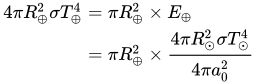
T⊕ can then be found: where T⊙ is the temperature of the Sun, R⊙ the radius of the Sun, and a0 is the distance between the Earth and the Sun. This gives an effective temperature of 6 °C on the surface of the Earth, assuming that it perfectly absorbs all emission falling on it and has no atmosphere.
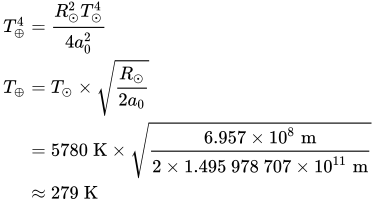
The Earth has an albedo of 0.3, meaning that 30% of the solar radiation that hits the planet gets scattered back into space without absorption. The effect of albedo on temperature can be approximated by assuming that the energy absorbed is multiplied by 0.7, but that the planet still radiates as a black body (the latter by definition of effective temperature, which is what we are calculating). This approximation reduces the temperature by a factor of 0.71/4, giving 255 K (−18 °C; −1 °F).[29][30]
The above temperature is Earth's as seen from space, not ground temperature but an average over all emitting bodies of Earth from surface to high altitude. Because of the greenhouse effect, the Earth's actual average surface temperature is about 288 K (15 °C; 59 °F), which is higher than the 255 K (−18 °C; −1 °F) effective temperature, and even higher than the 279 K (6 °C; 43 °F) temperature that a black body would have.
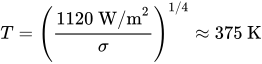
In the above discussion, we have assumed that the whole surface of the earth is at one temperature. Another interesting question is to ask what the temperature of a blackbody surface on the earth would be assuming that it reaches equilibrium with the sunlight falling on it. This of course depends on the angle of the sun on the surface and on how much air the sunlight has gone through. When the sun is at the zenith and the surface is horizontal, the irradiance can be as high as 1120 W/m2.[31] The Stefan–Boltzmann law then gives a temperature of or 102 °C (216 °F). (Above the atmosphere, the result is even higher: 394 K (121 °C; 250 °F).) We can think of the earth's surface as "trying" to reach equilibrium temperature during the day, but being cooled by the atmosphere, and "trying" to reach equilibrium with starlight and possibly moonlight at night, but being warmed by the atmosphere.
Origination
[edit]Thermodynamic derivation of the energy density
[edit]The fact that the energy density of the box containing radiation is proportional to can be derived using thermodynamics.[32][15] This derivation uses the relation between the radiation pressure p and the internal energy density , a relation that can be shown using the form of the electromagnetic stress–energy tensor. This relation is:


Now, from the fundamental thermodynamic relation we obtain the following expression, after dividing by and fixing :



The last equality comes from the following Maxwell relation:
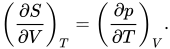
From the definition of energy density it follows that where the energy density of radiation only depends on the temperature, therefore

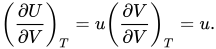
Now, the equality is after substitution of
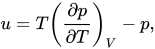

Meanwhile, the pressure is the rate of momentum change per unit area. Since the momentum of a photon is the same as the energy divided by the speed of light, where the factor 1/3 comes from the projection of the momentum transfer onto the normal to the wall of the container.
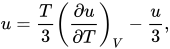
Since the partial derivative can be expressed as a relationship between only and (if one isolates it on one side of the equality), the partial derivative can be replaced by the ordinary derivative. After separating the differentials the equality becomes which leads immediately to , with as some constant of integration.


Derivation from Planck's law
[edit]
The law can be derived by considering a small flat black body surface radiating out into a half-sphere. This derivation uses spherical coordinates, with θ as the zenith angle and φ as the azimuthal angle; and the small flat blackbody surface lies on the xy-plane, where θ = π/2.
The intensity of the light emitted from the blackbody surface is given by Planck's law, where
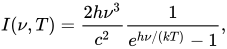
- is the amount of power per unit surface area per unit solid angle per unit frequency emitted at a frequency by a black body at temperature T.
- is the Planck constant
- is the speed of light, and
- is the Boltzmann constant.


The quantity is the power radiated by a surface of area A through a solid angle dΩ in the frequency range between ν and ν + dν.

The Stefan–Boltzmann law gives the power emitted per unit area of the emitting body,

Note that the cosine appears because black bodies are Lambertian (i.e. they obey Lambert's cosine law), meaning that the intensity observed along the sphere will be the actual intensity times the cosine of the zenith angle. To derive the Stefan–Boltzmann law, we must integrate over the half-sphere and integrate from 0 to ∞.

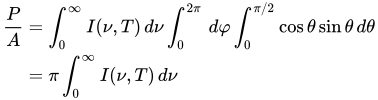
Then we plug in for I:
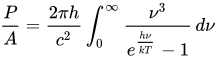
To evaluate this integral, do a substitution, which gives:
![{\displaystyle {\begin{aligned}u&={\frac {h\nu }{kT}}\\[6pt]du&={\frac {h}{kT}}\,d\nu \end{aligned}}}](https://wikimedia.org/api/rest_v1/media/math/render/svg/0fb1c7102e8ce13d53e3d5ca6b34b2aaa7b4e002)

The integral on the right is standard and goes by many names: it is a particular case of a Bose–Einstein integral, the polylogarithm, or the Riemann zeta function . The value of the integral is (where is the Gamma function), giving the result that, for a perfect blackbody surface:



Finally, this proof started out only considering a small flat surface. However, any differentiable surface can be approximated by a collection of small flat surfaces. So long as the geometry of the surface does not cause the blackbody to reabsorb its own radiation, the total energy radiated is just the sum of the energies radiated by each surface; and the total surface area is just the sum of the areas of each surface—so this law holds for all convex blackbodies, too, so long as the surface has the same temperature throughout. The law extends to radiation from non-convex bodies by using the fact that the convex hull of a black body radiates as though it were itself a black body.
Energy density
[edit]The total energy density U can be similarly calculated, except the integration is over the whole sphere and there is no cosine, and the energy flux (U c) should be divided by the velocity c to give the energy density U: Thus is replaced by , giving an extra factor of 4.
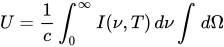
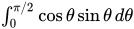

Thus, in total: The product is sometimes known as the radiation constant or radiation density constant.[33][34]


Decomposition in terms of photons
[edit]The Stephan–Boltzmann law can be expressed as[35] where the flux of photons, , is given by and the average energy per photon,, is given by


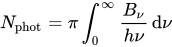



Marr and Wilkin (2012) recommend that students be taught about instead of being taught Wien's displacement law, and that the above decomposition be taught when the Stefan–Boltzmann law is taught.[35]
See also
[edit]Notes
[edit]- ^ "2022 CODATA Value: Stefan–Boltzmann constant". The NIST Reference on Constants, Units, and Uncertainty. NIST. May 2024. Retrieved 2024-05-18.
- ^ a b "Thermal insulation — Heat transfer by radiation — Vocabulary". ISO_9288:2022. International Organization for Standardization. 2022. Retrieved 2023-06-17.
- ^ a b c d Siegel, Robert; Howell, John R. (1992). Thermal Radiation Heat Transfer (3 ed.). Taylor & Francis. ISBN 0-89116-271-2.
- ^ a b Reif, F. (1965). Fundamentals of Statistical and Thermal Physics. Waveland Press. ISBN 978-1-57766-612-7.
- ^ Bohren, Craig F.; Huffman, Donald R. (1998). Absorption and scattering of light by small particles. Wiley. pp. 123–126. ISBN 978-0-471-29340-8.
- ^ Narimanov, Evgenii E.; Smolyaninov, Igor I. (2012). "Beyond Stefan–Boltzmann Law: Thermal Hyper-Conductivity". Conference on Lasers and Electro-Optics 2012. OSA Technical Digest. Optical Society of America. pp. QM2E.1. arXiv:1109.5444. CiteSeerX 10.1.1.764.846. doi:10.1364/QELS.2012.QM2E.1. ISBN 978-1-55752-943-5. S2CID 36550833.
- ^ Golyk, V. A.; Krüger, M.; Kardar, M. (2012). "Heat radiation from long cylindrical objects". Phys. Rev. E. 85 (4): 046603. doi:10.1103/PhysRevE.85.046603. hdl:1721.1/71630. PMID 22680594. S2CID 27489038.
- ^ "radiant exitance". Electropedia: The World's Online Electrotechnical Vocabulary. International Electrotechnical Commission. Retrieved 20 June 2023.
- ^ Goody, R. M.; Yung, Y. L. (1989). Atmospheric Radiation: Theoretical Basis. Oxford University Press. ISBN 0-19-505134-3.
- ^ Grainger, R. G. (2020). "A Primer on Atmospheric Radiative Transfer: Chapter 3. Radiometric Basics" (PDF). Earth Observation Data Group, Department of Physics, University of Oxford. Retrieved 15 June 2023.
- ^ "Radiation Energy Density". HyperPhysics. Retrieved 20 June 2023.
- ^ Tyndall, John (1864). "On luminous [i.e., visible] and obscure [i.e., infrared] radiation". Philosophical Magazine. 4th series. 28: 329–341. ; see p. 333.
- ^ In his physics textbook of 1875, Adolph Wüllner quoted Tyndall's results and then added estimates of the temperature that corresponded to the platinum filament's color: Wüllner, Adolph (1875). Lehrbuch der Experimentalphysik [Textbook of experimental physics] (in German). Vol. 3. Leipzig, Germany: B.G. Teubner. p. 215.
- ^ From Wüllner 1875, p. 215: "Wie aus gleich zu besprechenden Versuchen von Draper hervorgeht, … also fast um das 12fache zu." (As follows from the experiments of Draper, which will be discussed shortly, a temperature of about 525°[C] corresponds to the weak red glow; a [temperature] of about 1200°[C], to the full white glow. Thus, while the temperature climbed only somewhat more than double, the intensity of the radiation increased from 10.4 to 122; thus, almost 12-fold.)
- ^ a b Wisniak, Jaime (November 2002). "Heat radiation law – from Newton to Stefan" (PDF). Indian Journal of Chemical Technology. 9: 551–552. Retrieved 2023-06-15.
- ^ Stefan stated (Stefan 1879, p. 421): "Zuerst will ich hier die Bemerkung anführen, … die Wärmestrahlung der vierten Potenz der absoluten Temperatur proportional anzunehmen." (First of all, I want to point out here the observation which Wüllner, in his textbook, added to the report of Tyndall's experiments on the radiation of a platinum wire that was brought to glowing by an electric current, because this observation first caused me to suppose that thermal radiation is proportional to the fourth power of the absolute temperature.)
- ^ Boltzmann, Ludwig (1884). "Ableitung des Stefan'schen Gesetzes, betreffend die Abhängigkeit der Wärmestrahlung von der Temperatur aus der electromagnetischen Lichttheorie" [Derivation of Stefan's law, concerning the dependency of heat radiation on temperature, from the electromagnetic theory of light]. Annalen der Physik und Chemie (in German). 258 (6): 291–294. Bibcode:1884AnP...258..291B. doi:10.1002/andp.18842580616.
- ^ Badino, M. (2015). The Bumpy Road: Max Planck from Radiation Theory to the Quantum (1896–1906). SpringerBriefs in History of Science and Technology. Springer International Publishing. p. 31. ISBN 978-3-319-20031-6. Retrieved 2023-06-15.
- ^ "Thermodynamic derivation of the Stefan–Boltzmann Law". TECS. 21 February 2020. Retrieved 20 June 2023.
- ^ Sloane, N. J. A. (ed.). "Sequence A081820". The On-Line Encyclopedia of Integer Sequences. OEIS Foundation.
- ^ Moldover, M. R.; Trusler, J. P. M.; Edwards, T. J.; Mehl, J. B.; Davis, R. S. (1988-01-25). "Measurement of the Universal Gas Constant R Using a Spherical Acoustic Resonator". Physical Review Letters. 60 (4): 249–252. Bibcode:1988PhRvL..60..249M. doi:10.1103/PhysRevLett.60.249. PMID 10038493.
- ^ Çengel, Yunus A. (2007). Heat and Mass Transfer: a Practical Approach (3rd ed.). McGraw Hill.
- ^ Stefan 1879, pp. 426–427
- ^ Soret, J.L. (1872). Comparaison des intensités calorifiques du rayonnement solaire et du rayonnement d'un corps chauffé à la lampe oxyhydrique [Comparison of the heat intensities of solar radiation and of radiation from a body heated with an oxy-hydrogen torch]. 2nd series (in French). Vol. 44. Geneva, Switzerland: Archives des sciences physiques et naturelles. pp. 220–229.
- ^ Waterston, John James (1862). "An account of observations on solar radiation". Philosophical Magazine. 4th series. 23 (2): 497–511. Bibcode:1861MNRAS..22...60W. doi:10.1093/mnras/22.2.60. On p. 505, the Scottish physicist John James Waterston estimated that the temperature of the sun's surface could be 12,880,000°.
- ^ Pouillet (1838). "Mémoire sur la chaleur solaire, sur les pouvoirs rayonnants et absorbants de l'air atmosphérique, et sur la température de l'espace" [Memoir on solar heat, on the radiating and absorbing powers of the atmospheric air, and on the temperature of space]. Comptes Rendus (in French). 7 (2): 24–65. On p. 36, Pouillet estimates the sun's temperature: " … cette température pourrait être de 1761° … " ( … this temperature [i.e., of the Sun] could be 1761° … )
- ^ English translation: Taylor, R.; Woolf, H. (1966). Scientific Memoirs, Selected from the Transactions of Foreign Academies of Science and Learned Societies, and from Foreign Journals. Johnson Reprint Corporation. Retrieved 2023-06-15.
- ^ "Luminosity of Stars". Australian Telescope Outreach and Education. Retrieved 2006-08-13.
- ^ Intergovernmental Panel on Climate Change Fourth Assessment Report. Chapter 1: Historical overview of climate change science (PDF) (Report). p. 97. Archived from the original (PDF) on 2018-11-26.
- ^ "Solar Radiation and the Earth's Energy Balance". Archived from the original on 2012-07-17. Retrieved 2010-08-16.
- ^ "Introduction to Solar Radiation". Newport Corporation. Archived from the original on October 29, 2013.
- ^ Knizhnik, Kalman. "Derivation of the Stefan–Boltzmann Law" (PDF). Johns Hopkins University – Department of Physics & Astronomy. Archived from the original (PDF) on 2016-03-04. Retrieved 2018-09-03.
- ^ Lemons, Don S.; Shanahan, William R.; Buchholtz, Louis J. (2022-09-13). On the Trail of Blackbody Radiation: Max Planck and the Physics of his Era. MIT Press. p. 38. ISBN 978-0-262-37038-7.
- ^ Campana, S.; Mangano, V.; Blustin, A. J.; Brown, P.; Burrows, D. N.; Chincarini, G.; Cummings, J. R.; Cusumano, G.; Valle, M. Della; Malesani, D.; Mészáros, P.; Nousek, J. A.; Page, M.; Sakamoto, T.; Waxman, E. (August 2006). "The association of GRB 060218 with a supernova and the evolution of the shock wave". Nature. 442 (7106): 1008–1010. arXiv:astro-ph/0603279. Bibcode:2006Natur.442.1008C. doi:10.1038/nature04892. ISSN 0028-0836. PMID 16943830. S2CID 119357877.
- ^ a b Marr, Jonathan M.; Wilkin, Francis P. (2012). "A Better Presentation of Planck's Radiation Law". Am. J. Phys. 80 (5): 399. arXiv:1109.3822. Bibcode:2012AmJPh..80..399M. doi:10.1119/1.3696974. S2CID 10556556.
References
[edit]- Stefan, J. (1879). "Über die Beziehung zwischen der Wärmestrahlung und der Temperatur" [On the relationship between heat radiation and temperature] (PDF). Sitzungsberichte der Mathematisch-naturwissenschaftlichen Classe der Kaiserlichen Akademie der Wissenschaften (in German). 79: 391–428.
- Boltzmann, Ludwig (1884). "Ableitung des Stefan'schen Gesetzes, betreffend die Abhängigkeit der Wärmestrahlung von der Temperatur aus der electromagnetischen Lichttheorie" [Derivation of Stefan's little law concerning the dependence of thermal radiation on the temperature of the electro-magnetic theory of light]. Annalen der Physik und Chemie. 258 (6): 291–294. Bibcode:1884AnP...258..291B. doi:10.1002/andp.18842580616. ISSN 0003-3804.