


T-square (fractal)
 | This article includes a list of references, related reading, or external links, but its sources remain unclear because it lacks inline citations. (May 2014) |
In mathematics, the T-square is a two-dimensional fractal. It has a boundary of infinite length bounding a finite area. Its name comes from the drawing instrument known as a T-square.[1]
.png)
Algorithmic description
[edit]
It can be generated from using this algorithm:
- Image 1:
- Start with a square. (The black square in the image)
- Image 2:
- At each convex corner of the previous image, place another square, centered at that corner, with half the side length of the square from the previous image.
- Take the union of the previous image with the collection of smaller squares placed in this way.
- Images 3–6:
- Repeat step 2.


The method of creation is rather similar to the ones used to create a Koch snowflake or a Sierpinski triangle, "both based on recursively drawing equilateral triangles and the Sierpinski carpet."[1]
Properties
[edit]The T-square fractal has a fractal dimension of ln(4)/ln(2) = 2.[citation needed] The black surface extent is almost everywhere in the bigger square, for once a point has been darkened, it remains black for every other iteration; however some points remain white.
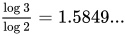
The fractal dimension of the boundary equals .
Using mathematical induction one can prove that for each n ≥ 2 the number of new squares that are added at stage n equals .

The T-Square and the chaos game
[edit]The T-square fractal can also be generated by an adaptation of the chaos game, in which a point jumps repeatedly half-way towards the randomly chosen vertices of a square. The T-square appears when the jumping point is unable to target the vertex directly opposite the vertex previously chosen. That is, if the current vertex is v[i] and the previous vertex was v[i-1], then v[i] ≠ v[i-1] + vinc, where vinc = 2 and modular arithmetic means that 3 + 2 = 1, 4 + 2 = 2:

If vinc is given different values, allomorphs of the T-square appear that are computationally equivalent to the T-square but very different in appearance:
 |
 |
T-square fractal and Sierpiński triangle
[edit]The T-square fractal can be derived from the Sierpiński triangle, and vice versa, by adjusting the angle at which sub-elements of the original fractal are added from the center outwards.
 |
See also
[edit]- List of fractals by Hausdorff dimension
- The Toothpick sequence generates a similar pattern
- H tree
References
[edit]- ^ a b Dale, Nell; Joyce, Daniel T.; and Weems, Chip (2016). Object-Oriented Data Structures Using Java, p.187. Jones & Bartlett Learning. ISBN 9781284125818. "Our resulting image is a fractal called a T-square because with it we can see shapes that remind us of the technical drawing instrument of the same name."
Further reading
[edit]- Hamma, Alioscia; Lidar, Daniel A.; Severini, Simone (2010). "Entanglement and area law with a fractal boundary in topologically ordered phase". Phys. Rev. A. Vol. 82. doi:10.1103/PhysRevA.81.010102.
- Ahmed, Emad S. (2012). "Dual-mode dual-band microstrip bandpass filter based on fourth iteration T-square fractal and shorting pin". Radioengineering. 21 (2): 617.