


Talk:Quantum eraser experiment
 | This article is rated C-class on Wikipedia's content assessment scale. It is of interest to the following WikiProjects: | ||||||||||
| |||||||||||
.jpg)

External link[edit]
I read the entire external link article "A Scientific American article: A Do-It-Yourself Quantum Eraser" and there was no "do it yourself" experiment instructions.. perhaps consider renaming or removing the link. I was quite disappointed when I discovered there really is no "at home" experiment. —Preceding unsigned comment added by 71.112.198.228 (talk) 08:45, 5 May 2008 (UTC)
- Really? I've read the article and the description of how to make the apparatus. The way the article is written you have to jump around to lots of different sub-pages. Scientific American also seems to have a policy of gradually chopping away at their on-line articles. Maybe it is gone by now. I'll see what I can find out. P0M (talk) 20:57, 5 May 2008 (UTC)
- Dig deeper. Start at http://www.sciam.com/slideshow.cfm?id=a-do-it-yourself-quantum-eraser and enlarge all images.P0M (talk) 20:20, 10 May 2008 (UTC)
- Still there in Sept 2015. Its awesome! 67.198.37.16 (talk) 16:41, 24 September 2015 (UTC)
Interference not restored?[edit]
>>An event that is remote in space and in time can restore the readily visible interference pattern that manifests itself through the constructive and destructive wave interference<< This must be wrong, it implies signalling. As far as I know the interference pattern is not readily visible, but can only be seen in correlations between the detectors.```` — Preceding unsigned comment added by 86.11.41.83 (talk) 07:34, 4 February 2013 (UTC)
This page really is very unclear. It needs to be rewritten. I can try doing it if I have a chance. 12:10 30 Oct 2008.
- It would be helpful if you described here what parts of the article seem unclear to you and why you find them unclear. P0M (talk) 01:16, 1 November 2008 (UTC)
- What is wrong is that the quantum eraser experiment only brings back the interference conditioned on the measurement of the entangled partners. The way it is written, it sounds like the interference is brought back unconditionally, which is wrong. —Preceding unsigned comment added by PWS 19:28, 8 November 2008 (UTC)
- Please be more explicit, and, if possible, more concrete. I really have no idea of what you are talking about even though I understand all of the words. Are you saying that interference phenomena is some part of the entire apparatus (which part?) is restored and yet the interference phenomena in another part of the apparatus (which part?O are not restored?
- If that is what you are saying you will need to supply adequate citations to support your claim.
- My citation: the last three paragraphs of the Scientific American article this page is based on. Also, if you look at the original Phys. Rev. A article cited in the Wikipedia page, it says “one can erase the which-path information and recover interference by correlating the particle detection with an appropriate measurement on the which-path markers.″ The idea that you need to correlate (or condition) the particle detection to recover the interference is completely missing from the Wikipedia article. Peterwshor (talk) 02:42, 10 November 2008 (UTC) PWS
- I see the feature of the experiment you are talking about. I've worked through the problem before but will have to refresh my memory. As I recall, the requirements for correlations, etc., are basically artifacts of the experimental design and do not imply anything significant about the reality of "erasure." Actually, the term "erasure" is an unfortunate choice of words because what actually happens is that a marking process such as changing the polarization of a beam of light is, in effect, reversed by another change introduced into the light path.
- In order to understand the experiment completely you need to work through all of the polarity changes. The reason that the coincidence counter has to be involved is because the "erasure" procedure actually creates two groups of photons with the possibility of self-interference, and so the experiment needs to sort the two groups out. The interference phenomena occur regardless of whether the experimenter can see them or whether they are "smeared out" as they are in this experiment minus the correlation counter. If the article is going to talk about that fact, then it needs to specify the polarizations of photons at various points in their passages through the apparatus. I think I can see how to do this in a schematic way. I suppose it would be worth the effort. P0M (talk) 06:14, 11 November 2008 (UTC)
- There are several phase changes and polarization changes involved. The result is that one process of polarization puts whatever passes through slit A at odds with whatever passes through slit B, making it impossible for them to interfere. But the means chosen to get polarizations back to compatiblity is not a simple reversal. If we call "A" the polarization state of one photon and "A'" the polarization state of its entangled twin, then when the photon in the lower part of the apparatus goes through the slits it does so as components that have been differently polarized by quarter wave plates 1 and 2. So A -> B and C. B and C cannot interfere because they are crossed. Then another kind of polarization is performed, this time on the twin photon in the upper path and A' becomes Z or Z' depending on the orientation chosen for the polarizer. Because the photons are entangled, the twin in the lower path undergoes another change in polarization depending on the experimenters' just-mentioned choice. In one orientation, half of the photons arriving at the movable detector at the end of the s path are restored to mutual polarizations and an interference fringe is present. In the other orientation of the top polarizer the other half of the photons at the end of the s path that are restored to mutual polarizations form another interference pattern, but it is out of phase with the previous one. All of this stuff happens, and all of the interferences are there, regardless of whether they are immediately observable to the experimenter. For instance, if the flux of photons that pass through the BBO and are down-shifted in frequency and then make it through the double slit apparatus is not great, the resulting interference pattern could be washed out by ambient illumination and/or by other extraneous photons. The experimental design shows that the experimenters had to take steps to sort out a rather faint signal. There are filters that pass the exact frequency of the down-shifted photons and absorb other frequencies, and the detection "screen" is actually a highly sensitive device that has to be scanned across the area of space where the interference pattern is expected. In addition, since only half of the photons get through in a state to interfere with themselves, not only do the other half of them have to be sorted out by coincidence counting, but the experimenters double the time the detection device pauses at each of its stations as it is moved by the steeping motor.
- There appear to be several reasons for the coincidence counter's use. First, as just noted, half the entangled photons get through with crossed polarization and the other half get through with the same polarization, interfere, and create a fringe. That fringe will tend to get washed out by the entangled photons that get through and also by any photons that are not entangled. There could also be noise in the system, even electrical noise in the detector that also needs to be cleaned up. Noting the coincidences and sorting out the photons that have been once again permitted to interfere with themselves is not essential to the restoration of interference (the "erasing" of which-path information), but it is essential to sorting out those photons on which "erasure" has been effective from photons that needed to have received a different change in polarization to "erase" their which-path information. P0M (talk) 02:07, 14 November 2008 (UTC)
And it really is wrong[edit]
Rewrite[edit]
Ouch. I just had a look at the article and the fundamental statement of how the experiment works was wrong from the time it was written. Let's get it right this time.
The quantum eraser experiment is a double-slit experiment in which particle entanglement and selective polarization is used to determine which slit a particle goes through by measuring the particle's entangled partner. This entangled partner never enters the double slit experiment. Earlier experiments with the basic Young double-slit experiment had already determined that anything done to discover by which path (through slit a or through slit b) a photon traveled to the detection screen would destroy the interference effect that is responsible for the production of interference fringes on the detection screen.
It should be:
The quantum eraser experiment is a variation of Young's double slit experiment that established that when a photon is acted upon in any way that permits determining which of the slits it has transited then it cannot interfere with itself. When a stream of photons is marked in this way, then the characteristic interference fringes characteristic of the Young experiment will not be seen. The quantum eraser experiment demonstrates that it is possible to create situations in which a photon that has been "marked" so as to enable determination of which of two slits it transited in order to reach a detection screen can later be "unmarked." A photon that has been so marked cannot interfere with itself. But a photon that has been marked and then unmarked can interfere with itself. When a stream of photons has been marked and then unmarked it can once again produce the fringes characteristic of the Young experient. The experiment has three phases:

In the first phase, pairs of entangled photons are created using a BBO device. The entangled photons are polarized and diverge in two directions from the point of their creation. Those that go down the lower path in diagram 1 encounter a double slit and then are picked up using a sensitive scanner that sweeps across the interference pattern that they produce when they interfere with themselves. The number of photons at each step along the way is recorded, and the list thus produced is graphed. The graph shows a standard interference pattern. In principle the same procedure could be followed with the photons proceeding along the upper path as there is nothing that distinguishes the two streams of photons insofar as their suitability for demonstrating self-interference.

In the second phase, quarter-wave plates are inserted so that anything that goes through slit A gets its polarization changed into circular polarization in one direction (clockwise or counter-clockwise) and anything that goes through slit B gets th other circular polarization. When the detector device is swept across the region of space where an interference pattern was earlier detected, no such result is observed, and it is as though only one slit were present in the photon path. This result is consistent with the very well tested observation that anything that is done that could detect which path a photon has taken through a double-slit apparatus, anything done that "marks" the path of the photon, will prevent an interference pattern from appearing.

In the third phase, no further changes are made in the lower pathway. Instead, a polarizer is inserted in the upper path so that the entangled twins of any photons going through the lower path are also changed in their polarization. Since the photons in the upper path have had their polarizations changed, the photons in the lower path must undergo the same modifications in their own polarizations. By choosing the appropriate angle of polarization for the upper polarizer, half of the photons in the lower path can be coerced to again have the same polarization. Once they have the same polarization they can interfere with each other again, or, to put it another way, now there is nothing that marks whether each of them went through path A or path B. So they again interfere with each other. The problem for the experimenter is that the other half of the photons in the lower path get their polarizations changed also, but in their case they are still differentiated one from another. Since they have another set of opposed polarizations, they still cannot interfere with each other, or, to put it another way, their "which path" information can still be determined by measuring their polarizations. So they do not interfere with each other. Thus half of the light that reaches the scanning detector consists of non-interfering photons, and the self-interfering photons tend to get lost in the overall pattern of illumination. Fortunately, the experimenters can distinguish the two groups of photons because
only half of the photons will pass through the upper polarizer, and the photons that reach the upper detection screen are the twins of the photons that have their marking polarizations "erased" in the lower path. By rotating the upper polarizer, the experimenters can select either the photons that have clockwise or counter-clockwise polarizations to "erase" and thus restore their ability to interfere with themselves. Whichever group the experimenters select will self-interfere, but the other photons will not self-interfere and their presence in the scanning photon detector will tend to wash out the interference fringes. However, the coincidence detector can match the photons that actually reach the upper detector with their "restored" twins in the lower path. The unmatched photons can be deleted from the electronic record and then when the numbers of photons detected are graphed the Young fringe pattern emerges.
Because of the way the polarizers affect light as they are shifting it from one mode of polarization to another mode of polarization, the two groups of photons that can be "restored" in the lower path will be 180 degrees out of phase with each other. The result is that the Young fringes for the two groups will be flipped left to right.
I think I've got it right now. Anybody see any problems? P0M (talk) 03:28, 15 November 2008 (UTC)
And it's still wrong[edit]
Or at least very misleading.
I am working on a rewrite incorporating the following complaints; I will add it here when I am finished. The short version is that what you see on the screen never actually changes, even when interference is restored. If this were not true, the experiment would violate causality, as you could, for example, send messages in Morse code from the future to the past by either erasing or not erasing the information, which would cause the pattern at the screen to change when the original photons arrived at the screen. When the information is 'erased', what is actually changing is the correlation between the photon which enters the double-slit experiment and the one which does not (for simplicity I will refer to this second photon as the 'non-interacting photon', even though that's probably horrible terminology). In the 'erased', restored interference case, we can get the following measurements results: |R, +45> (Double-slit photon spin right circular, non-interacting photon spin +45 degrees), |R, -45>, |L, +45>, or |L, -45>. If we get |—,+45> then we have no way of knowing whether the photon went through the upper or lower slit; similarly if we get |—,-45>. However this misses a subtlety - the interference pattern for the |—,+45> case is opposite that of the |—,-45> case in that where one has bright fringes, the other has dark fringes and vice versa. The effect is such that when the two are added together, no overall change is observed at the screen. This is supported by the external link *A more technical analysis of the quantum eraser experiment and by a careful reading of the other sources (which also seem to gloss over this point).
This is a confusing enough concept that it might be worthwhile to devote a specific section of the page to it, explaining how this experiment does not violate all physics as we know it (it mystified me for a good few days when I first came across the Scientific American version, and again for a few hours when I read Wikipedia's slightly different version about a week ago).
EDIT: I see this has already been addressed somewhat: P0M stated that
As I recall, the requirements for correlations, etc., are basically artifacts of the experimental design and do not imply anything significant about the reality of "erasure."
and
The interference phenomena occur regardless of whether the experimenter can see them or whether they are "smeared out" as they are in this experiment minus the correlation counter.
which would contradict my argument, but which I find to be highly implausible for the causality-breaking reasons I mentioned earlier. P0M, do you have a reference for your claim that no correlations need to be present in the experiment? Or at least an argument of your own?
I suspect some of the confusion may stem from the fact that the article is dealing with the delayed-choice quantum eraser. I have not seen a version of the experiment which would not permit delayed choice, but I suspect it is only those versions which would not require correlation. 74.69.50.116 (talk) 05:38, 14 October 2012 (UTC)
Needed additional elements[edit]
- The article already cited, http://grad.physics.sunysb.edu/~amarch/, makes the useful observation that:
One can wonder then, if this perplexing behavior is just due to a disturbance between the "which-way" detector and the photon. The detector might be changing something about the photon which causes it to get off course to its position in the interference pattern. The answer is, as the experiment described in the next section shows, that this is not the case. A "which-way" detector can be designed that in no way disturbs the photon and the same phenomenon is observed.
- The article makes another observation: That since the polarization of the entangled photon in the upper part of the apparatus must be changed according to the way that its twin in the lower part of the apparatus is changed, it is possible to learn of the polarity of the lower-path photon by measuring the polarity of the upper path photon. So one can know the polarity of any lower path photon -- but this just assures in another way that the lower path photon cannot interfere with itself. The factor that "marks" the photons in the lower path is shown to be related to the polarity imposed by the quarter-wave plates, and there is no evidence for anything additional having occurred in interaction with the double-slit apparatus to disturb the photon and make it therefore unable to interfere with itself. When a polarizer is added in the upper path with the result that interference is again possible and the characteristic Young fringes appear, it is even more clear that the state of polarization of the light is the only factor that is influencing whether a photon can interfere with itself. P0M (talk) 08:11, 15 November 2008 (UTC)
- A third point is made in the website article and in the original article upon which it was based: By increasing the length of the path between the BBO and the upper polarizer, the changes made in the behavior of the photons in the lower path that are depending on the changes induced by the upper polarizer will still occur. Paradoxically, photons will be detected at Ds at time t, and their twin entangled photons will only encounter the upper polarizer at some later time t+m. Nevertheless, the phenomena observed at Ds will be in accord with the changes imposed upon them at a later time by the upper polarizer. This result has given rise to questions about whether the cause of some event can occur after the event has occurred. P0M (talk) 08:24, 15 November 2008 (UTC)
Cleanup-section: Introduction[edit]
User:Diza added a {{Cleanup}} tag on October 31, 2009, but formatted it wrong, including the criticism "messy, repetitive and lacks a coherent overview" as part of the tag. I am correcting the tag and adding this section to record the criticism for cleanup editors. Please direct any questions or comments to User:Diza, not me. Unconventional (talk) 14:37, 12 November 2009 (UTC)
Discrepancy between article and original paper[edit]
While reviewing the article, I noticed a discrepancy between it and the original paper. The paper gives the distance from the photon emitter to the QWPs as 42 cm, and from the photon emitter to the POL1 linear polarizer as 98 cm for the quantum eraser experiment and 2 m for the delayed quantum eraser experiment. (The distance to POL1 in the quantum eraser experiment is not explicitly given, but Fig. 1 in the paper suggests that POL1 is attached or adjacent to detector p.) Thus, the linear polarization in the double-slit path is measured between the slits and detector for the quantum eraser experiment, and after detection of the s photon in the delayed experiment. The article incorrectly describes the linear polarization as being measured prior to the double-slits, and needs to be changed. The dashed line in Illustration 2 repeats this mistake. (Perhaps the mistake was the result of the paper's Fig. 1, in which the p path appears to be shorter than the s path. But the distances given indicate that the figure is not to scale.) Unconventional (talk) 18:21, 12 November 2009 (UTC)
- Are you really talking about the illustrations that go with the Wikipedia article? I guess you must be talking about the original article. By "QWP" you mean quarter-wave plate? P0M (talk) 16:08, 13 November 2009 (UTC)
- I just had a look at the original article again. The wording of that article is a little confusing because it uses the word "behind" -- and whether something is in front or behind depends on the point of view of the observer. In the article's illus FIG 1, the photons hit the quarter wave plates first and then the double slits. That is what is shown on the series of diagrams shown above on the Talk page. The illustration for the actual Wiki article is different, and it is not as clear as it should be what the sequence is. P0M (talk) 20:27, 14 November 2009 (UTC)
- To clarify, I'm talking about two things: (1) The dashed line between the "+" symbols in the article's Illustration 2 suggests that the polarized p photon leaving the linear polarization filter affects the entangled s photon before it enters the quarter wave plates; and (2) the last paragraph of the Experiment section says so explicitly in its third sentence: "the photons heading down toward the double slits will meet the two circular polarizers after having been rotated". This is incorrect. The s photon hits the quarter wave plates and the slits (at 42 cm) before the p photon is linearly polarized (at 98 cm, or 2 m for the delayed erasure experiment). I would correct the text myself, but I'm not too clear on what effect a linear polarizer has on circularly polarized photons (nor vice-versa), and I can't fix the image because I have no means to edit SVG files. Unconventional (talk) 00:34, 15 November 2009 (UTC)
Something missing?[edit]
Isn't there something missing from the original paper? Just as the polarization of the p photon by POL1 coerces the polarization of the s photon after the slits, the polarization of the s photon by the QWPs must affect the polarization of the p photon before it gets to POL1. (But how? If s goes through both QWPs, would the complementary polarizations cancel out?) It seems to me that wasn't addressed in the paper, unless it's covered by the math (which I'm too dumb to follow). I can't guess what effect this would have on interpretation. Is there peer review criticism that should be added to the article? Unconventional (talk) 19:22, 12 November 2009 (UTC)
Use of future tense in description of experiment?[edit]
As an interested amateur I have recently read a number of standard non-academic works on elementary particle physics (e.g. Q is for Quantum by John Gribben, The Particle Garden by Gordon Kane). I am now exploring aspects of these books via Wikipedia and in the process have come to admire the clarity of many of the relevant physics articles. These seem to follow a fairly standard format, at least as far as those dealing with well known experiments, e.g. Double-slit experiment, and Delayed choice quantum eraser. That is to say, the experiment itself is generally described in the present tense, such that the wording could be used as a recipe for repeating the experiment, while the outcome is set in the past tense, describing what the original experimenters actually observed. In this article, however, the tense in the penultimate paragraph of the section entitled The experiment (beginning 'Next, in an attempt...') the tense suddenly switches to the future, and this tense is carried on throughout this and the final paragraph ('The next progression in the setup will...'). To me this reads as though it is describing some future experiment which could be conducted as an extension to the experiment which has already been described, together with a prediction of what might be observed as the outcome of such a future experiment. My point is not one of semantics, nor philosophy (and not pedantry I hope) merely an attempt to get clarity of concepts that for all of us (including Richard Feynman) are very difficult to grasp. I suspect that the wording should in fact be in the present tense, consistent with the earlier paragraphs describing the experiment. However, the fact that no one else appears to have raised this point makes me wonder if this is in fact based upon my own fundamental mis-understanding hence my reluctance to be bold and make the edits myself. Inspeximus (talk) 16:13, 17 January 2010 (UTC)
Violate causality?[edit]
Can you use this to violate causality? At one end, someone decides whether or not to stick a polarizer in front of a stream of one part of entangled pairs, and at the other end someone checks for an interference pattern. Doesn't one end know whether or not the other end used the polarizer, no matter their distance? --68.161.167.116 (talk) 14:51, 30 March 2010 (UTC)
- The whole subject of causality is fairly well saturated with conceptual difficulties. In common speech we tend to say things like, "She then lit a match, which caused the "empty" gasoline tank to explode." In other words, we pay attention to a sort of trigger event and ignore the fact that the tank once had gasoline in it, it had been drained, and in that process it had filled mostly with air from the outside, that vaporized gasoline remained and was mixed with the oxygen and other components of the atmosphere, etc.
- There have indeed been discussions about whether quantum entanglement could be used to produce events that occur out of the expected time sequence. In the case above, the striking of the match, if it occurs first, is called the cause. If, however, the tank exploded as an unlighted match was being brought close to the open valve or inspection port of the tank, we would not call the match the cause of the explosion. We would conclude that the heat of the gasoline explosion ignited the match.
- The temporal anomalies that lurk in this experiment occur if the length of the photon path in the top half of the diagram is enough longer than the path in the bottom half, so that the photon that hits the detection screen in the bottom part of the diagram gets there and discloses whether it interferes with itself or not, and does so at a time before its entangled twin can have been polarized (or not polarized) in the upper path.
- As for knowing whether a polarizer was used in the upper branch or not, it actually doesn't matter. The experimenters could even prearrange which runs of the experiment would have the upper polarizer and which runs would not. You and I could agree whether you would or would not throw the circuit breaker in the basement that controls my ceiling light. I would not be surprised if you said that you would turn my lights on at 2 a.m., and they did turn on at that time. However, if you promised to turn the lights on at 12, 2, 4, and 6 and my lights turned on by themselves at 11:55, 1:55, 3:55, and 5:55, I would suspect you of playing a practical joke on me or of having set your watch wrong. If I then verified, somehow, that you threw the switches when you said you did, I would be totally freaked out.
- What I have not seen are experiments that do not use entangled photons, that use just a regular double-slit experiment with the exception that the experimenters can arrange to open or close one or both of the slits after the photon has passed that point in the experiment but before it reaches the detection screen. If one could create a self-interfering photon by closing the barn door after the horse were loose, then I'd really be impressed.P0M (talk) 01:40, 31 March 2010 (UTC)
- There's a much much much simpler answer, and it has to do with the coincidence counter. Without the coincidence counter, there is no interference pattern. If you had a 100% perfect photon detector, you'd still have a 50% detection rate cause the upper polarizer discards 50% of the photons. You would have to convey these classical bits of information to the other party, at sub-light-speed, in order for the interference pattern to be seen. The SciAm home-made eraser article, up top, illustrates this very clearly. 67.198.37.16 (talk) 17:00, 24 September 2015 (UTC)
"Bizarre effect"[edit]
The final sentence of the introduction:
| “ | Doing so appears to have the bizarre effect of determining the outcome of an event after it has already occurred. | ” |
This seems to need some clarification. What is so bizarre about determining the outcome of an event after it has occurred? After an event has occurred, one would think that it would be easy to "determine" the outcome of the event. After reading the article on the delayed choice quantum eraser experiment, if I understand it correctly, that sentence should read:
| “ | Doing so appears to have the bizarre effect of changing the outcome of an event after it has already occurred. | ” |
"Changing" (or "altering"), now that would be bizarre, and that would seem to be what they are saying in the "delayed choice" experiment. I will go ahead and change "determining" to "altering", and if anybody contests that, perhaps we can discuss it here? – Paine Ellsworth ( CLIMAX ) 18:30, 19 November 2011 (UTC)
- I'll try to reword it. Your way won't work because it implies that there was first one result and then another result took its place. P0M (talk) 21:21, 19 November 2011 (UTC)
- I changed the text, after a couple day's wait, for the reason mentioned above. P0M (talk) 22:48, 21 November 2011 (UTC)
- Yes, okay... it's still very confusing, but then, it's "bizarre", so I suppose it's supposed to confound, right? Thank you very much for your help, P0M! – PIE, alias: – Paine Ellsworth ( CLIMAX ) 07:07, 22 November 2011 (UTC)
- Nobody is supposed to understand this stuff. What is very hard to argue with is the experimental results and the math that predicts experimental results.
- Dr. John Cramer has done some very interesting work with "retrocausal" physics. See http://www.npl.washington.edu/AV/altvw90.html and also Wheeler's delayed choice experiment.
- One way to look at the version of the Wheeler experiment, i.e., the one that speaks of what would happen if a photon from a star hit a gravitational lens on its way to earth and had a 50-50 chance of going around the black hole causing the lens effect, is to say that the photon either goes by the left route or by the right route, and that it doesn't decide which way to take until somebody in a lab on earth decides which way to intercept ("measure") the photon. Another way is to say that something goes both ways, and the two versions of the "something" arrive in the earth lab and are either resolved so that they appear to come either by the left or the right route (the particle "materialization" of the "ghost(s)" or "somethings") or they are resolved so that they are directed onto the same detection screen (making it impossible to tell anything about which path the photon "really" traveled) and so an interference effect occurs. According to the first way, a decision to perform one experimental measurement or the other will "retroactively" decide something that happened tens of thousands of years ago when the photons involved hit the gravitational lens and had to decide whether to turn left or turn right to go around the black hole. According to the second way, all those many years ago the photons-in-flight simply went both ways, and the choice by earth scientists of today determined which way to deal with these "double-ghosts."
- Dr. Gunn Quznetsov's interpretation of quantum physics (http://www.china-learn.info/Science/Event-probability%20interpretation.html) is easier for me to understand and "deal with" than some of the others. He gives a reasonable way to think about what I call the "quantum double-ghosts."
- The quantum eraser experiments that use entangled photons are the most difficult for me to deal with. The temporal sequences seem impossible to explain away. I think Cramer has the same feeling about those experiments, and he has attempted to make an experiment that would permit something like instantaneous communication between, e.g., Earth and Mars. It's the ansible of Orson Scott Card's Ender's Game" all over again. But he has been quiet about results for the last few years.P0M (talk) 14:02, 22 November 2011 (UTC)
Proposed update[edit]
Since P0M and I seem to disagree on whether the correlation is inherent in the physics I am posting my proposed update here first. I should probably update the 'up'/'down' and 'left'/'right' notation to reflect the actual directions used in the experiment, and maybe look for some pictures to help with the explanation.
74.69.50.116 (talk) 05:57, 14 October 2012 (UTC)
The quantum eraser experiment is a variation of Thomas Young's classic double-slit experiment. It establishes that when a photon is acted upon in a fashion that allows which slit it has passed through to be determined, the photon cannot interfere with itself. When a stream of photons is marked in this way, then the interference fringes characteristic of the Young experiment will not be seen. This experiment displays the capability to create situations in which an entangled photon pair, ‘marked’ to expose through which slit one photon has passed, can later be ‘unmarked’ by manipulating the second photon which did not enter the double slit apparatus. The double-slit photon in the 'marked' pairs cannot interfere with itself and will not produce fringe patterns, but the corresponding photon in a photon pair that has been 'marked' and then 'unmarked' can interfere with itself and will produce the fringes characteristic of Young's experiment.
This experiment involves an apparatus with two main sections. After two entangled photons are created, each is directed into its own section of the apparatus. It then becomes clear that anything done to learn the path of the entangled partner of the photon being examined in the double-slit part of the apparatus will influence the second photon, and vice-versa. The experimental apparatus is so constructed that at some point between the double slits and the detection screen (or between a beam splitter that also creates two paths for photon travel and thus the possibility of interference) a change in the apparatus can be made that either maintains separation of the two paths or else runs them together. If the two paths are kept separate, no interference phenomena will be observed. However, if the two paths are reunited then it becomes impossible to determine by which single path a photon might have arrived after the reunion. (Imagine an Interstate highway that takes a northern path around a city, I-1000 North, and a southern path around the city, I-1000 South. While a car is north of the city it is clear that it has traveled by way of I-1000 North, but after its path merges with traffic from I-1000 South neither it nor any other car can be identified as having gone north or south of the city.)
The advantage of manipulating the entangled partners of the photons in the double-slit part of the experimental apparatus is that experimenters can destroy or restore the interference pattern in the latter without changing anything in that part of the apparatus. Experimenters do so by manipulating the entangled photon, and then correlating a measurement of the entangled photon with a measurement of its partner in the double-slit experiment. They can do so before or after its partner has entered or after it has exited the double-slits and other elements of experimental apparatus between the photon emitter and the detection screen.
The entangled photon can be measured, very simplistically, as ‘up’ or ‘down’, while the double-slit photon is measured as ‘left’ or ‘right’. When no interference is present, an ‘up’ measurement gives information on which slit the double-slit photon has passed through (slit 1 if the double-slit photon returned ‘right’, slit 2 otherwise), and a ‘down’ measurement gives similar information (slit 1 if the double-slit photon returned ‘left’, slit 2 otherwise). When interference is restored, an ‘up’ measurement combined with a ‘left’ or ‘right’ measurement gives no information about which path the double-slit photon took, and neither does a ‘down’ measurement. The set of double-slit photons whose partners had ‘up’ measurements produces an interference pattern, as does set of double-slit photons whose partners had ‘down’ measurements. Overall though, the ‘up’ and ‘down’ measurements provide opposing interference patterns, so that an observer at the screen with no knowledge of the measurements would see no change – it is only by separating the photons into groups by measurement result that an interference pattern is restored.
So, under conditions where the double-slit part of the experiment has been set up to prevent the creation of interference phenomena (because there is definitive "which path" information present), the quantum eraser can be used to effectively erase that information. In doing so, the experimenter restores interference without altering the double-slit part of the experimental apparatus. An event that is remote in space and in time can restore the readily visible interference pattern that manifests itself through the constructive and destructive wave interference. The apparatus currently under discussion does not have any provision for varying its time parameters, however.
A variation of this experiment, delayed choice quantum eraser, allows the decision whether to measure or destroy the "which path" information to be delayed until after the entangled particle partner (the one going through the slits) has either interfered with itself or not. Doing so appears to have the bizarre effect of causing the outcome of an event (whether or not the double-slit photon interfered with itself) after the event has already occurred. In other words, something that happens at time t apparently reaches back to some time t - 1 and acts as a determining causal factor at that earlier time.
Diagram is confusing[edit]
I am having a devil of a time understanding the diagrams in the article. Where do the photons come from and which direction are they moving? It seems in need of improvement, especially compared to the much more clear delayed choice quantum eraser diagram. Ranatoro (talk) 18:11, 25 March 2013 (UTC)
- I tried to improve the image. Unfortunately, Inkscape frequently tries to mess up the arrowheads. It looks fine on my computer, and then when it comes back via Wikipedia and the web the arrowheads are rotated. No time to try to fix things now.P0M (talk) 01:35, 27 March 2013 (UTC)
Request to delete[edit]
I have a request to delete this article. I have transferred the information to the Delayed choice quantum eraser where I merged it with other simular experiments. I think it is no useful to have a special article about one experiment. DParlevliet (talk) 16:18, 28 January 2014 (UTC)
- I disagree with most of your changes. See the recent comment by a physicist regarding the article that you have made many severe changes in.P0M (talk) 02:06, 31 January 2014 (UTC)
Please read what you offer as proof[edit]
I have deleted the recent change be DParlevliet. The citation (http://arxiv.org/pdf/quantph/9501016 ) offered as justification mentions "this experiment," but the experiment being discribed is not this one. Such irresponsible claiming of evidence to change an article without prior discussion and agreement is disruptive.P0M (talk) 17:17, 7 March 2014 (UTC)
polarised at birth[edit]
We all know the two polarised slit experiment, that the polarization lenses are on both or one slit.
We must make the classic two slit experiment, but now the polatization glass should be not in two slits, but in the electron gun itself, and the other experiment will be without detectors and polarizers, also the slits will be as in the classical experiment, undisturbed.
Then we will rotate the polarizing glass of the electron gun or the lazer if we make that experiment with light.
Polarization on the lazer gun, and rotation of the polarizing glass
has no effect on the quantum interference results. Neither the rotation of the polarized glass.
We have to see that. It will be boring, because mathematically it will be same as the classic one,
but we have to do it still — Preceding unsigned comment added by 2.84.206.251 (talk) 16:21, 14 July 2014 (UTC)
External links modified[edit]
Hello fellow Wikipedians,
I have just added archive links to one external link on Quantum eraser experiment. Please take a moment to review my edit. If necessary, add {{cbignore}} after the link to keep me from modifying it. Alternatively, you can add {{nobots|deny=InternetArchiveBot}} to keep me off the page altogether. I made the following changes:
- Added archive http://web.archive.org/web/20071015191251/http://www.sciam.com/article.cfm?chanID=sa006&articleID=DD39218F-E7F2-99DF-39D45DA3DD2602A1&pageNumber=1&catID=2 to http://www.sciam.com/article.cfm?chanID=sa006&articleID=DD39218F-E7F2-99DF-39D45DA3DD2602A1&pageNumber=1&catID=2
When you have finished reviewing my changes, please set the checked parameter below to true or failed to let others know (documentation at {{Sourcecheck}}).
 An editor has reviewed this edit and fixed any errors that were found.
- If you have discovered URLs which were erroneously considered dead by the bot, you can report them with this tool.
- If you found an error with any archives or the URLs themselves, you can fix them with this tool.
Cheers.—cyberbot IITalk to my owner:Online 18:39, 29 February 2016 (UTC)
The many Quantum Erasers experiment, and why you can't win the lottery[edit]
Some people prefer the "many Quantum Erasers experiment". Some European lotteries have 7 numbers to find, and all are decimal numbers. Because the classic Quantum Eraser doesn't win you a lottery, people tried mentally to create a 0/1 system, so you don't try to read many data,simply if the experiment was interfered or not. Thus you analyze each decimal number to a longer binary, and thus you need many different setups to reveal one digit - interference or non interference - not many data exist in each setup, thus you express any possible number via many simple on-off binary states of separate setups lined in order.
Of course it doesn't work for the same reasons. It is as silly as the original experiment, so of course we have to mention it because we mentioned the one setup version.
they tried mentally to look for other artifacts, but no meaningful artifacts were found, no data could be transferred - this is also a mental experiment, because freezing particles is a hard job and we always distort their initial state — Preceding unsigned comment added by 2.84.220.137 (talk) 01:16, 10 October 2016 (UTC)
"without disturbing its wavefunction"?[edit]
Right in the introduction, step two was "the experimenter marks through which slit each photon went, without disturbing its wavefunction". This is just wrong, you can't mark the slit without disturbing the wave-function. No matter what your interpretation of quantum mechanics, a measurement does disturb the wave function; that's why there is which way/interference complementarity. I just removed "without disturbing its wavefunction", because now at least it's not wrong, but the description is still misleading. It suggests that somehow the which-slit information is somehow already there and all one has to do is to "mark" the slit. The point is that, to know through which slit the photon went, one has to perform an active measurement, coupling the photon with something else, and that's what destroys interference. This article needs some re-working. — Preceding unsigned comment added by 130.102.82.120 (talk) 22:15, 15 February 2017 (UTC)
- We need an article on The strong baseball principle as described by Mermin here. The result is that you have to be very careful about what you say about events, especially ones that could have happened but didn't. Gah4 (talk) 10:55, 8 August 2020 (UTC)
Non-locality and the style of the article[edit]
As many have pointed out in this talk page before, the style of the article is not Wikipedia's summary style but instead written like a personal essay. This leads to some far-fetched proclamations, such as evidence of non-locality. I don't feel like delving into Wikipedia's cesspit of quantum physics "inaccuracies", but I feel at least like pointing this one out. Bright☀ 15:50, 28 July 2017 (UTC)
Fix incorrect description of experiment[edit]
The current description states that circular polarizers in front of each slit were used in discussed experiment. However, it's clearly visible from the original article or figures (1,2) that only quarter-wave plates were used. It's quite important because photons passed through crossed polarizers can't produce interference pattern. I propose the following changes, but as my native language is not English, please have a look and correct the language if needed. The biggest part of "Non-locality" section is also removed as it's explaining the experiment basing on wrong understanding of setup. I didn't find the source of it's calculations either.
@@ -59,77 +59,16 @@ In delayed-choice experiments quantum effects can mimic an influence of future a First, a photon is shot through a specialized nonlinear optical device: a beta barium borate (BBO) crystal. This crystal converts the single photon into two entangled photons of lower frequency, a process known as spontaneous parametric down-conversion (SPDC). These entangled photons follow separate paths. One photon goes directly to a detector, while the second photon passes through the double-slit mask to a second detector. Both detectors are connected to a coincidence circuit, ensuring that only entangled photon pairs are counted. A stepper motor moves the second detector to scan across the target area, producing an intensity map. This configuration yields the familiar interference pattern.

Next, a circular polarizerquarter-wave plate (QWP) is placed in front of each slit in the double-slit mask, producing clockwise circular polarization in light passing through one slit, and counter-clockwise circular polarization in the other slit (see(assuming vertical/horizontal possible polarizations of entangled photons, see Figure 1). ThisThe difference of polarization is measured at the detector, thus "marking"for each after-slit-path "marks" the photons and destroyingthus destroys the interference pattern at the detector (see Fresnel–Arago laws).
Finally, a linear polarizer at 45° angle to the vertical axis is introduced in the path of the first photon of the entangled pair, giving this photon a diagonal polarization (see Figure 2). Entanglement ensures a complementary diagonal polarization in its partner, which passes through the double-slit mask. This alters the "marking" effect of the circular polarizers:quarter-wave plates: each will produce a mix of clockwise and counter-clockwise polarized light. Thus the second detector can no longer determine which path was taken, and the interference fringes are restored.
A double slit with rotating polarizers can also be accounted for by considering the light to be a classical wave.[1] However this experiment uses entangled photons, which are not compatible with classical mechanics.
Non-locality
A very common misunderstanding about this experiment is that it may be used to communicate information instantaneously between two detectors. But you must take into consideration the above coincidence detector. The linear polarizer in the top path is effectively filtering out half the entangled photons, and via the coincidence detector, is filtering out the corresponding photons in the bottom path. The coincidence detectors can only communicate classically.
Imagine Alice on the first detector measuring either linearin presence or circular polarizationabsence of linear polarizer and instantaneously affecting the result of Bob's interference measurement. One could even conceive a situation in which Alice would switch from a circular polarizer toremove a linear polarizer onin front of her detector long after Bob made his measurement: Bob's interference pattern would suddenly change from interference to a smear - but in the past. Following this train of thought would lead to an abundance of time paradoxes, like Bob measuring one pattern and telling Alice to switch her detectorinsert or remove the polarizer in the future to the polarizerso that it would cause the opposite pattern. So something must be wrong.
The misunderstanding is that Bob always measures a smear, never an interference pattern, no matter what Alice does. Only after Alice informs Bob at which time her detector clicked and he filter the corresponding counts (coincidence detection), the interference pattern will appear in the filtered data (in the linear polarizer's case). In this case filtered/left over counts form interference pattern/antipattern correspondingly and there is no way to separate them without knowing data from Alice's detector. Non-locality manifests in a somewhat more subtle way. How? Let's say that the BBO crystal produces the following state:

(Alice's photon has clockwise polarization and Bob's photon has anti-clockwise polarization) or (Bob's photon has clockwise polarization and Alice's photon has anti-clockwise polarization)
If Alice places a circular polarizer in front of her detector that filters out photons with clockwise polarization, then every time Alice measures a photon, Bob's corresponding photon is sure to have a clockwise polarization:

Since Bob has placed opposite polarization filters on each slit, we know that these photons can only have passed through (let's say) the first slit. From that slit, they hit the screen according to the wave-function:
![{\displaystyle f_{1}(x)={\frac {1}{\sqrt {2\pi {\sqrt {d^{2}+(x+a/2)^{2}}}}}}\exp \left[i(h/\lambda ){\sqrt {d^{2}+(x+a/2)^{2}}}\right],}](https://wikimedia.org/api/rest_v1/media/math/render/svg/262327e76ba832b8de00bb7e666f9346c33e260d)
where a is the spacing between the slits, d is the distance from the slits to the screen and x is the distance to the middle of the screen. The intensity of light on the screen (counts of photons) will be proportional to the square of the amplitude of this wave, in other words
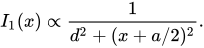
Likewise, when Alice measures a photon with anti-clockwise polarization, Bob receives an anti-clockwise polarized photon which can only pass through the second slit and arrives at the screen with a wave-function
![{\displaystyle f_{2}(x)={\frac {1}{\sqrt {2\pi {\sqrt {d^{2}+(x-a/2)^{2}}}}}}\exp \left[i(h/\lambda ){\sqrt {d^{2}+(x-a/2)^{2}}}\right].}](https://wikimedia.org/api/rest_v1/media/math/render/svg/aff6033e32b15f4685f136786fb8dbdef8050212)
Notice that the only difference is the sign of a/2, because the photon was emitted from another slit. The pattern on the screen is another smear, but shifted by a. Now, this point is important: if Alice never tells him directly, then Bob never knows which polarization Alice measured, since both are produced in equal amounts by the crystal. So what Bob actually sees on his screen is the sum of the two intensities:
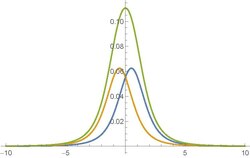

The results of this experiment are summarized in Fig.3. Bob can only distinguish the two peaks in his data after he has had access to Alice's results: for the set of photons where Alice measured clockwise polarization, Bob's subset of photons is distributed according to and for the set of photons where Alice measured anti-clockwise polarization, Bob's subset of photons is distributed according to


Next, let Alice use a linear polarizer instead of a circular one. The first thing to do is write down the system's wave-function in terms of linear polarization states:


So say Alice measures a horizontally polarized photon. Then the wave function of Bob's photon is in a superposition of clockwise and anti-clockwise polarizations, which means indeed it can pass through both slits! After travelling to the screen, the wave amplitude is
![{\displaystyle h(x)={\frac {1}{\sqrt {2}}}\left[f_{1}(x)+f_{2}(x)\right],}](https://wikimedia.org/api/rest_v1/media/math/render/svg/f7eab93156d532bf369c53f87674afd60d4b296a)
and the intensity is

where is the phase difference between the two wave function at position x on the screen. The pattern is now indeed an interference pattern! Likewise, if Alice detects a vertically polarized photon then the wave amplitude of Bob's photon is

![{\displaystyle v(x)={\frac {i}{\sqrt {2}}}\left[f_{1}(x)-f_{2}(x)\right],}](https://wikimedia.org/api/rest_v1/media/math/render/svg/15f312a86519a1963cb59e53d95330256b27087f)
and

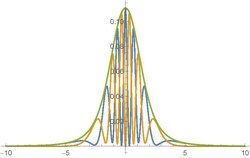
and once again an interference pattern appears, but slightly changed because of the 180º phase difference between the two photons traversing each slit. So can this be used by Alice to send a message to Bob, encoding her messages in changes between the two types of patterns? No! Remember that, as before, if Bob is not told which polarization Alice measured, then all he sees is the sum of both patterns. The result is therefore,


which is again a smudge. The results are given in Fig.4.
So what's so odd about this experiment? The correlations change according to which experiment was conducted by Alice. Despite the fact that the total pattern is the same, the two subsets of outcomes give radically different correlations: if Alice measured a linear polarization the total smear is subdivided into two interference patterns whereas if Alice measured a circular polarization the pattern is the sum of two other Gaussian bell-shapes. How could Bob's photon know that it could go in the forbidden stripes of the interference pattern when Alice was measuring a circular polarization but not when Alice was measuring a linear one? This can only be orchestrated by a global dynamic of the system as a whole, it cannot be locally carried by each photon on its own. This experiment demonstrates the phenomenon of microscopic non-locality.[dubious ] <\div>
See also
31.7.226.106 (talk) 12:54, 25 August 2018 (UTC)
polarization[edit]
I thought the experiment was done with polarization states, which are quantum mechanically equivalent to slits, but physically different. It seems from above that some have figured out that things need to be fixed, but maybe still aren't. I should probably get the original paper before saying more. It is described in the book "Through two doors at once", though. Gah4 (talk) 07:51, 8 March 2019 (UTC)
electrons[edit]
It seems that the whole article is written in terms of photons, but actually has to apply to any entangled (quantum) particles. Specifically, it also applies to electrons. In the case of electrons, it is somewhat easier to detect where one is by shining photons on it. Not so easy with photons. Gah4 (talk) 10:59, 8 August 2020 (UTC)
- ^ Chiao, R Y; Kwia, P G; Steinberg, A M (June 1995). "Quantum non-locality in two-photon experiments at Berkeley". Quantum and Semiclassical Optics: Journal of the European Optical Society Part B. 7 (3): 259–278. arXiv:quantph/9501016. Bibcode:1995QuSOp...7..259C. doi:10.1088/1355-5111/7/3/006.