


Tensor product of algebras
| Algebraic structure → Ring theory Ring theory |
|---|
|
Rings
Related structures
|
|
Commutative rings
p-adic number theory and decimals
|


![{\displaystyle \mathbb {Z} [1/p]}](https://wikimedia.org/api/rest_v1/media/math/render/svg/ab7b4e5c999e46c7614c3264b1d80708f4363433)


In mathematics, the tensor product of two algebras over a commutative ring R is also an R-algebra. This gives the tensor product of algebras. When the ring is a field, the most common application of such products is to describe the product of algebra representations.
Definition[edit]
Let R be a commutative ring and let A and B be R-algebras. Since A and B may both be regarded as R-modules, their tensor product

is also an R-module. The tensor product can be given the structure of a ring by defining the product on elements of the form a ⊗ b by[1][2]

and then extending by linearity to all of A ⊗R B. This ring is an R-algebra, associative and unital with identity element given by 1A ⊗ 1B.[3] where 1A and 1B are the identity elements of A and B. If A and B are commutative, then the tensor product is commutative as well.
The tensor product turns the category of R-algebras into a symmetric monoidal category.[citation needed]
Further properties[edit]
There are natural homomorphisms from A and B to A ⊗R B given by[4]


These maps make the tensor product the coproduct in the category of commutative R-algebras. The tensor product is not the coproduct in the category of all R-algebras. There the coproduct is given by a more general free product of algebras. Nevertheless, the tensor product of non-commutative algebras can be described by a universal property similar to that of the coproduct:
![{\displaystyle {\text{Hom}}(A\otimes B,X)\cong \lbrace (f,g)\in {\text{Hom}}(A,X)\times {\text{Hom}}(B,X)\mid \forall a\in A,b\in B:[f(a),g(b)]=0\rbrace ,}](https://wikimedia.org/api/rest_v1/media/math/render/svg/b41ec985950c28907175a6ed4509acf9d8441bab)
where [-, -] denotes the commutator. The natural isomorphism is given by identifying a morphism on the left hand side with the pair of morphisms on the right hand side where and similarly .




Applications[edit]
The tensor product of commutative algebras is of frequent use in algebraic geometry. For affine schemes X, Y, Z with morphisms from X and Z to Y, so X = Spec(A), Y = Spec(R), and Z = Spec(B) for some commutative rings A, R, B, the fiber product scheme is the affine scheme corresponding to the tensor product of algebras:

More generally, the fiber product of schemes is defined by gluing together affine fiber products of this form.
Examples[edit]
- The tensor product can be used as a means of taking intersections of two subschemes in a scheme: consider the -algebras , , then their tensor product is , which describes the intersection of the algebraic curves f = 0 and g = 0 in the affine plane over C.
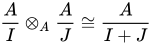
- More generally, if is a commutative ring and are ideals, then , with a unique isomorphism sending to .
- Tensor products can be used as a means of changing coefficients. For example, and .
- Tensor products also can be used for taking products of affine schemes over a field. For example, is isomorphic to the algebra which corresponds to an affine surface in if f and g are not zero.
- Given -algebras and whose underlying rings are graded-commutative rings, the tensor product becomes a graded commutative ring by defining for homogeneous , , , and .
![{\displaystyle \mathbb {C} [x,y]}](https://wikimedia.org/api/rest_v1/media/math/render/svg/bef1bb44559f9eb88d544757f8f49058b6ef3374)
![{\displaystyle \mathbb {C} [x,y]/f}](https://wikimedia.org/api/rest_v1/media/math/render/svg/a49db608a962370acd574119081d254971055766)
![{\displaystyle \mathbb {C} [x,y]/g}](https://wikimedia.org/api/rest_v1/media/math/render/svg/cd663bc5558ac47d38133146155322d11574aa51)
![{\displaystyle \mathbb {C} [x,y]/(f)\otimes _{\mathbb {C} [x,y]}\mathbb {C} [x,y]/(g)\cong \mathbb {C} [x,y]/(f,g)}](https://wikimedia.org/api/rest_v1/media/math/render/svg/e97846c36dacf193ba03073a393a14c33b41d417)




![{\displaystyle \mathbb {Z} [x,y]/(x^{3}+5x^{2}+x-1)\otimes _{\mathbb {Z} }\mathbb {Z} /5\cong \mathbb {Z} /5[x,y]/(x^{3}+x-1)}](https://wikimedia.org/api/rest_v1/media/math/render/svg/a34549691ae9c0baa843a32b369abd8c4490189d)
![{\displaystyle \mathbb {Z} [x,y]/(f)\otimes _{\mathbb {Z} }\mathbb {C} \cong \mathbb {C} [x,y]/(f)}](https://wikimedia.org/api/rest_v1/media/math/render/svg/4a28a99538d462372760b9adc944af0018ef2df0)
![{\displaystyle \mathbb {C} [x_{1},x_{2}]/(f(x))\otimes _{\mathbb {C} }\mathbb {C} [y_{1},y_{2}]/(g(y))}](https://wikimedia.org/api/rest_v1/media/math/render/svg/0d87d8ea3c128cf7395d5c4379225bdc44ea20da)
![{\displaystyle \mathbb {C} [x_{1},x_{2},y_{1},y_{2}]/(f(x),g(y))}](https://wikimedia.org/api/rest_v1/media/math/render/svg/4b44e54f2d54cbc7c3ecd0562f84915bac37c55d)





See also[edit]
- Extension of scalars
- Tensor product of modules
- Tensor product of fields
- Linearly disjoint
- Multilinear subspace learning
Notes[edit]
References[edit]
- Kassel, Christian (1995), Quantum groups, Graduate texts in mathematics, vol. 155, Springer, ISBN 978-0-387-94370-1.
- Lang, Serge (2002) [first published in 1993]. Algebra. Graduate Texts in Mathematics. Vol. 21. Springer. ISBN 0-387-95385-X.