


Thrupp & Maberly

Thrupp & Maberly was a British coachbuilding business based in the West End of London, England. Coach-makers to Queen Victoria they operated for more than two centuries[1] until 1967 when they closed while in the ownership of Rootes Group.
Mr Thrupp[edit]
_(26769741549).jpg)
This family coachbuilding firm was started near Worcester about 1740. The founder's son, Joseph Thrupp (died London 1821), came to London about 1765 and ran a coach making business in George Street, Grosvenor Square.[2][3] There was access to the workshops through an arch in Oxford Street, and in the early 19th century this was developed into a showroom.[4]
Though his best known coachbuilder descendant was George Athelstane Thrupp (1822-1905) Joseph left a number of notable descendants[note 1] who were not coach, carriage or harness makers.

Joseph's London business was continued by his nephew Henry East Thrupp (1774-1852),[note 2] father of coach builder Robert (1813-1871), together with Joseph's much younger fourth son Charles Joseph Thrupp (1791-1872),[note 3] who left his nine surviving children £30,000. Those nine children included George Athelstane Thrupp (1822-1905) and it was G A Thrupp's sister, Ellen (1829-1914), who married business partner George Henry Maberly (1836-1901) in 1869.[5]
and Mr Maberly[edit]
A decade before, at the beginning of 1858, coachbuilder George Maberly (1797-1883) had merged his own 70 Welbeck Street business with Thrupps, moving to Oxford Street and becoming their partner.[6] The firm's name was immediately changed to Thrupp & Maberly. In 1863 they advertised they were Coach Builders & Harness-Makers by Appointment to the Queen. Later his son George Henry Maberly (1836-1901) was taken into George Athelstane Thrupp's partnership.[2]
George Athelstane Thrupp[edit]
Head of his family's coachbuilding firm George Athelstane Thrupp (1822–1905) became a leader of his craft, known to his fellows throughout the world. He was a founder of the Coach-makers' Benevolent Institution and helped form the Institute of British Carriage Manufacturers and the technical schools for coach artisans which were taken over by the Regent Street Polytechnic. He served as Master of the Coachmakers' and Coach Harness Makers' Company in 1883[2] Thrupp's publications included:
- A History of the Art of Coachbuilding published in 1877, originally a series of lectures delivered in 1876 to the Society of Arts;
- Coach Trimming with William Farr in 1888;
and he edited William Simpson's Hand Book for Coach Painters, also published in 1888.[2]
His son George Herbert Thrupp (1859–1925) joined Thrupp & Maberly, but his sister's son, Gerald Clare Maberly (1871–1961), became a barrister.
Motor vehicles[edit]
As far back as the 1880s Thrupp & Maberly began its move from making horse-drawn carriages to making car bodies watching developments in electric cars, fitting Immisch motors in carriages to order and in 1896 supplying an electric car to the Queen of Spain. By the spring of 1897 Thrupp & Maberley held the British licence for the Duryea Motor Wagon. More commissions followed and the business grew leading to large numbers of bodies being made for staff cars during World War I.[7]
After the 1914-1918 war Thrupp & Maberly produced a range of bespoke bodies for up-market British and European marques. In 1924, the works were moved to new premises at 108 Cricklewood Lane, Cricklewood, London, with a showroom at 20 North Audley Street in the West End of London, which in 1925 was bought by the remarkable salesmen the Rootes brothers. The Rootes brothers interests were then in distribution and repair and not manufacture. Thrupp & Maberly remained a prestige coachbuilder, concentrating on luxury bodies for Rolls-Royce, Daimler and Bentley automobiles. In 1929, they built the body for Sir Henry Segrave's land speed record car, the Golden Arrow.[7] The Rootes brothers bought Humber, and with it Hillman in 1928, and from 1932 bodies were made for the top of the range Humbers. Additional premises were obtained in 1936 in the old Darracq works in Warple Way, Acton, London, adjacent to a company called British Light Steel Pressings, with whom they merged in 1939. During the Second World War they again built staff cars on Humber chassis.[7]
When peacetime production resumed after the end of the Second World War the Acton works was disposed of, and as the market for luxury coach-built vehicles was in decline, they concentrated on special bodies for Rootes Group vehicles, including making all the catalogued open-top Humbers.[7] By the mid-1960s, this work was also in decline, and the Cricklewood factory closed in 1967[8] when employee numbers had fallen to 1,000.[9]
At the time of its sale in January 1968 the Cricklewood factory on Edgware Road by the North Circular Road contained 120,000 square feet on a site of six acres.[10]
Gallery[edit]
-
 Landaulette on a Humber Snipe 80 chassis 1934
 -
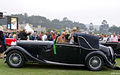 Drophead coupé on a Derby Bentley chassis 1934
 -
 2-door toureron a Rolls-Royce chassis 1935
 -
 Pullman limousine on a Humber chassis 1949
 -
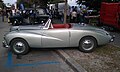 Open two-seater 1953Sunbeam Alpine
 -
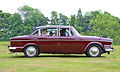 Humber Imperial 1964 a Humber Super Snipe with luxury finishes


Locations[edit]

For many years this business operated from 269 (renumbered 425) Oxford Street, London, with access from the side street, George Street (now Balderton Street). In 1914 their premises which had included their workshops were purchased by the store on the opposite side of Oxford Street, Selfridge & Co, to open Selfridge's household department[11] though war seems to have disrupted Selfridge's plans and Thrupp & Maberly's showroom remained at that address until 1916. That year they moved the showroom along to 475 Oxford Street then moved again in late 1921 to 20 North Audley Street, all in the same locality. When the Rootes brothers took control Thrupp & Maberly was moved a mile further south and set up in Rootes' new premises in the new Devonshire House, Piccadilly, opening there 22 September 1926.[12] There again they advertised they were by appointment to H.M. the King official retailers of Rolls-Royce cars and special coach builders to the Daimler Company.[13] In 1928 ownership passed to Humber Limited, a new member of the Rootes Group.[14]
- West End addresses
1. 33 George Street (now Balderton Street),[15] Grosvenor Square, .
- a.k.a. 269 Oxford Street
- a.k.a. 425 Oxford Street following re-numbering of Oxford Street
Both showrooms and workshops were on the corner of Oxford and George (Lumley) Streets until 1916 (following its sale to Selfridges in 1914)
The multi-storey premises included their workshops which were accessed from George Street. The workshops were demolished in 1937.
2. 475 Oxford Street until 1922
3. 20 North Audley Street until 1926
4. Devonshire House, Piccadilly (Rootes Group)
Thrupp & Sons were listed separately in 1842 as coach spring and patent axle tree manufacturers at 5, 6, 11 & 12 George Street (now Lumley Street) Grosvenor Square and Thrupp & Sons, tyre smiths, George Street Grosvenor Square.[16]
Notes[edit]
- ^ * Arthur Thomas Thrupp (1828-1889), Royal Navy officer
- Dorothea Ann Thrupp (1777-1847), writer
- Frederick Thrupp (1812-1895), sculptor
- John Thrupp (1817-1870), historian
- Joseph Francis Thrupp (1827–1867), churchman and academic
- ^ Thrupp, Henry East, son of Robert, St James. Apprenticed smith to Henry East, 8 January 1789 - Blacksmith's Company apprenticeship abstracts (possibly his grandfather)
- ^ ODNB shows an incorrect death date
References[edit]
- ^ "200 Years Of British Coach-Building". The Times. No. 54744. 12 April 1960. p. 3.
- ^ a b c d Goodman, Bryan K. (2004). "Thrupp, George Athelstane (1822–1905)". Oxford Dictionary of National Biography. Oxford University Press.
- ^ Greenwood, Martin (2004). "Thrupp, Frederick (1812–1895)". Oxford Dictionary of National Biography. Oxford University Press.
- ^ Saint, Andrew, ed. (2020). "381–451 Oxford Street (Davies Street to North Audley Street)". Survey of London, vol. 53: Oxford Street. Yale University Press.
- ^ Birth Death and Marriage records 1837 to 1983 and censuses 1841 through to 1911
- ^ "Classified advertising: CARRIAGES.-MABERLY, coach builder removed to 269 Oxford Street in partnership with Messrs Thrupp". The Times. No. 22922. 20 February 1858. p. 2.
- ^ a b c d Nick Walker. A-Z of British Coachbuilders. Bay View Books 1997. ISBN 1-870979-93-1
- ^ Bid to save car plants. The Times, Monday, 19 June 1967; pg. 24; Issue 56971.
- ^ J. S. Cockburn, H. P. F. King, K. G. T. McDonnell, A History of the County of Middlesex - Volume 5 - Page 77, Institute of Historical Research, 1976
- ^ Design increases floor space. The Times, Monday, 22 January 1968; pg. 15; Issue 57155
- ^ "Selfridge's New Capital". The Times. No. 40481. 26 March 1914. p. 23.
- ^ The Times, Tuesday, 21 September 1926; pg. 3; Issue 44382
- ^ Classified advertising, The Times, Tuesday, 3 May 1927; pg. 2; Issue 44571
- ^ Rootes Motors Limited. The Times, Monday, 21 November 1949; pg. 8; Issue 51544
- ^ Sheppard, F. H. W., ed. (1980). "'North Audley Street: Balderton Street'". Survey of London: Volume 40, the Grosvenor Estate in Mayfair, Part 2 (The Buildings) (British History Online ed.). London: London County Council. pp. 110–111. Retrieved 23 February 2023.
- ^ Robson's London Directory for 1842, Robson & Co, Cheapside 1842
External links[edit]

- Thrupp & Maberly handbill 1863
- The History of Coaches by George Athelstane Thrupp at Gutenberg.org
- Works by George Athelstane Thrupp at Project Gutenberg
Further reading[edit]
- Coachbuilding in London. Robert Vickers. London's Industrial Archaeology, No. 5, March 1994