


Total variation distance of probability measures

In probability theory, the total variation distance is a distance measure for probability distributions. It is an example of a statistical distance metric, and is sometimes called the statistical distance, statistical difference or variational distance.
Definition[edit]
Consider a measurable space and probability measures and defined on . The total variation distance between and is defined as:[1]



This is the largest absolute difference between the probabilities that the two probability distributions assign to the same event.
Properties[edit]
The total variation distance is an f-divergence and an integral probability metric.
Relation to other distances[edit]
The total variation distance is related to the Kullback–Leibler divergence by Pinsker’s inequality:
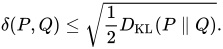
One also has the following inequality, due to Bretagnolle and Huber[2] (see, also, Tsybakov[3]), which has the advantage of providing a non-vacuous bound even when :


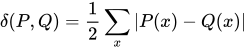
The total variation distance is half of the L1 distance between the probability functions: on discrete domains this is the distance between probability mass functions[4] , The relationship holds more generally as well:[5] when the distributions have standard probability density functions p and q, or the analogous distance between Radon-Nikodym derivatives with any common dominating measure. This result can be shown by noticing that the supremum in the definition is achieved exactly at the set where one distribution dominates the other.[6]

The total variation distance is related to the Hellinger distance as follows:[7]


These inequalities follow immediately from the inequalities between the 1-norm and the 2-norm.
Connection to transportation theory[edit]
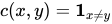
The total variation distance (or half the norm) arises as the optimal transportation cost, when the cost function is , that is,
![{\displaystyle {\frac {1}{2}}\|P-Q\|_{1}=\delta (P,Q)=\inf\{\mathbb {P} (X\neq Y):{\text{Law}}(X)=P,{\text{Law}}(Y)=Q\}=\inf _{\pi }\operatorname {E} _{\pi }[{\mathbf {1} }_{x\neq y}],}](https://wikimedia.org/api/rest_v1/media/math/render/svg/2d2141e7653b1e6d9719ca99a55eddfb5011d844)
where the expectation is taken with respect to the probability measure on the space where lives, and the infimum is taken over all such with marginals and , respectively.[8]


See also[edit]
References[edit]
- ^ Chatterjee, Sourav. "Distances between probability measures" (PDF). UC Berkeley. Archived from the original (PDF) on July 8, 2008. Retrieved 21 June 2013.
- ^ Bretagnolle, J.; Huber, C, Estimation des densités: risque minimax, Séminaire de Probabilités, XII (Univ. Strasbourg, Strasbourg, 1976/1977), pp. 342–363, Lecture Notes in Math., 649, Springer, Berlin, 1978, Lemma 2.1 (French).
- ^ Tsybakov, Alexandre B., Introduction to nonparametric estimation, Revised and extended from the 2004 French original. Translated by Vladimir Zaiats. Springer Series in Statistics. Springer, New York, 2009. xii+214 pp. ISBN 978-0-387-79051-0, Equation 2.25.
- ^ David A. Levin, Yuval Peres, Elizabeth L. Wilmer, Markov Chains and Mixing Times, 2nd. rev. ed. (AMS, 2017), Proposition 4.2, p. 48.
- ^ Tsybakov, Aleksandr B. (2009). Introduction to nonparametric estimation (rev. and extended version of the French Book ed.). New York, NY: Springer. Lemma 2.1. ISBN 978-0-387-79051-0.
- ^ Devroye, Luc; Györfi, Laszlo; Lugosi, Gabor (1996-04-04). A Probabilistic Theory of Pattern Recognition (Corrected ed.). New York: Springer. ISBN 978-0-387-94618-4.
- ^ Harsha, Prahladh (September 23, 2011). "Lecture notes on communication complexity" (PDF).
- ^ Villani, Cédric (2009). Optimal Transport, Old and New. Grundlehren der mathematischen Wissenschaften. Vol. 338. Springer-Verlag Berlin Heidelberg. p. 10. doi:10.1007/978-3-540-71050-9. ISBN 978-3-540-71049-3.
 | This probability-related article is a stub. You can help Wikipedia by expanding it. |