


Vaccinium myrtillus
| Vaccinium myrtillus | |
|---|---|

| |
| By Amédée Masclef, published in Atlas des plantes de France, 1891 | |
Scientific classification 
| |
| Kingdom: | Plantae |
| Clade: | Tracheophytes |
| Clade: | Angiosperms |
| Clade: | Eudicots |
| Clade: | Asterids |
| Order: | Ericales |
| Family: | Ericaceae |
| Genus: | Vaccinium |
| Subgenus: | Vaccinium subg. Vaccinium |
| Section: | Vaccinium sect. Myrtillus |
| Species: | V. myrtillus
|
| Binomial name | |
| Vaccinium myrtillus L. 1753
| |
| Synonyms[2] | |
| |
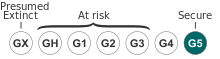
Vaccinium myrtillus or European blueberry is a holarctic species of shrub with edible fruit of blue color, known by the common names bilberry, blaeberry, wimberry, and whortleberry.[3] It is more precisely called common bilberry or blue whortleberry to distinguish it from other Vaccinium relatives.
Description[edit]
Vaccinium myrtillus is a small deciduous shrub that grows 4–18 in (10–46 cm) tall. It has light green leaves that turn red in autumn and are simple and alternate in arrangement.[4] Leaves are 0.4–1.2 in (1.0–3.0 cm) long and ovate to lanceolate or broadly elliptic in shape.[4]
Common names[edit]
Regional names include blaeberry (Scotland), urts or hurts (Cornwall and Devon),[5] hurtleberry,[6] myrtleberry,[7] wimberry, whinberry, winberry,[8] and fraughan.[9]
Distribution and habitat[edit]
Vaccinium myrtillus is a Holarctic species native to continental Europe, the British Isles, north and central Asia, Japan, Greenland, Iceland, Western Canada, and the Western United States. It occurs in the acidic soils of heaths, boggy barrens, degraded meadows, open forests and parklands, slopes, and moraines.[10][11]
Uses[edit]

The fruits will stain hands, teeth and tongue deep blue or purple while eating and so it was traditionally used as a dye for food and clothes in Britain.[12]

Fruit[edit]
Vaccinium myrtillus has been used for centuries in traditional medicine, particularly in traditional Austrian medicine as a tea or liqueur in attempts to treat various disorders.[13] Bilberry dietary supplements are marketed in the United States, although there is little evidence these products have any effect on health or diseases.[3]
In cooking, the bilberry fruit is commonly used for pies, tarts and flans, cakes, jams, muffins, cookies, sauces, syrups, juices, and candies.[3]
Leaves[edit]
In traditional medicine, bilberry leaves were used mainly for treating skin disorders.[3] Consuming the leaves may be unsafe.[3]
Harvesting[edit]
Although bilberries are in high demand by consumers in Northern Europe, the berries are harvested in the wild without any cultivation. Some authors state that opportunities exist to improve the crop if cultivated using common agricultural practices.[14][better source needed]

Chemistry[edit]
Bilberry and the related V. uliginosum both produce lignins, in part because they are used as defensive chemicals.[15] Although many plants change their lignin production – usually to increase it – to handle the stresses of climate change, lignin levels of both Vaccinium species appear to be unaffected.[15]
V. myrtillus contains a high concentration of triterpenes which remain under laboratory research for their possible biological effects.[16]
See also[edit]
- Blaeberry River
- Mahonia aquifolium (Oregon grape)
- Myrtus
References[edit]
- ^ NatureServe (2024). "Vaccinium myrtillus". Arlington, Virginia. Retrieved 10 April 2024.
- ^ Vaccinium myrtillus L. The Plant List
- ^ a b c d e "Bilberry". National Center for Complementary and Integrative Health, US National Institutes of Health. 1 August 2020. Retrieved 4 October 2022.
- ^ a b "Vaccinium myrtillus". www.fs.usda.gov. Retrieved 2022-09-13.
- ^ Phillipps, K. C. (1993). A Glossary of the Cornish Dialect. Padstow: Tabb House. p. 57. ISBN 0-907018-91-2.
- ^ "Vaccinium myrtillus". Germplasm Resources Information Network. Agricultural Research Service, United States Department of Agriculture. Retrieved 12 December 2017. citing Wiersema, J. H. & B. León (1999), World economic plants: a standard reference, and Huxley, A., ed. (1992), The new Royal Horticultural Society dictionary of gardening
- ^ "Bilberry, Blaeberry, Whortleberry, Whinberry, Windberry, Myrtle Berry, Vaccinium myrtillus". Wild Food UK. Retrieved 2020-07-31.
- ^ Henley, Jon. Bilberries: the true taste of northern England, The Guardian, Monday 9 June 2008
- ^ "Fraughan is an anglicisation of the Irish word Fraochán (or heather fruit, as the plant is often found growing with heather)". téarma.ie.
- ^ "Vaccinium myrtillus Linnaeus". Flora of North America. Retrieved 2021-09-21.
- ^ "Vaccinium myrtillus L." USDA Plants Database. Retrieved 2021-09-21.
- ^ "Make Traditional Dyes – Bilberry Dye". Barley Hall. York Archaeological Trust, Arts Council England and VisitEngland. Archived from the original on 2012-04-21.
- ^ Vogl S, Picker P, Mihaly-Bison J, Fakhrudin N, Atanasov AG, Heiss EH, Wawrosch C, Reznicek G, Dirsch VM, Saukel J, Kopp B (2013-03-25). "Ethnopharmacological in vitro studies on Austria's folk medicine--an unexplored lore in vitro anti-inflammatory activities of 71 Austrian traditional herbal drugs". J Ethnopharmacol. 149 (3): 750–71. doi:10.1016/j.jep.2013.06.007. PMC 3791396. PMID 23770053.
- ^ Nestby, Rolf; Percival, D.; Martinussen, Inger S.; Opstad, Nina; Rohloff, Jens (2017-08-08). "The European Blueberry (Vaccinium myrtillus L .) and the Potential for Cultivation. A Review". S2CID 52997599.
{{cite journal}}: Cite journal requires|journal=(help) - ^ a b Bidart-Bouzat, M. Gabriela; Imeh-Nathaniel, Adebobola (2008). "Global Change Effects on Plant Chemical Defenses against Insect Herbivores". Journal of Integrative Plant Biology. 50 (11). Wiley Publishing (Institute of Botany, the Chinese Academy of Sciences): 1339–1354. doi:10.1111/j.1744-7909.2008.00751.x. ISSN 1672-9072. PMID 19017122.
- ^ Szakiel, Anna; Pączkowski, Cezary; Pensec, Flora; Bertsch, Christophe (2012). "Fruit cuticular waxes as a source of biologically active triterpenoids". Phytochemistry Reviews. 11 (2–3). Springer Science and Business Media LLC: 263–284. Bibcode:2012PChRv..11..263S. doi:10.1007/s11101-012-9241-9. ISSN 1568-7767. PMC 3601259. PMID 23519009.
External links[edit]

