


Ericales
| Ericales | |
|---|---|

| |
| Rhododendron simsii | |
Scientific classification 
| |
| Kingdom: | Plantae |
| Clade: | Tracheophytes |
| Clade: | Angiosperms |
| Clade: | Eudicots |
| Clade: | Asterids |
| Order: | Ericales Bercht. & J.Presl[1] |
| Families | |
The Ericales are a large and diverse order of dicotyledons. Species in this order have considerable commercial importance including for tea, persimmon, blueberry, kiwifruit, Brazil nuts, argan, cranberry, sapote, and azalea. The order includes trees, bushes, lianas, and herbaceous plants. Together with ordinary autophytic plants, the Ericales include chlorophyll-deficient mycoheterotrophic plants (e.g., Sarcodes sanguinea) and carnivorous plants (e.g., genus Sarracenia).
Many species have five petals, often grown together. Fusion of the petals as a trait was traditionally used to place the order in the subclass Sympetalae.[2]
Mycorrhizal associations are quite common among the order representatives, and three kinds of mycorrhiza are found exclusively among Ericales (namely, ericoid, arbutoid and monotropoid mycorrhiza). In addition, some families among the order are notable for their exceptional ability to accumulate aluminum.[3]
Ericales are a cosmopolitan order. Areas of distribution of families vary largely – while some are restricted to tropics, others exist mainly in Arctic or temperate regions. The entire order contains over 8,000 species, of which the Ericaceae account for 2,000–4,000 species (by various estimates).
According to molecular studies, the lineage that led to Ericales diverged from other plants about 127 million years[4] or diversified 110 million years ago.[5]
Economic importance
[edit]The most commercially used plant in the order is tea (Camellia sinensis) from the family Theaceae. The order also includes some edible fruits, including kiwifruit (esp. Actinidia deliciosa), persimmon (genus Diospyros), blueberry, huckleberry, cranberry, Brazil nut, and Mamey sapote. The order also includes shea (Vitellaria paradoxa), which is the major dietary lipid source for millions of sub-Saharan Africans. Many Ericales species are cultivated for their showy flowers: well-known examples are azalea, rhododendron, camellia, heather, polyanthus, cyclamen, phlox, and busy Lizzie.
Gallery of photos
[edit]-
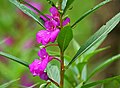 Impatiens balsamina of Balsaminaceae family
 -
 Primula rosea of Primulaceae family
 -


Classification
[edit]
These families are recognized in the APG III system[1] as members of the Ericales:
- Family Actinidiaceae (kiwifruit family)
- Family Balsaminaceae (balsam family)
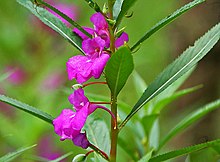
Impatiens balsamina from the Balsaminaceae - Family Clethraceae (clethra family)
- Family Cyrillaceae (cyrilla family)
- Family Diapensiaceae
- Family Ebenaceae (ebony and persimmon family)
- Family Ericaceae (heath, rhododendron, and blueberry family)
- Family Fouquieriaceae (ocotillo family)
- Family Lecythidaceae (Brazil nut family)
- Family Marcgraviaceae
- Family Mitrastemonaceae
- Family Pentaphylacaceae
- Family Polemoniaceae (phlox family)
- Family Primulaceae (primrose and snowbell family)
- Family Roridulaceae
- Family Sapotaceae (sapodilla family)
- Family Sarraceniaceae (American pitcher plant family)
- Family Sladeniaceae
- Family Styracaceae (silverbell family)
- Family Symplocaceae (sapphireberry family)
- Family Tetrameristaceae
- Family Theaceae (tea and camellia family)
Likely phylogenetic relationships between the families of the Ericales:[6]
| Ericales |
| ||||||||||||||||||||||||||||||||||||||||||||||||||||||||||||||||||||||||||||||||||||||||||||||||||||||||||||||||||||||||||||||||||||
Previously included families
[edit]These families are not recognized in the APG III system[1] but have been in common use in the recent past:
- Family Myrsinaceae (cyclamen and scarlet pimpernel family) → Primulaceae
- Family Pellicieraceae → Tetrameristaceae
- Family Maesaceae → Primulaceae
- Family Ternstroemiaceae → Pentaphylacaceae
- Family Theophrastaceae → Primulaceae
These make up an early diverging group of asterids.[7] Under the Cronquist system, the Ericales included a smaller group of plants, which were placed among the Dilleniidae:
- Family Ericaceae
- Family Cyrillaceae
- Family Clethraceae
- Family Grubbiaceae
- Family Empetraceae
- Family Epacridaceae
- Family Pyrolaceae
- Family Monotropaceae
See also
[edit]- Paradinandra, a fossil genus with uncertain placement within the order Ericales
References
[edit]- ^ a b c Angiosperm Phylogeny Group (2009). "An update of the Angiosperm Phylogeny Group classification for the orders and families of flowering plants: APG III". Botanical Journal of the Linnean Society. 161 (2): 105–121. doi:10.1111/j.1095-8339.2009.00996.x. hdl:10654/18083.
- ^ Robyns, W. (31 December 1972). "Outline of a New System of Orders and Families of Sympetalae". Bulletin du Jardin Botanique National de Belgique. 42 (4): 363–372. doi:10.2307/3667661. JSTOR 3667661.
- ^ (Jansen et al., 2004).
- ^ Bremer, K.; Friis, E. M.; Bremer, B. (2004). "Molecular phylogenetic dating of asterid flowering plants shows early Cretaceous diversification". Systematic Biology. 53 (3): 496–505. doi:10.1080/10635150490445913. ISSN 1063-5157. PMID 15503676.
- ^ a b Rose, Jeffrey P.; Kleist, Thomas J.; Löfstrand, Stefan D.; Drew, Bryan T.; Schönenberger, Jürg; Sytsma, Kenneth J. (1 May 2018). "Phylogeny, historical biogeography, and diversification of angiosperm order Ericales suggest ancient Neotropical and East Asian connections". Molecular Phylogenetics and Evolution. 122: 59–79. doi:10.1016/j.ympev.2018.01.014. ISSN 1055-7903. PMID 29410353.
- ^ Soltis, Douglas; Soltis, Pamela; Endress, Peter; Chase, Mark W.; Manchester, Steven; Judd, Walter; Majure, Lucas; Mavrodiev, Evgeny (2018). Phylogeny and Evolution of the Angiosperms (p. 262). University of Chicago Press. Kindle Edition. LCCN 2016046547.
- ^ Bremer, Birgitta; Kåre Bremera; Nahid Heidaria; Per Erixona; Richard G. Olmsteadb; Arne A. Anderbergc; Mari Källersjöd; Edit Barkhordarian (August 2002). "Phylogenetics of asterids based on 3 coding and 3 non-coding chloroplast DNA markers and the utility of non-coding DNA at higher taxonomic levels". Molecular Phylogenetics and Evolution. 24 (2): 274–301. doi:10.1016/S1055-7903(02)00240-3. PMID 12144762.
Bibliography
[edit]

- du Mortier, B.C.J. (1829). Analyse des Familles de Plantes : avec l'indication des principaux genres qui s'y rattachent. Vol. 28. Tournay: Imprimerie de J. Casterman.
- Jansen, S.; Watanabe, T.; Caris, P.; Geuten, K.; Lens, F.; Pyck, N.; Smets, E. (2004). "The Distribution and Phylogeny of Aluminium Accumulating Plants in the Ericales". Plant Biology. 6 (4): 498–505. Bibcode:2004PlBio...6..498J. doi:10.1055/s-2004-820980. PMID 15248133. S2CID 260248095.
- Judd, W.S.; Campbell, C.S.; Kellogg, E.A.; Stevens, P.F.; Donoghue, M.J. (2002). "Ericales". Plant Systematics: A Phylogenetic Approach (2nd ed.). Sinauer Associates. pp. 425–436. ISBN 978-0-87893-403-4.
- Smets, E.; Pyck, N. (February 2003). "Ericales (Rhododendron)". Nature Encyclopedia of Life Sciences. Nature Publishing Group. Archived from the original on 13 May 2011. Retrieved 23 March 2022.
- Arne A. Anderberg; Bertil Stahl; Mari Kallersjo (May 2000). "Maesaceae, a New Primuloid Family in the Order Ericales s.l.". Taxon. 49 (2): 183–187. doi:10.2307/1223834. JSTOR 1223834.
- Schönenberger, Jürg; Anderberg, Arne A.; Sytsma, Kenneth J. (1 March 2005). "Molecular Phylogenetics and Patterns of Floral Evolution in the Ericales". International Journal of Plant Sciences. 166 (2): 265–288. doi:10.1086/427198. JSTOR 10.1086/427198. S2CID 35461118.


