


Ulmus glabra
| Ulmus glabra | |
|---|---|
.jpg)
| |
| Wych elm | |
Scientific classification 
| |
| Kingdom: | Plantae |
| Clade: | Tracheophytes |
| Clade: | Angiosperms |
| Clade: | Eudicots |
| Clade: | Rosids |
| Order: | Rosales |
| Family: | Ulmaceae |
| Genus: | Ulmus |
| Subgenus: | U. subg. Ulmus |
| Section: | U. sect. Ulmus |
| Species: | U. glabra
|
| Binomial name | |
| Ulmus glabra | |

| |
| Distribution map | |
| Synonyms | |
|
List
| |

Ulmus glabra Hudson, the wych elm or Scots elm, has the widest range of the European elm species, from Ireland eastwards to the Ural Mountains, and from the Arctic Circle south to the mountains of the Peloponnese and Sicily, where the species reaches its southern limit in Europe;[2] it is also found in Iran. A large deciduous tree, it is essentially a montane species, growing at elevations up to 1,500 m (4,900 ft), preferring sites with moist soils and high humidity.[3] The tree can form pure forests in Scandinavia and occurs as far north as latitude 67°N at Beiarn in Norway. It has been successfully introduced as far north as Tromsø and Alta in northern Norway (70°N).[4] It has also been successfully introduced to Narsarsuaq, near the southern tip of Greenland (61°N).
The tree was by far the most common elm in the north and west of the British Isles and is now acknowledged as the only indisputably British native elm species. Owing to its former abundance in Scotland, the tree is occasionally known as the Scotch or Scots elm; Loch Lomond is said to be a corruption of the Gaelic Lac Leaman interpreted by some as 'Lake of the Elms', 'leaman' being the plural form of leam or lem, 'elm'.[5]
Closely related species, such as Bergmann's elm U. bergmanniana and Manchurian elm U. laciniata, native to northeast Asia, were once sometimes included in U. glabra;[6] another close relative is the Himalayan or Kashmir elm U. wallichiana. Conversely, Ulmus elliptica from the Caucasus, considered a species by some authorities,[7][8][9] is often listed as a regional form of Ulmus glabra.[10]
Etymology[edit]
The word "wych" (also spelled "witch") comes from the Old English wice, meaning pliant or supple, which also gives definition to wicker and weak. Jacob George Strutt's 1822 book, Sylva Britannica attests that the Wych Elm was sometimes referred to as the "Wych Hazel", a name now applied to the unrelated species Hamamelis, commonly called "wych hazels".[11]
Classification[edit]
Subspecies[edit]
Some botanists, notably Lindquist (1931), have proposed two subspecies:[12]
- U. glabra subsp. glabra in the south of the species' range: broad leaves with short tapering base and acute lobes;[13] trees often with a short, forked trunk and a low, broad crown;
- U. glabra subsp. montana (Stokes) Lindqvist in the north of the species' range (northern Britain, Scandinavia): leaves narrower, with a long tapering base and without acute lobes;[13] trees commonly with a long single trunk and a tall, narrow crown.[14]
Much overlap is seen between populations with these characters, and the distinction may owe to environmental influence, rather than genetic variation; the subspecies are not accepted by Flora Europaea.[15]
-
 Wych near Castle Douglas, Galloway, late April
 -
 Wych, Scandale Beck, Cumbria, May
 -
 U. glabra subsp. montana, Edinburgh, October


.jpg)
Description[edit]
The type sometimes reaches heights of 40 m (130 ft), typically with a broad crown where open-grown, supported by a short bole up to 2 m (6.6 ft) diameter at breast height (DBH). Normally, root suckers are not seen; natural reproduction is by seed alone. The tree is notable for its very tough, supple young shoots, which are always without the corky ridges or 'wings' characteristic of many elms. The alternate leaves are deciduous, 6–17 cm long by 3–12 cm broad, usually obovate with an asymmetric base, the lobe often completely covering the short (<5 mm) petiole;[16] the upper surface is rough. Leaves on juvenile or shade-grown shoots sometimes have three or more lobes near the apex.[17] The perfect hermaphrodite flowers appear before the leaves in early spring, produced in clusters of 10–20; they are 4 mm across on 10 mm long stems, and being wind-pollinated, are apetalous. The fruit is a winged samara 20 mm long and 15 mm broad, with a single, round, 6 mm seed in the centre, maturing in late spring.[18][19]
-
 Flowers
 -
 Nascent seeds
 -
 Samarae, showing seed on stalk side of centre
 -
 Typical unlobed leaves
 -
 Leaves with extra lobes
 -
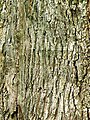 Bark, estimated age 100 years
 -
 Bole of old specimen
 -
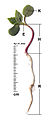 Seedling, showing cotyledons (K)


.jpg)

Pests and diseases[edit]
While the species is highly susceptible to Dutch elm disease,[20][21] it is less favoured as a host by the elm bark beetles, which act as vectors. Research in Spain has indicated the presence of a triterpene, alnulin, rendering the tree bark less attractive to the beetle than the field elm, though at 87 μg/g dried bark, its concentration is not as effective as in Ulmus laevis (200 μg/g).[22] Moreover, once the tree is dying, its bark is quickly colonized by the fungus Phoma, which radically reduces the amount of bark available for the beetle to breed on.[23] In European trials, clones of apparently resistant trees were inoculated with the pathogen, causing 85 – 100% wilting, resulting in 68% mortality by the following year. DNA analysis by Cemagref (now Irstea) in France has determined the genetic diversity within the species is very limited, making the chances of a resistant tree evolving rather remote.[24]
Still, a 300-year-old example growing in Grenzhammer, Ilmenau has been scientifically proven to be resistant to Dutch elm disease.[25]
The Swedish Forest Tree Breeding Association at Källstorp produced triploid and tetraploid forms of the tree, but these proved no more resistant to Dutch elm disease than the normal diploid form.[26]
In trials conducted in Italy, the tree was found to have a slight to moderate susceptibility to elm yellows, and a high susceptibility to the elm leaf beetle Xanthogaleruca luteola.[27]
![Two hundred year-old wych beside Jedburgh Abbey (2022), a survivor (2024) in an area of high DED infectivity.[28][29]](/wiki/File:Jedburgh_Giant..._a_rare_wych_elm_that_survived_black_elm_disease.jpg)
Cultivation[edit]
The wych elm is moderately shade-tolerant, but requires deep, rich soils as typically found along river valleys.[30] The species is intolerant of acid soils and flooding,[31] as it is of prolonged drought.[32] Although rarely used as a street tree owing to its shape, it can be surprisingly tolerant of urban air pollution, constricted growing conditions, and severe pollarding.
As wych elm does not sucker from the roots, and any seedlings are often consumed by uncontrolled deer populations, regeneration is very restricted, limited to sprouts from the stumps of young trees. The resultant decline has been extreme, and the wych elm is now uncommon over much of its former range. It is best propagated from seed or by layering stooled stock plants, although softwood cuttings taken in early June will root fairly reliably under mist.[33]
Wych elm was widely planted in Edinburgh in the 19th century as a park and avenue tree, and despite losses, it remains abundant there, regenerating through seedlings.[34][5] It was introduced to New England in the 18th century,[35] to Canada (as U. montana at the Dominion Arboretum, Ottawa) [36][37] and Australia in the 19th century.[38]
-
 Wych, The Meadows, Edinburgh, 1989
 -
 Burr-wych, Royal Terrace Gardens, Edinburgh, 2016
 -
 Burl-wych, Stockbridge, Edinburgh, 2016
 -
 Wych, Learmonth Gardens, Edinburgh, 2016
 -
 Wych, Middle Meadows Walk, Edinburgh, 2016
 -
 Fastigiate form of wych, Learmonth Gardens, Edinburgh, 2016
 -
 Ulmus glabra Huds., Pelhřimov, Czech Republic, 2017
 -
 Tromsø, Norway, June 2022

.jpg)

.jpg)
._Middle_Meadows_Walk,_Edinburgh.jpg)
._Learmonth_Gardens,_Edinburgh_(2).jpg)


Uses[edit]
Lumber[edit]
Wych elm wood is prized by craftsmen for its colouring, its striking grain, its 'partridge-breast' or 'catspaw' markings, and when worked, its occasional iridescent greenish sheen or 'bloom'. The bosses on old trees produce the characteristic fissures and markings of 'burr elm' wood.[39] Bosses fringed with shoots are burrs, whereas unfringed bosses are burls.
-
 Untreated wood grain of wych elm
 -
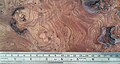 Waxed wood grain of burr wych elm
 -
 Burr on wych bole, Royal Terrace Gardens, Edinburgh
 -
 Burl on wych bole, Regent Road, Edinburgh
 -
 Burls on trunk and branches of wych elm, Dalry Cemetery, Edinburgh
 -
 Crown galls (burls on outer branches) on wych elm, North Ayrshire


.jpg)


Medicine[edit]

In 18th century France, the inner bark of Ulmus glabra, orme pyramidale, had a brief reputation as a panacea;[40][41] "it was taken as a powder, as an extract, as an elixir, even in baths. It was good for the nerves, the chest, the stomach — what can I say? — it was a true panacea."[42] It was this so-called "pyramidal elm bark" about which Michel-Philippe Bouvart famously quipped "Take it, Madame... and hurry up while it [still] cures."[42] It still appeared in a pharmacopeia of 1893.[41]
Notable trees[edit]

E. M. Forster cites a particular wych elm, one that grew at his childhood home of Rooks Nest, Stevenage, Hertfordshire, 16 times in his novel Howards End. This tree overhangs the house of the title and is said to have a "...girth that a dozen men could not have spanned..." Forster describes the tree as "...a comrade, bending over the house, strength and adventure in its roots." The wych elm of the novel had pigs' teeth embedded in the trunk by country people long ago and it was said that chewing some of the bark could cure toothache. In keeping with the novel's epigraph, "Only connect...", the wych elm may be seen by some as a symbol of the connection of humans to the earth. Margaret Schlegel, the novel's protagonist, fears that any "....westerly gale might blow the wych elm down and bring the end of all things..." The tree is changed to a chestnut in the 1991 film adaptation of Howards End.
The UK Champion listed in the Tree Register of the British Isles was at Brahan in the Scottish Highlands[43] (died 2021[29]); it had a girth of 703 cm (2.23 m DBH) and a height of 24 m.[44] Possibly the oldest specimen in England was found in 2018 in a field north of Hopton Castle in Shropshire. Coppiced long ago, its bole girth measured 6.3 m in 2018. The oldest specimen in Edinburgh is believed to be the tree (girth 5.2 m) in the former grounds of Duddingston House, now Duddingston Golf Course.[45] Other notable specimens in Edinburgh are to be found in Learmonth Gardens and The Meadows.[46]
In Europe, a large tree planted in 1620 grows at Bergemolo, 5 km south of Demonte in Piedmont, Italy (bole-girth 6.2 m, 2.0 m DBH, height 26 m., 2008).[47][48] Other ancient specimens grow at Styria, in Austria, and at Grenzhammer, Germany (see Gallery). In 1998, over 700 healthy, mature trees were discovered on the upper slopes of Mount Šimonka in Slovakia, but they are believed to have survived courtesy of their isolation from disease-carrying beetles rather than any innate resistance; 50 clones of these trees were presented to the Prince of Wales for planting at his Highgrove Estate, and at Clapham, Yorkshire.[49]
-
![300-year-old U. glabra (after lopping), Grenzhammer, Ilmenau, Germany[50]](//upload.wikimedia.org/wikipedia/commons/thumb/6/6c/Ilmenau_Grenzhammer_Ulme.JPG/80px-Ilmenau_Grenzhammer_Ulme.JPG)
-
 U. glabra, planted 1620, Bergemolo, near Demonte, Italy
 -
 U. glabra, Hopton Castle, Shropshire, England
 -
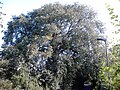 The Duddingston elm (girth 5.2 m), Edinburgh
 -
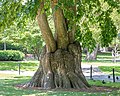 Old wych regenerating, Boston Public Garden (2022)
 -
![The Last Ent of Affric, Glen Affric (2022)[51]](//upload.wikimedia.org/wikipedia/commons/thumb/7/70/Wych_elm%2C_Gleann_na_C%C3%ACche_%28geograph_7210938%29.jpg/120px-Wych_elm%2C_Gleann_na_C%C3%ACche_%28geograph_7210938%29.jpg)
![300-year-old U. glabra (after lopping), Grenzhammer, Ilmenau, Germany[50]](/wiki/File:Ilmenau_Grenzhammer_Ulme.JPG)


.jpg)
2.jpg)
![The Last Ent of Affric, Glen Affric (2022)[51]](/wiki/File:Wych_elm,_Gleann_na_C%C3%ACche_(geograph_7210938).jpg)
Cultivars[edit]
About 40 cultivars have been raised, although at least 30 are now probably lost to cultivation as a consequence of Dutch elm disease and/or other factors:
- Albo-Variegata
- Australis
- Camperdownii
- Cebennensis
- Concavaefolia
- Cornuta
- Corylifolia Purpurea
- Corylifolia
- Fastigiata Macrophylla
- Fastigiata Stricta
- Fastigiata Variegata
- Firma
- Flava
- Gigantea
- Gittisham
- Grandidentata
- Holgeri
- Horizontalis
- Insularis
- Latifolia
- Latifolia Aurea
- Latifolia Aureo-Variegata
- Latifolia Nigricans
- Luteo Variegata
- Lutescens
- Macrophylla
- Maculata
- Minor
- Nana
- Nitida
- Nigra
- Oblongata
- Pendula Macrophylla
- Pendula Variegata
- Pyrenaica
- Spectabilis
- Superba
- Tomentosa
NB: 'Exoniensis', Exeter Elm, has traditionally been classified as a form of U. glabra, but its identity is now a matter of contention.
Hybrids and hybrid cultivars[edit]
U. glabra hybridises naturally with U. minor, producing elms of the Ulmus × hollandica group, from which have arisen a number of cultivars:
- Alba
- Angustifolia
- Balder
- Belgica
- Blandford
- Canadian Giant
- Cicestria
- Cinerea
- Commelin
- Dampieri
- Dauvessei
- Daveyi
- Dovaei
- Dumont
- Elegantissima
- Eleganto-Variegata
- Etrusca
- Fastigiata
- Fjerrestad
- Folia Rhomboidea
- Freja
- Fulva
- Gaujardii
- Groeneveld
- Haarlemensis
- Klemmer
- Loke
- Macrophylla Aurea
- Major
- Microphylla
- Modiolina
- Muscaviensis
- Nottingham
- Odin
- Pioneer
- Pitteurs
- Serpentina
- Smithii
- Superba
- Tricolor
- Tyr
- Vegeta
- Viminalis
- Viscosa
- Wentworthii Pendula
- Wredei
- Ypreau
However, hybrids of U. glabra and U. pumila, the Siberian elm, have not been observed in the field and only achieved in the laboratory, though the ranges of the two species, the latter introduced by man, overlap in parts of Southern Europe, notably Spain.[22] A crossing in Russia of U. glabra and U. pumila produced the hybrid named Ulmus × arbuscula.
Hybrids with U. glabra in their ancestry have featured strongly in recent artificial hybridization experiments in Europe, notably at Wageningen in the Netherlands, and a number of hybrid cultivars have been commercially released since 1960.[52] The earlier trees were raised in response to the initial Dutch elm disease pandemic that afflicted Europe after the First World War, and were to prove vulnerable to the much more virulent strain of the disease that arrived in the late 1960s. However, further research eventually produced several trees effectively immune to disease, which were released after 1989.[53]
- Arno, Clusius, Columella, Commelin, Den Haag, Dodoens, Groeneveld, Homestead, Lobel, Nanguen = Lutèce, Pioneer, Plinio, Regal, San Zanobi, Urban, Wanoux = Vada.
Accessions[edit]
- North America
- Arnold Arboretum, US. Acc. no. 391–2001, wild collected in Georgia
- Bartlett Tree Experts, US. Acc. nos. 1505, 5103, origin undisclosed
- Dawes Arboretum [5], US. 6 trees, no acc. details available
- Missouri Botanical Garden [6], US. Acc. nos. 1969–6164, 1986–0160
- Morton Arboretum, US. Acc. nos. 591–54, 255–81, and by its synonym U. sukaczevii, acc. nos. 949–73, 181–76
- Europe
- [Held in nearly all arboreta]
- Australasia
In art[edit]
-
 Wych elms, Samuel Bough, Edinburgh Castle from Princes Street, c.1878

See also[edit]
- Who put Bella in the Wych Elm? – graffiti that appeared in 1944 following the discovery of the remains of a woman inside a wych elm in Worcestershire, England
References[edit]
- ^ Barstow, M.; Rivers, M.C. (2017). "Ulmus glabra". IUCN Red List of Threatened Species. 2017: e.T61966807A61966819. doi:10.2305/IUCN.UK.2017-3.RLTS.T61966807A61966819.en. Retrieved 19 November 2021.
- ^ Raimondo, Francesco Maria (1977-01-01). "First finding of " Ulmus glabra " Huds. on the Madonie, Northern Sicily". Webbia. 31 (2): 261–277. doi:10.1080/00837792.1977.10670074. ISSN 0083-7792.
- ^ Heybroek, H. M., Goudzwaard, L, Kaljee, H. (2009). Iep of olm, karakterboom van de Lage Landen (:Elm, a tree with character of the Low Countries). KNNV, Uitgeverij. ISBN 9789050112819
- ^ "Utbredelse - Naturhistorisk museum". Archived from the original on 2020-09-26.
- ^ a b Richens, R. H. (1983). Elm. Cambridge University Press. ISBN 9780521294621
- ^ Elwes, H. J. & Henry, A. (1913). The Trees of Great Britain & Ireland. Vol. VII. 1848–1929. Republished 2014 Cambridge University Press, ISBN 9781108069380
- ^ Elwes, Henry John, & Henry, Augustine, (1913) The Trees of Great Britain & Ireland, Vol.7, pp.1863-1864 [1]
- ^ Bean, W. J. (1988) Trees and shrubs hardy in Great Britain, 8th edition, Murray, London
- ^ Krüssman, Gerd, Manual of Cultivated Broad-Leaved Trees & Shrubs (1984 vol. 3)
- ^ Richens, R. H., Elm (Cambridge 1983), p.279
- ^ Jacob George Strutt (1822). Sylva Britannica. p. 66. Full text of expanded 1830 edition.
- ^ Bertil, Lindguist (1931). "Two varieties of North West European Ulmus glabra". Botanical Society Report. 9: 785. Retrieved 29 August 2017.
- ^ a b Myking, Tor; Yakovlev, Igor (2006). "Variation in leaf morphology and chloroplast DNA in Ulmus glabra in the northern suture zone: Effects of distinct glacial refugia". Scandinavian Journal of Forest Research. 21 (2): 99–107. doi:10.1080/02827580500539265. S2CID 84736722.
- ^ bioportal.naturalis.nl L.1587168 Ulmus glabra Huds. subsp. montana (Stokes) Lindq., Thirsk, Yorkshire, 1937
- ^ Flora Europaea: Ulmus glabra
- ^ "Herbarium specimen - E00824735". Herbarium Catalogue. Royal Botanic Garden Edinburgh. Sheet labelled Ulmus scabra Mill. = Ulmus montana With.; "Herbarium specimen - E00824732". Herbarium Catalogue. Royal Botanic Garden Edinburgh. Sheet labelled Ulmus montana = Ulmus glabra Huds. RBGE specimen, 1900; "Herbarium specimen - E00824730". Herbarium Catalogue. Royal Botanic Garden Edinburgh. Sheet described as Ulmus glabra Huds. from Bridge of Allan, Scotland, 1899; "Herbarium specimen - E00824764". Herbarium Catalogue. Royal Botanic Garden Edinburgh. Cotyledon and seedling leaves, Ulmus scabra Mill. = Ulmus montana With.
- ^ Coleman, M (ed.). (2009). Wych Elm. Royal Botanic Garden Edinburgh. ISBN 978-1-906129-21-7.
- ^ Bean, W. J. (1981). Trees and shrubs hardy in Great Britain, 7th edition. Murray, London.
- ^ White, J. & More, D. (2003). Trees of Britain and Northern Europe. Cassell's, London
- ^ Forestry Commission. Dutch elm disease in Britain, UK
- ^ Brasier, C. M. (1996). New horizons in Dutch elm disease control. Pages 20–28 in: Report on Forest Research, 1996. Forestry Commission. HMSO, London, UK.
- ^ a b Martín-Benito, Dario; García-Vallejo, Maria Concepción; Pajares, Juan Alberto; López, David (2005). "Triterpenes in elms in Spain" (PDF). Canadian Journal of Forest Research. 35: 199–205. doi:10.1139/x04-158. S2CID 85380172. Archived from the original (PDF) on 2007-06-28. Retrieved 2007-06-18.
- ^ Webber, Joan (1981). "A natural biological control of Dutch elm disease". Nature. 292 (5822): 449–451. Bibcode:1981Natur.292..449W. doi:10.1038/292449a0. S2CID 4328001.
- ^ Solla et al. (2005). "Screening European Elms for Resistance to Ophiostoma novo-ulmi". Forest Science, 134–141. 51 (2) 2005. Society of American Foresters.
- ^ "In Ilmenau steht die einzige resistente Bergulme Europas". 15 March 2014. Archived from the original on 2022-07-01.
- ^ Went, Johanna C. (1954). "The Dutch elm disease - Summary of fifteen years hybridisation and selection work (1937–1952)". European Journal of Plant Pathology. 60 (2): 109–127. doi:10.1007/BF02151105. S2CID 38868071.
- ^ Mittempergher, L; Santini, A (2004). "The history of elm breeding" (PDF). Investigacion Agraria: Sistemas y Recursos Forestales. 13 (1): 161–177. Archived from the original (PDF) on 11 February 2017.
- ^ 'Borders Wych (Elm) Hunt', Royal Botanic Garden Edinburgh, 2024
- ^ a b Coleman, Max, 'Wake-up call to climate change'; Botanics Stories, Royal Botanic Garden Edinburgh, 2022
- ^ Edlin, H. L. (1949). British woodland trees. Batsford, London.
- ^ Thomas, Peter A.; Stone, Duncan; La Porta, Nicola (2018). "Biological Flora of the British Isles: Ulmus glabra" (PDF). Journal of Ecology. 106 (4): 1724–1766. doi:10.1111/1365-2745.12994. S2CID 89800637.
- ^ CAB International (2005) Forestry Compendium. CAB International, Wallingford, UK
- ^ Beckett, K. & G. (1979). Planting Native Trees and Shrubs. Jarrold & Sons, Norwich, UK.
- ^ Coleman, Max, ed., Wych Elm (Edinburgh, 2009)
- ^ Browne, Daniel Jay (1851). The Trees of America. New York: Harper & Brothers. p. 481.
- ^ Saunders, William; Macoun, William Tyrrell (1899). Catalogue of the trees and shrubs in the arboretum and botanic gardens at the central experimental farm (2 ed.). Ottawa. pp. 74–75.
- ^ canadiantreetours.org
- ^ Spencer, Roger, ed., Horticultural Flora of South-Eastern Australia, Vol. 2 (Sydney, 1995), Ulmus, p. 103-118 [2]
- ^ Coleman, Max, ed., Wych Elm (Royal Botanic Garden publications, Edinburgh, 2009)
- ^ Simon Morelot, Cours élémentaire d'histoire naturelle pharmaceutique..., 1800, p. 349 "the elm, pompously named pyramidal...it had an ephemeral reputation"
- ^ a b Georges Dujardin-Beaumetz, Formulaire pratique de thérapeutique et de pharmacologie, 1893, p. 260
- ^ a b Gaston de Lévis, Souvenirs et portraits, 1780-1789, 1813, p. 240
- ^ The Brahan Elm, forestry.gov.uk
- ^ "The Woodland Trust" (PDF). Archived from the original (PDF) on 9 November 2005.
- ^ CEC information; tree may be seen on Google Streetview, beside Cavalry Park Drive, E. of Holy Rood High School.
- ^ Edinburgh Wych-elm photographs [3] [4]
- ^ Association of Nature Patriarchs in Italy: Piemonte - Olmo di Bergemolo, access-date: November 23, 2016
- ^ "Google Maps". Google.co.uk. Retrieved 7 February 2017.
- ^ "CST Slovakia - News". Archived from the original on 2005-09-16. Retrieved 2006-08-04.
- ^ "Ilmenaus bekannteste und vermutlich Europas älteste Ulme fiel dem Unwetter zum Opfer". ilmenau.de. 2015. Archived from the original on 29 August 2017. Retrieved 2017-08-29.
- ^ Coleman, Max, 'Last Ent set to repopulate Glen Affric'; Botanics Stories, Royal Botanic Garden Edinburgh, 2024
- ^ Green, Peter Shaw (1964). "Registration of cultivar names in Ulmus". Arnoldia. 24 (6–8). Arnold Arboretum, Harvard University: 41–80. Retrieved 16 February 2017.
- ^ Heybroek, H.M. (1993). "The Dutch Elm Breeding Program". In Sticklen, Mariam B.; Sherald, James L. (eds.). Dutch Elm Disease Research. New York, USA: Springer-Verlag. pp. 16–25. ISBN 978-1-4615-6874-2. Retrieved 26 October 2017.
Further reading[edit]
- Coleman, Max, ed.: Wych Elm (Edinburgh, 2009; ISBN 978-1-906129-21-7). A study of the species, with particular reference to the wych elm in Scotland and its use by craftsmen.
External links[edit]

- Ulmus glabra distribution map: linnaeus.nrm.se [8]
- Jobling & Mitchell, 'Field Recognition of British Elms', Forestry Commission Booklet
- U. glabra, Flora of North America, www.efloras.org
- Ulmus glabra- information, genetic conservation units and related resources. European Forest Genetic Resources Programme (EUFORGEN)
- Clarkson, R. & Coleman, M. (2022) 'Propagating healthy mature elms that have survived in areas severely impacted by Dutch elm disease: a scoping study for a wych elm project in Scotland.' Royal Botanic Garden Edinburgh.
- The Forest Plantations (Greenland)
- Synonymy list
- Grow wych elm from seed

![[8]](https://web.archive.org/web/20130623020052/http://linnaeus.nrm.se/flora/di/ulma/ulmus/ulmuglav.jpg)