


Yang–Baxter equation
In physics, the Yang–Baxter equation (or star–triangle relation) is a consistency equation which was first introduced in the field of statistical mechanics. It depends on the idea that in some scattering situations, particles may preserve their momentum while changing their quantum internal states. It states that a matrix , acting on two out of three objects, satisfies


where is followed by a swap of the two objects. In one-dimensional quantum systems, is the scattering matrix and if it satisfies the Yang–Baxter equation then the system is integrable. The Yang–Baxter equation also shows up when discussing knot theory and the braid groups where corresponds to swapping two strands. Since one can swap three strands in two different ways, the Yang–Baxter equation enforces that both paths are the same.


History[edit]
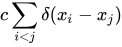
According to Jimbo[1], the Yang–Baxter equation (YBE) manifested itself in the works of J. B. McGuire[2] in 1964 and C. N. Yang[3] in 1967. They considered a quantum mechanical many-body problem on a line having as the potential. Using Bethe's Ansatz techniques, they found that the scattering matrix factorized to that of the two-body problem, and determined it exactly. Here YBE arises as the consistency condition for the factorization.
In statistical mechanics, the source of YBE probably goes back to Onsager's star-triangle relation, briefly mentioned in the introduction to his solution of the Ising model[4] in 1944. Hunt for solvable lattice models has been actively pursued since then, culminating in Baxter's solution of the eight vertex model[5] in 1972.
Another line of development was the theory of factorized S-matrix in two dimensional quantum field theory[6]. Zamolodchikov pointed out[7] that the algebraic mechanics working here is the same as that in the Baxter's and others' works.
The YBE has also manifested itself in a study of Young operators in the group algebra of the symmetric group in the work of A. A. Jucys[8] in 1966.
![{\displaystyle \mathbb {C} [S_{n}]}](https://wikimedia.org/api/rest_v1/media/math/render/svg/03192415c4c777069325cf912b2d2e8ef259d00b)
General form of the parameter-dependent Yang–Baxter equation[edit]
Let be a unital associative algebra. In its most general form, the parameter-dependent Yang–Baxter equation is an equation for , a parameter-dependent element of the tensor product (here, and are the parameters, which usually range over the real numbers ℝ in the case of an additive parameter, or over positive real numbers ℝ+ in the case of a multiplicative parameter).


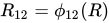
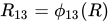
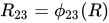
Let for , with algebra homomorphisms determined by






The general form of the Yang–Baxter equation is

for all values of , and .


Parameter-independent form[edit]
Let be a unital associative algebra. The parameter-independent Yang–Baxter equation is an equation for , an invertible element of the tensor product . The Yang–Baxter equation is

where , , and .
With respect to a basis[edit]
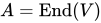
Often the unital associative algebra is the algebra of endomorphisms of a vector space over a field , that is, . With respect to a basis of , the components of the matrices are written , which is the component associated to the map . Omitting parameter dependence, the component of the Yang–Baxter equation associated to the map reads








Alternate form and representations of the braid group[edit]
Let be a module of , and . Let be the linear map satisfying for all . The Yang–Baxter equation then has the following alternate form in terms of on .
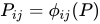





- .

Alternatively, we can express it in the same notation as above, defining , in which case the alternate form is


In the parameter-independent special case where does not depend on parameters, the equation reduces to
- ,

and (if is invertible) a representation of the braid group, , can be constructed on by for . This representation can be used to determine quasi-invariants of braids, knots and links.




Symmetry[edit]
Solutions to the Yang–Baxter equation are often constrained by requiring the matrix to be invariant under the action of a Lie group . For example, in the case and , the only -invariant maps in are the identity and the permutation map . The general form of the -matrix is then for scalar functions .







The Yang–Baxter equation is homogeneous in parameter dependence in the sense that if one defines , where is a scalar function, then also satisfies the Yang–Baxter equation.


The argument space itself may have symmetry. For example translation invariance enforces that the dependence on the arguments must be dependent only on the translation-invariant difference , while scale invariance enforces that is a function of the scale-invariant ratio .


Parametrizations and example solutions[edit]
A common ansatz for computing solutions is the difference property, , where R depends only on a single (additive) parameter. Equivalently, taking logarithms, we may choose the parametrization , in which case R is said to depend on a multiplicative parameter. In those cases, we may reduce the YBE to two free parameters in a form that facilitates computations:



for all values of and . For a multiplicative parameter, the Yang–Baxter equation is


for all values of and .
The braided forms read as:


In some cases, the determinant of can vanish at specific values of the spectral parameter . Some matrices turn into a one dimensional projector at . In this case a quantum determinant can be defined [clarification needed].


Example solutions of the parameter-dependent YBE[edit]
- A particularly simple class of parameter-dependent solutions can be obtained from solutions of the parameter-independent YBE satisfying , where the corresponding braid group representation is a permutation group representation. In this case, (equivalently, ) is a solution of the (additive) parameter-dependent YBE. In the case where and , this gives the scattering matrix of the Heisenberg XXX spin chain.

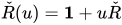



- The -matrices of the evaluation modules of the quantum group are given explicitly by the matrix

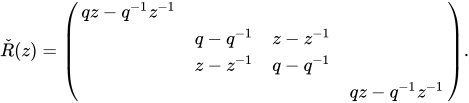
Then the parametrized Yang-Baxter equation with the multiplicative parameter is satisfied:

Classification of solutions[edit]
There are broadly speaking three classes of solutions: rational, trigonometric and elliptic. These are related to quantum groups known as the Yangian, affine quantum groups and elliptic algebras respectively.
Set-theoretic Yang–Baxter equation[edit]
Set-theoretic solutions were studied by Drinfeld.[9] In this case, there is an -matrix invariant basis for the vector space in the sense that the -matrix maps the induced basis on to itself. This then induces a map given by restriction of the -matrix to the basis. The set-theoretic Yang–Baxter equation is then defined using the 'twisted' alternate form above, asserting




Examples[edit]
- .
- where , the transposition map.
- If is a (right) shelf, then is a set-theoretic solution to the YBE.





Classical Yang–Baxter equation[edit]
Solutions to the classical YBE were studied and to some extent classified by Belavin and Drinfeld.[10] Given a 'classical -matrix' , which may also depend on a pair of arguments , the classical YBE is (suppressing parameters)



![{\displaystyle [r_{12},r_{13}]+[r_{12},r_{23}]+[r_{13},r_{23}]=0.}](https://wikimedia.org/api/rest_v1/media/math/render/svg/519d6b0ed851ece19ab3c03f5be0f5a8ce7bb24b)
This equation emerges from so called quasi-classical solutions to the quantum YBE, in which the -matrix admits an asymptotic expansion in terms of an expansion parameter




See also[edit]
References[edit]
- H.-D. Doebner, J.-D. Hennig, eds, Quantum groups, Proceedings of the 8th International Workshop on Mathematical Physics, Arnold Sommerfeld Institute, Clausthal, FRG, 1989, Springer-Verlag Berlin, ISBN 3-540-53503-9.
- Vyjayanthi Chari and Andrew Pressley, A Guide to Quantum Groups, (1994), Cambridge University Press, Cambridge ISBN 0-521-55884-0.
- Jacques H.H. Perk and Helen Au-Yang, "Yang–Baxter Equations", (2006), arXiv:math-ph/0606053.
- ^ Jimbo, M. (1989). "Introduction to the Yang-Baxter Equation". International Journal of Modern Physics A. 4 (15). World Scientific: 3759–3777. Bibcode:1989IJMPA...4.3759J. doi:10.1142/S0217751X89001503.
- ^ McGuire, J. B. (1964-05-01). "Study of Exactly Soluble One‐Dimensional N‐Body Problems". Journal of Mathematical Physics. 5 (5). The American Institute of Physics (AIP): 622–636. Bibcode:1964JMP.....5..622M. doi:10.1063/1.1704156. ISSN 0022-2488.
- ^ Yang, C. N. (1967-12-04). "Some Exact Results for the Many-Body Problem in one Dimension with Repulsive Delta-Function Interaction". Physical Review Letters. 19 (23). American Physical Society (APS): 1312–1315. Bibcode:1967PhRvL..19.1312Y. doi:10.1103/PhysRevLett.19.1312. ISSN 0031-9007.
- ^ Onsager, L. (1944-02-01). "Crystal Statistics. I. A Two-Dimensional Model with an Order-Disorder Transition". Physical Review. 65 (3–4). Americal Physical Society (APS): 117–149. Bibcode:1944PhRv...65..117O. doi:10.1103/PhysRev.65.117.
- ^ Baxter, R. J. (1972). "Partition function of the Eight-Vertex lattice model". Annals of Physics. 70 (1). Elsevier: 193–228. Bibcode:1972AnPhy..70..193B. doi:10.1016/0003-4916(72)90335-1. ISSN 0003-4916.
- ^ Zamolodchikov, Alexander B.; Zamolodchikov, Alexey B. (1979). "Factorized S-matrices in two dimensions as the exact solutions of certain relativistic quantum field theory models". Annals of Physics. 120 (2). Elsevier: 253–291. Bibcode:1979AnPhy.120..253Z. doi:10.1016/0003-4916(79)90391-9. ISSN 0003-4916.
- ^ Zamolodchikov, Alexander B. (1979). "Z4-symmetric factorized S-matrix in two space-time dimensions". Comm. Math. Phys. 69 (2). Elsevier: 165–178. Bibcode:1979CMaPh..69..165Z. doi:10.1007/BF01221446. ISSN 0003-4916.
- ^ Jucys, A. A. (1966). "On the Young operators of the symmetric group" (PDF). Lietuvos Fizikos Rinkinys. 6. Gos. Izd-vo Polit. i Nauch. literatury.: 163–180.
- ^ Drinfeld, Vladimir (1992). Quantum groups : proceedings of workshops held in the Euler International Mathematical Institute, Leningrad, Fall 1990. Berlin: Springer-Verlag. doi:10.1007/BFb0101175. ISBN 978-3-540-55305-2. Retrieved 4 February 2023.
- ^ Belavin, A. A.; Drinfel'd, V. G. (1983). "Solutions of the classical Yang - Baxter equation for simple Lie algebras". Functional Analysis and Its Applications. 16 (3): 159–180. doi:10.1007/BF01081585. S2CID 123126711. Retrieved 4 February 2023.
External links[edit]
- "Yang-Baxter equation", Encyclopedia of Mathematics, EMS Press, 2001 [1994]
| International | |
|---|---|
| National | |
| Other | |
