


Follicle (fruit)

In botany, a follicle is a dry unilocular fruit formed from one carpel, containing two or more seeds.[1] It is usually defined as dehiscing by a suture in order to release seeds,[2] for example in Consolida (some of the larkspurs), peony and milkweed (Asclepias).
Some difficult cases exist however, so that the term indehiscent follicle is sometimes used, for example with the genus Filipendula, which has indehiscent fruits that could be considered intermediate between a (dehiscent) follicle and an (indehiscent) achene.[3]
An aggregate fruit that consists of follicles may be called a follicetum. Examples include hellebore, aconite, Delphinium, Aquilegia or the family Crassulaceae, where several follicles occur in a whorl on a shortened receptacle, or Magnolia, which has many follicles arranged in a spiral on an elongated receptacle.[2]
The follicles of some species dehisce by the ventral suture (as in Banksia),[4] or by the dorsal suture (as in Magnolia).[5]
-
 Follicles from Helleborus foetidus
 -
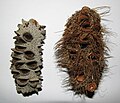 Only some flowers in a Banksia inflorescence mature into follicles embedded in the "cone"
 -
 Follicles of Stenocarpus sinuatus will release papery brown seeds


References
[edit]- ^ Hickey, M.; King, C. (2001). The Cambridge Illustrated Glossary of Botanical Terms. Cambridge University Press.
- ^ a b Rendle, Alfred Barton (1911). . In Chisholm, Hugh (ed.). Encyclopædia Britannica. Vol. 11 (11th ed.). Cambridge University Press. p. 257.
- ^ "Flora of China online".
- ^ Renshaw, A.; Burgin, S. (2008). "Enantiomorphy in Banksia (Proteaceae): flowers and fruits". Australian Journal of Botany. 56 (4): 342–346. doi:10.1071/BT07073.
- ^ Kapil, R. N. and N. N. Bhandari (1964) Morphology and embryology of Magnolia Archived 1 May 2013 at the Wayback Machine. Proc. nat. Inst. Sci. India 30, 245–262.
External links
[edit]
- . Collier's New Encyclopedia. 1921.
.svg) | This plant morphology article is a stub. You can help Wikipedia by expanding it. |