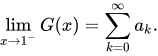
provided that entirely within a single Stolz sector, that is, a region of the openunit disk where
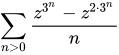
for some fixed finite . Without this restriction, the limit may fail to exist: for example, the power series
converges to at but is unbounded near any point of the form so the value at is not the limit as tends to 1 in the whole open disk.
Note that is continuous on the real closed interval for by virtue of the uniform convergence of the series on compact subsets of the disk of convergence. Abel's theorem allows us to say more, namely that the restriction of to is continuous.
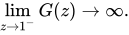
The theorem can also be generalized to account for sums which diverge to infinity.[citation needed] If
then
However, if the series is only known to be divergent, but for reasons other than diverging to infinity, then the claim of the theorem may fail: take, for example, the power series for
At the series is equal to but
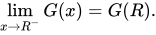
We also remark the theorem holds for radii of convergence other than : let
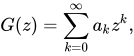
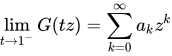
be a power series with radius of convergence and suppose the series converges at Then is continuous from the left at that is,
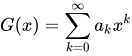
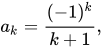
The utility of Abel's theorem is that it allows us to find the limit of a power series as its argument (that is, ) approaches from below, even in cases where the radius of convergence, of the power series is equal to and we cannot be sure whether the limit should be finite or not. See for example, the binomial series. Abel's theorem allows us to evaluate many series in closed form. For example, when
we obtain
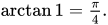
by integrating the uniformly convergent geometric power series term by term on ; thus the series
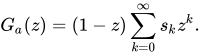
After subtracting a constant from we may assume that Let Then substituting and performing a simple manipulation of the series (summation by parts) results in
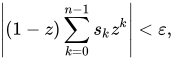
Given pick large enough so that for all and note that
when lies within the given Stolz angle. Whenever is sufficiently close to we have
so that when is both sufficiently close to and within the Stolz angle.
Converses to a theorem like Abel's are called Tauberian theorems: There is no exact converse, but results conditional on some hypothesis. The field of divergent series, and their summation methods, contains many theorems of abelian type and of tauberian type.
Ahlfors, Lars Valerian (September 1, 1980). Complex Analysis (Third ed.). McGraw Hill Higher Education. pp. 41–42. ISBN0-07-085008-9. - Ahlfors called it Abel's limit theorem.











![{\displaystyle [0,t]}](https://wikimedia.org/api/rest_v1/media/math/render/svg/37d2d2fa44908c699e2b7b7b9e92befc8283f264)

![{\displaystyle [0,1]}](https://wikimedia.org/api/rest_v1/media/math/render/svg/738f7d23bb2d9642bab520020873cccbef49768d)













![{\displaystyle [-z,0]}](https://wikimedia.org/api/rest_v1/media/math/render/svg/41869b3cdfed3beea9b72b715ee1d6b2ffcc75aa)