


Summation by parts
In mathematics, summation by parts transforms the summation of products of sequences into other summations, often simplifying the computation or (especially) estimation of certain types of sums. It is also called Abel's lemma or Abel transformation, named after Niels Henrik Abel who introduced it in 1826.[1]
Statement[edit]
Suppose and are two sequences. Then,



Using the forward difference operator , it can be stated more succinctly as


Summation by parts is an analogue to integration by parts:
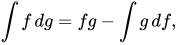
or to Abel's summation formula:

An alternative statement is

which is analogous to the integration by parts formula for semimartingales.
Although applications almost always deal with convergence of sequences, the statement is purely algebraic and will work in any field. It will also work when one sequence is in a vector space, and the other is in the relevant field of scalars.
Newton series[edit]
The formula is sometimes given in one of these - slightly different - forms
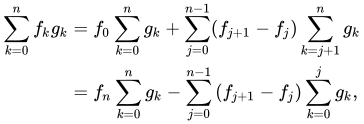
which represent a special case () of the more general rule

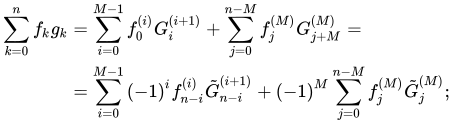
both result from iterated application of the initial formula. The auxiliary quantities are Newton series:
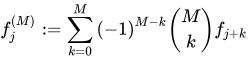
and
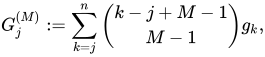
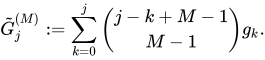
A particular () result is the identity


Here, is the binomial coefficient.

Method[edit]
For two given sequences and , with , one wants to study the sum of the following series:


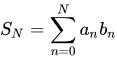
If we define then for every and
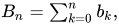


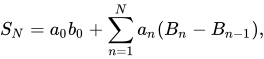

Finally

This process, called an Abel transformation, can be used to prove several criteria of convergence for .

Similarity with an integration by parts[edit]
The formula for an integration by parts is .
![{\textstyle \int _{a}^{b}f(x)g'(x)\,dx=\left[f(x)g(x)\right]_{a}^{b}-\int _{a}^{b}f'(x)g(x)\,dx}](https://wikimedia.org/api/rest_v1/media/math/render/svg/91ae99bc2a7a9e7d289c1d0d4605af0bfa391fc5)
Beside the boundary conditions, we notice that the first integral contains two multiplied functions, one which is integrated in the final integral ( becomes ) and one which is differentiated ( becomes ).


The process of the Abel transformation is similar, since one of the two initial sequences is summed ( becomes ) and the other one is differenced ( becomes ).


Applications[edit]
- It is used to prove Kronecker's lemma, which in turn, is used to prove a version of the strong law of large numbers under variance constraints.
- It may be used to prove Nicomachus's theorem that the sum of the first cubes equals the square of the sum of the first positive integers.[2]
- Summation by parts is frequently used to prove Abel's theorem and Dirichlet's test.
- One can also use this technique to prove Abel's test: If is a convergent series, and a bounded monotone sequence, then converges.


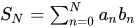
Proof of Abel's test. Summation by parts gives





Using the same proof as above, one can show that if
- the partial sums form a bounded sequence independently of ;
- (so that the sum goes to zero as goes to infinity)
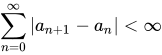
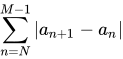

then converges.
In both cases, the sum of the series satisfies:

Summation-by-parts operators for high order finite difference methods[edit]
A summation-by-parts (SBP) finite difference operator conventionally consists of a centered difference interior scheme and specific boundary stencils that mimics behaviors of the corresponding integration-by-parts formulation.[3][4] The boundary conditions are usually imposed by the Simultaneous-Approximation-Term (SAT) technique.[5] The combination of SBP-SAT is a powerful framework for boundary treatment. The method is preferred for well-proven stability for long-time simulation, and high order of accuracy.
See also[edit]
- Convergent series
- Divergent series
- Integration by parts
- Cesàro summation
- Abel's theorem
- Abel sum formula
References[edit]
- ^ Chu, Wenchang (2007). "Abel's lemma on summation by parts and basic hypergeometric series". Advances in Applied Mathematics. 39 (4): 490–514. doi:10.1016/j.aam.2007.02.001.
- ^ Edmonds, Sheila M. (1957). "Sums of powers of the natural numbers". The Mathematical Gazette. 41 (337): 187–188. doi:10.2307/3609189. JSTOR 3609189. MR 0096615.
- ^ Strand, Bo (January 1994). "Summation by Parts for Finite Difference Approximations for d/dx". Journal of Computational Physics. 110 (1): 47–67. doi:10.1006/jcph.1994.1005.
- ^ Mattsson, Ken; Nordström, Jan (September 2004). "Summation by parts operators for finite difference approximations of second derivatives". Journal of Computational Physics. 199 (2): 503–540. doi:10.1016/j.jcp.2004.03.001.
- ^ Carpenter, Mark H.; Gottlieb, David; Abarbanel, Saul (April 1994). "Time-Stable Boundary Conditions for Finite-Difference Schemes Solving Hyperbolic Systems: Methodology and Application to High-Order Compact Schemes". Journal of Computational Physics. 111 (2): 220–236. CiteSeerX 10.1.1.465.603. doi:10.1006/jcph.1994.1057.
Bibliography[edit]
- Abel, Niels Henrik (1826). "Untersuchungen über die Reihe u.s.w.". J. Reine Angew. Math. 1: 311–339.
