


Andropogon gerardi
| Andropogon gerardi | |
|---|---|
.jpg)
| |
Scientific classification 
| |
| Kingdom: | Plantae |
| Clade: | Tracheophytes |
| Clade: | Angiosperms |
| Clade: | Monocots |
| Clade: | Commelinids |
| Order: | Poales |
| Family: | Poaceae |
| Subfamily: | Panicoideae |
| Genus: | Andropogon |
| Species: | A. gerardi
|
| Binomial name | |
| Andropogon gerardi | |
| Synonyms[3] | |
|
List
| |

Andropogon gerardi, commonly known as big bluestem, is a species of tall grass native to much of the Great Plains and grassland regions of central and eastern North America. It is also known as tall bluestem,[4] bluejoint,[5] and turkeyfoot.[6]
Taxonomy[edit]
Andropogon gerardi was formally named in 1792 by Fulgenzio Vitman.[2] It was named for French botanist Louis Gérard, who had first described the plant from specimens that had been cultivated in Provence, France.[7]
Kew's International Plant Names Index and USDA Germplasm Resources Information Network reject the spelling gerardii and provide reasoning for gerardi as being the correct spelling for the specific epithet of this taxon.[2][6] Andropogon gerardii still makes appearances in various literature, including other USDA publications.[8]
Description[edit]
Big bluestem is a perennial warm-season bunchgrass. It is tolerant of a wide range of soil conditions. The main roots are 6–10 ft (1.8–3.0 m) deep, and the plants send out strong, tough rhizomes, so it forms very strong sod.[4] Depending on soil and moisture conditions, it grows to a height of 1–3 m (3.3–9.8 ft). The stem base turns blue or purple as it matures.
Big bluestem blooms in the summer and seeds into the fall. The inflorescence (cluster of flowers) is a raceme of two to six, most commonly three, narrow spike-like racemes alternately arranged along the top of the stem.[9] It somewhat resembles a wild turkey's foot.[4] Each raceme contains pairs of spikelets. Each pair has a stalked spikelet with another stalkless spikelet at the base of the stalk. The stalkless spikelet usually has a fertile, perfect floret (with both female and male parts) and an awn (bristle), and the stalked spikelet is awnless, and is sterile or has a staminate (male) flower.
-
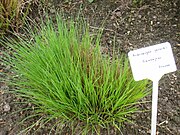 New growth in May at the Berlin Botanical Garden
 -
 The flowerhead in bloom
 -
 The spike-like raceme bent to show the pairs of spikelets
 -
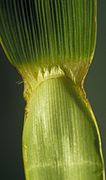 Ligule

_in_flower_Sand_Lake_Wetland_Management_District_01_(14635029543).jpg)

.jpg)
Ecology[edit]
Big bluestem is a mid-successional grass in prairie and other grassland ecosystems. It grows in tall, dense stands that can outcompete other plant species.[10] The stands grow until disturbance interrupts their spread. It is shade intolerant and is adapted to fire.
It is a host to larvae of several species of butterflies, including the arogos skipper, byssus skipper, cobweb skipper, common wood nymph, Delaware skipper, and dusted skipper.[11]
The larvae of the leaf beetle Diabrotica cristata feed on the roots and the adults visit the flowers of other species of prairie flowers.[7] Many ants decorate their nests with the seeds, including Formica glacialis, F. montana, and F. subsericea.[7] Several species of ants, such as F. glacialis, F. montana, F. subsericea, Lasius minutus, and L. umbratus build nests around the base of this bunchgrass, forming large soil mounds. In larger mounds, the nest is shared by multiple species of ants, and is "likened to an apartment complex with each ant species in its own nest partition". Up to 12 species of ants have been recorded in mounds found in the Chicago region.[7]
The rust fungus Puccinia andropogonis forms black telia on the leaves.[7]
Uses[edit]
The grass and its variants are good forage for horses and cattle, and can also be cut and used for hay. The grass is high in protein. While not considered the highest quality native forage found in the United States, it has long been considered a desirable and ecologically important grass by cattle ranchers and rangeland ecologists.[12][13]
Big bluestem is cultivated by specialty plant nurseries for its drought tolerance and native status. It is often grown for wildlife gardens, natural landscaping, and grassland habitat restoration projects.
Due to its high biomass, big bluestem is being considered as a potential feedstock for ethanol production.[14]
Symbols[edit]
Andropogon gerardi is the state grass of Illinois[15] and Missouri[16] and the official prairie grass of Manitoba.[17]
See also[edit]
- Schizachyrium scoparium (little bluestem)
References[edit]
- ^ NatureServe (5 January 2024). "Andropogon gerardii". NatureServe Network Biodiversity Location Data accessed through NatureServe Explorer. Arlington, Virginia: NatureServe. Retrieved 29 January 2024.
- ^ a b c Summa Pl. 6: 16. 1792. "Andropogon gerardii Vitman". International Plant Names Index (IPNI). Royal Botanic Gardens, Kew; Harvard University Herbaria & Libraries; Australian National Botanic Gardens. Retrieved 17 July 2021.
- ^ "Andropogon gerardi Vitman". Plants of the World Online. Board of Trustees of the Royal Botanic Gardens, Kew. Retrieved 17 July 2021.
- ^ a b c Uchytil, R. J. (1988). "Andropogon gerardii". Fire Effects Information System (FEIS). US Department of Agriculture (USDA), Forest Service (USFS), Rocky Mountain Research Station, Fire Sciences Laboratory. Retrieved 20 June 2013.
- ^ "Andropogon gerardii". Integrated Taxonomic Information System.
- ^ a b "Andropogon gerardi". Germplasm Resources Information Network. Agricultural Research Service, United States Department of Agriculture. Retrieved 12 December 2017.
- ^ a b c d e Wilhelm, Gerould; Rericha, Laura (2017). Flora of the Chicago Region: A Floristic and Ecological Synthesis. Indiana Academy of Sciences.
- ^ USDA, NRCS (n.d.). "Andropogon gerardii". The PLANTS Database (plants.usda.gov). Greensboro, North Carolina: National Plant Data Team.
- ^ Hilty, John (2020). "Big Bluestem (Andropogon gerardii)". Illinois Wildflowers.
- ^ "Big bluestem". Grow Native!. Missouri Prairie Foundation. Retrieved 2018-07-31.
- ^ The Xerces Society (2016), Gardening for Butterflies: How You Can Attract and Protect Beautiful, Beneficial Insects, Timber Press.
- ^ Hintz, Roger L.; Harmoney, Keith R.; Moore, Kenneth J.; George, J. Ronald; Brummer, Edward C. (1998). "Establishment of Switchgrass and Big Bluestem in Corn with Atrazine" (PDF). Agronomy Journal. 90 (5): 591–596. doi:10.2134/agronj1998.00021962009000050004x. Retrieved 17 January 2017.
- ^ Kaiser, Jerry (1 March 2011). "Big Bluestem and Indiangrass for Biomass Production by Variety Selection and Establishment Methods for Missouri, Illinois, and Iowa" (PDF). Natural Resources Conservation Service, United States Department of Agriculture. Archived from the original (PDF) on 9 February 2017. Retrieved 17 January 2017.
- ^ Zhang, Ke; Johnson, Loretta; Prasad, P.V. Vara; Pei, Zhijian; Wang, Donghai (2015). "Big bluestem as a bioenergy crop: A review". Renewable and Sustainable Energy Reviews. 52: 740–756. doi:10.1016/j.rser.2015.07.144.
- ^ "Illinois State Prairie Grass — Big Bluestem (Andropogon gerardii)". State Symbols Web Exhibit. Illinois State Museum. Archived from the original on 2012-10-20.
- ^ "State Symbols of Missouri - The State Grass". Office of the Secretary of State of Missouri.
- ^ "Vote for Manitoba's Official Prairie Grass Emblem". Manitoba Provincial Grass Campaign Committee. 2008.