


Ankerite
| Ankerite | |
|---|---|
-Mus%C3%A9e_de_min%C3%A9ralogie_de_Strasbourg.jpg) | |
| General | |
| Category | Carbonate mineral |
| Formula (repeating unit) | Ca(Fe,Mg,Mn)(CO3)2 |
| IMA symbol | Ank[1] |
| Strunz classification | 5.AB.10 |
| Crystal system | Trigonal |
| Crystal class | Rhombohedral (3) H–M symbol: (3) |
| Space group | R3 |
| Unit cell | a = 4.8312(2) c = 16.1663(3) [Å]; Z = 3 |
| Identification | |
| Color | Brown, yellow, white |
| Crystal habit | Chrystals rhombohedral with curved faces; columnar, stalactitic, granular, massive |
| Twinning | Simple t {0001}, {1010}. {1120} |
| Cleavage | Perfect on {1011} |
| Fracture | Subconchoidal |
| Tenacity | Brittle |
| Mohs scale hardness | 3.5–4.0 |
| Luster | Vitreous to pearly |
| Streak | White |
| Diaphaneity | Translucent to transparent |
| Specific gravity | 2.93–3.10 |
| Optical properties | Uniaxial (−) |
| Refractive index | nω = 1.690–1.750 nε = 1.510–1.548 |
| Birefringence | δ = 0.180–0.202 |
| Dispersion | Strong |
| References | [2][3][4] |
Ankerite is a calcium, iron, magnesium, manganese carbonate mineral of the group of rhombohedral carbonates with the chemical formula Ca(Fe,Mg,Mn)(CO3)2. In composition it is closely related to dolomite, but differs from this in having magnesium replaced by varying amounts of iron(II) and manganese. It forms a series with dolomite and kutnohorite.[3]
The crystallographic and physical characters resemble those of dolomite and siderite. The angle between the perfect rhombohedral cleavages is 73° 48′, the hardness is 3.5 to 4, and the specific gravity is 2.9 to 3.1. The color is white, grey or reddish to yellowish brown.[5]
Ankerite occurs with siderite in metamorphosed ironstones and sedimentary banded iron formations. It also occurs in carbonatites. In sediments it occurs as authigenic, diagenetic minerals and as a product of hydrothermal deposition.[2] It is one of the minerals of the dolomite-siderite series, to which the terms brown-spar, pearl-spar and bitter-spar have been historically loosely applied.[5]
It was first recognized as a distinct species by Wilhelm von Haidinger in 1825, and named for Matthias Joseph Anker (1771–1843) of Styria, an Austrian mineralogist.[3]
It has been found in Western Tasmania, in mines in Dundas, Tasmania.
Image gallery[edit]
-
 Ankerite on pyrite from King County, Washington
 -
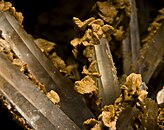 Ankerite on quartz from Peru


See also[edit]
References[edit]
- ^ Warr, L.N. (2021). "IMA–CNMNC approved mineral symbols". Mineralogical Magazine. 85 (3): 291–320. Bibcode:2021MinM...85..291W. doi:10.1180/mgm.2021.43. S2CID 235729616.
- ^ a b Handbook of Mineralogy
- ^ a b c Ankerite on Mindat.org
- ^ Ankerite on Webmineral
- ^ a b One or more of the preceding sentences incorporates text from a publication now in the public domain: Spencer, Leonard James (1911). "Ankerite". In Chisholm, Hugh (ed.). Encyclopædia Britannica. Vol. 2 (11th ed.). Cambridge University Press. p. 58.

External links[edit]

| Borates | |||||
|---|---|---|---|---|---|
| Carbonates | |||||
| Oxides |
| ||||
| Phosphates | |||||
| Silicates | |||||
| Sulfides | |||||
| Other |
| ||||
