


Prunus serotina
| Prunus serotina | |
|---|---|

| |
| Flowers and leaves | |
Scientific classification 
| |
| Kingdom: | Plantae |
| Clade: | Tracheophytes |
| Clade: | Angiosperms |
| Clade: | Eudicots |
| Clade: | Rosids |
| Order: | Rosales |
| Family: | Rosaceae |
| Genus: | Prunus |
| Subgenus: | Prunus subg. Padus |
| Species: | P. serotina
|
| Binomial name | |
| Prunus serotina | |

| |
| Natural range | |
| Synonyms[2] | |
| |
Prunus serotina, commonly called black cherry,[3] wild black cherry, rum cherry,[4] or mountain black cherry,[5] is a deciduous tree or shrub[6] in the rose family Rosaceae. Despite being called black cherry, it is not very closely related to the commonly cultivated cherries such as sweet cherry (P. avium), sour cherry (P. cerasus) and Japanese flowering cherries (P. serrulata, P. speciosa, P. sargentii, P. incisa, etc.) which belong to Prunus subg. Cerasus. Instead, P. serotina belongs to Prunus subg. Padus, a subgenus also including Eurasian bird cherry (P. padus) and chokecherry (P. virginiana).[7][8][9] The species is widespread and common in North America and South America.[10][11][12][13]
Black cherry is closely related to the chokecherry (P. virginiana); chokecherry, however, tends to be shorter (a shrub or small tree) and has smaller, less glossy leaves.
Description[edit]
Prunus serotina is a medium-sized, fast-growing forest tree growing to a height of 15–24 metres (49–79 feet). The leaves are 5–13 centimetres (2–5 inches) long, ovate-lanceolate in shape, with finely toothed margins. Fall leaf color is yellow to red. Flowers are small, white and 5-petalled, in racemes 10–15 cm (4–6 in) long which contain several dozen flowers. The flowers give rise to reddish-black "berries" (drupes) fed on by birds,[6] 5–10 millimetres (1⁄4–3⁄8 in) in diameter.[10][14]

For about its first decade the bark of a black cherry tree is thin, smooth, and banded, resembling a birch. A mature tree has very broken, dark gray to black bark. The leaves are long and shiny, resembling a sourwood's. An almond-like odour is released when a young twig is scratched and held close to the nose, revealing minute amounts of cyanide compounds produced and stored by the plant as a defense mechanism against herbivores.[15][16]
-
 Immature bark
 -
 Mature bark
 -
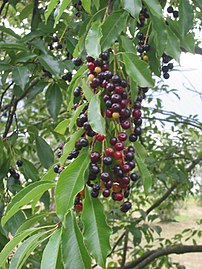 Immature fruit
 -
 Autumn foliage


Biochemistry[edit]
Like apricots and apples, the seeds of black cherries contain cyanogenic glycosides (compounds that can be converted into cyanide), such as amygdalin.[17][18] These compounds release hydrogen cyanide when the seed is ground or minced, which releases enzymes that break down the compounds.[clarification needed] These enzymes include amygdalin beta-glucosidase, prunasin beta-glucosidase and mandelonitrile lyase.[19] In contrast, although the flesh of black cherries also contains these glycosides, it does not contain the enzymes needed to convert them to cyanide, so the flesh is safe to eat.[20]
The foliage, particularly when wilted, also contains cyanogenic glycosides, which convert to hydrogen cyanide if eaten by animals.[21] Farmers are recommended to remove any trees that fall in a field containing livestock, because the wilted leaves could poison the animals. Removal is not always practical, though, because these trees often grow in very large numbers on farms, taking advantage of the light brought about by mowing and grazing. Entire fencerows can be lined with this poisonous tree, making it difficult to monitor all the branches falling into the grazing area. Black cherry is a leading cause of livestock illness,[citation needed] and grazing animals' access to it should be limited.
Subdivisions[edit]
Prunus serotina has the following subspecies and varieties:[22]
- Prunus serotina subsp. capuli (Cav. ex Spreng.) McVaugh – central + southern Mexico
- Prunus serotina subsp. eximia (Small) McVaugh – Texas
- Prunus serotina subsp. hirsuta (Elliott) McVaugh (syn. Prunus serotina var. alabamensis (C. Mohr) Little) – southeastern United States
- Prunus serotina subsp. serotina – Canada, United States, Mexico, Guatemala
- Prunus serotina subsp. virens (Wooton & Standl.) McVaugh – southwestern United States, northern + central Mexico
- Prunus serotina var. virens (Wooton & Standl.) McVaugh
- Prunus serotina var. rufula (Wooton & Standl.) McVaugh


Ecology[edit]
Prunus serotina is a pioneer species. In the Midwest, it is seen growing mostly in old fields with other sunlight-loving species, such as black walnut, black locust, and hackberry. Gleason and Cronquist (1991) describe P. serotina as "[f]ormerly a forest tree, now abundant as a weed-tree of roadsides, waste land, and forest-margins".[23] It is a moderately long-lived tree, with ages of up to 258 years known, though it is prone to storm damage, with branches breaking easily; any decay resulting, however, only progresses slowly. Fruit production begins around 10 years of age, but does not become heavy until 30 years and continues up to 100 years or more. Germination rates are high, and the seeds are widely dispersed by birds and bears[24] who eat the fruit and then excrete them. Some seeds however may remain in the soil bank and not germinate for as long as three years. All Prunus species have hard seeds that benefit from scarification to germinate (which in nature is produced by passing through an animal's digestive tract).[citation needed]
Deer browse the foliage.[24]
Pests and diseases[edit]
P. serotina is a host of caterpillars of various Lepidoptera. Hyphantria cunea can inhibit the impact of cyanide within the plants' leaves due to its alkaline stomach acid.[25] The eastern tent caterpillar defoliates entire groves some springs.
Uses[edit]
Prunus serotina subsp. capuli was cultivated in Central and South America well before European contact.[26]
Known as capolcuahuitl in Nahuatl (the source of the capuli epithet), it was an important food in pre-Columbian Mexico. Native Americans ate the fruit.[24] Edible raw, the fruit is also made into jelly, and the juice can be used as a drink mixer, hence the common name 'rum cherry'.[27]
Prunus serotina timber is valuable; perhaps the premier cabinetry timber of the U.S., traded as "cherry". High quality cherry timber is known for its strong orange hues, tight grain and high price. Low-quality wood, as well as the sap wood, can be more tan. Its density when dried is around 580 kg/m3 (36 lb/cu ft).[citation needed]
Prunus serotina was widely introduced into Western and Central Europe as an ornamental tree[28] in the mid-20th century,[29][30] where it has become locally naturalized.[28] It has acted as an invasive species there, negatively affecting forest community biodiversity and regeneration.[31][32]
References[edit]
- ^ Stritch, L. (2018). "Prunus serotina". IUCN Red List of Threatened Species. 2018: e.T61957524A61957527. doi:10.2305/IUCN.UK.2018-2.RLTS.T61957524A61957527.en. Retrieved 19 November 2021.
- ^ "Prunus serotina L." Plants of the World Online. Royal Botanic Gardens, Kew. Retrieved 17 March 2024.
- ^ World Economic Plants: A Standard Reference, Second Edition. CRC Press; 19 April 2016. ISBN 978-1-4665-7681-0. p. 833–.
- ^ "Prunus serotina (Black Cherry, Wild Cherry, Wild Rum Cherry) | North Carolina Extension Gardener Plant Toolbox". plants.ces.ncsu.edu. Retrieved 2021-01-23.
- ^ "Lady Bird Johnson Wildflower Center - The University of Texas at Austin". www.wildflower.org. Retrieved 2021-01-23.
- ^ a b "Prunus serotina". NC State Extension. NC Cooperative Extension. Retrieved 2017-02-21.
- ^ Wen, Jun; Berggren, Scott T.; Lee, Chung-Hee; Ickert-Bond, Stefanie; Yi, Ting-Shuang; Yoo, Ki-Oug; Xie, Lei; Shaw, Joey; Potter, Dan (2008-05-18). "Phylogenetic inferences in Prunus (Rosaceae) using chloroplast ndhF and nuclear ribosomal ITS sequences". Journal of Systematics and Evolution. 46 (3): 322. doi:10.3724/SP.J.1002.2008.08065 (inactive 31 January 2024). ISSN 1674-4918.
{{cite journal}}: CS1 maint: DOI inactive as of January 2024 (link) - ^ Liu, Xiao-Lin; Wen, Jun; Nie, Ze-Long; Johnson, Gabriel; Liang, Zong-Suo; Chang, Zhao-Yang (2013-05-01). "Polyphyly of the Padus group of Prunus (Rosaceae) and the evolution of biogeographic disjunctions between eastern Asia and eastern North America". Journal of Plant Research. 126 (3): 351–361. Bibcode:2013JPlR..126..351L. doi:10.1007/s10265-012-0535-1. ISSN 1618-0860. PMID 23239308. S2CID 5991106.
- ^ Shi, Shuo; Li, Jinlu; Sun, Jiahui; Yu, Jing; Zhou, Shiliang (2013). "Phylogeny and classification of Prunus sensu lato (Rosaceae)". Journal of Integrative Plant Biology. 55 (11): 1069–1079. doi:10.1111/jipb.12095. ISSN 1744-7909. PMID 23945216.
- ^ a b Rohrer, Joseph R. (2014). "Prunus serotina". In Flora of North America Editorial Committee (ed.). Flora of North America North of Mexico (FNA). Vol. 9. New York and Oxford: Oxford University Press – via eFloras.org, Missouri Botanical Garden, St. Louis, MO & Harvard University Herbaria, Cambridge, MA.
- ^ "Prunus serotina". County-level distribution map from the North American Plant Atlas (NAPA). Biota of North America Program (BONAP). 2014.
- ^ Morales Quirós, J. F. 2014. Rosaceae. En: Manual de Plantas de Costa Rica. Vol. VII. B.E. Hammel, M.H. Grayum, C. Herrera & N. Zamora (eds.). Monographs in Systematic Botany from the Missouri Botanical Garden 129: 437–463
- ^ Jørgensen, P. M., M. H. Nee & S. G. Beck. (eds.) 2014. Catálogo de las plantas vasculares de Bolivia, Monographs in systematic botany from the Missouri Botanical Garden 127(1–2): i–viii, 1–1744.
- ^ "Prunus serotina - Plant Finder".
- ^ "Black cherry (Prunus serotina)". ISU Forestry Extension. Iowa State University. Retrieved 2018-04-02.
- ^ "VT Forest Biology and Dendrology". Cnr.vt.edu. Archived from the original on 2007-09-13. Retrieved 2012-10-22.
- ^ Poulton JE (1988). "Localization and Catabolism of Cyanogenic Glycosides". Ciba Foundation Symposium 140 - Cyanide Compounds in Biology. Novartis Foundation Symposia. Vol. 140. pp. 67–91. doi:10.1002/9780470513712.ch6. ISBN 9780470513712. PMID 3073063.
- ^ Swain E, Poulton JE (October 1994). "Utilization of Amygdalin during Seedling Development of Prunus serotina". Plant Physiology. 106 (2): 437–445. doi:10.1104/pp.106.2.437. PMC 159548. PMID 12232341.
- ^ Yemm RS, Poulton JE (June 1986). "Isolation and characterization of multiple forms of mandelonitrile lyase from mature black cherry (Prunus serotina Ehrh.) seeds". Archives of Biochemistry and Biophysics. 247 (2): 440–5. doi:10.1016/0003-9861(86)90604-1. PMID 3717954.
- ^ Swain E, Li CP, Poulton JE (April 1992). "Development of the Potential for Cyanogenesis in Maturing Black Cherry (Prunus serotina Ehrh.) Fruits". Plant Physiology. 98 (4): 1423–1428. doi:10.1104/pp.98.4.1423. PMC 1080367. PMID 16668810.
- ^ Tenaglia, Dan. "Prunus serotina page". Missouri Plants. Missouri Botanical Garden.
- ^ McVaugh, Rogers (1951-12-01). "A revision of the North American black cherries (Prunus serotina Ehrh., and relatives)". Brittonia. 7 (4): 279–315. Bibcode:1951Britt...7..279M. doi:10.2307/2804698. ISSN 1938-436X. JSTOR 2804698. S2CID 29241557.
- ^ Gleason, Henry A. and Arthur Cronquist. 1991. "Manual of Vascular Plants of Northeastern United States and Adjacent Canada, Second Edition." The New York Botanical Garden. Bronx, New York.
- ^ a b c Peattie, Donald Culross (1953). A Natural History of Western Trees. New York: Bonanza Books. p. 539.
- ^ Fitzgerald, T. D. (1 March 2008). "Larvae of the fall webworm, Hyphantria cunea , inhibit cyanogenesis in Prunus serotina". Journal of Experimental Biology. 211 (5): 671–677. doi:10.1242/jeb.013664.
- ^ Morton, Julia (1987). "Capulin". Fruits of warm climates. Miami, FL: Florida Flair Books. pp. 108–109. ISBN 0-9610184-1-0. Retrieved 15 October 2013.
- ^ Angier, Bradford (1974). Field Guide to Edible Wild Plants. Harrisburg, PA: Stackpole Books. p. 190. ISBN 0-8117-0616-8. OCLC 799792.
- ^ a b C. Stace. R. van der Meijden & I. de Kort (eds.). "Prunus serotina (Cherry, Rum)". Flora of NW Europe. Archived from the original on 2007-12-06.
- ^ Starfinger U. 1997. Introduction and naturalization of Prunus serotina in Central Europe. In: "Plant Invasions: Studies from North America and Europe" (eds by J.H. Brock, M. Wade, P.Pysek, D. Green). Backhuys Publ. Leiden: 161-171.
- ^ Kalina M. Nowakowska; Aleksandra Halarewicz (2006). "Coleoptera found on neophyte Prunus serotina (Ehrh.) within forest community and open habitat" (PDF). Electronic Journal of Polish Agricultural Universities, Biology, Volume 9, Issue 1.
- ^ Stypiński P. 1979. Stanowiska czeremchy amerykańskiej Padus serotina (Ehrh.) Borkh. w lasach państwowych Pojezierza Mazurskiego. Rocznik dendrologiczny (in Polish). 32: 191-204.
- ^ Szymon Bijak; Maciej Czajkowski; £ukasz Ludwisiak (December 2014). "Wystêpowanie czeremchy amerykañskiej (Prunus serotina Ehrh.) w Lasach Pañstwowych" [Occurrence of black cherry (Prunus serotina Ehrh.) in the State Forests in Poland] (PDF). Leœne Prace Badawcze [Forest Research Papers] (in Polish). 75 (4): 359–365. doi:10.2478/frp-2014-0033. S2CID 55833138. Retrieved 2018-04-02.
External links[edit]
| National | |
|---|---|
| Other | |


- IUCN Red List least concern species
- Bird cherries
- Prunus
- Trees of Northern America
- Trees of Guatemala
- Flora of the Appalachian Mountains
- Flora of the United States
- Plants described in 1784
- Taxa named by Jakob Friedrich Ehrhart
- Flora of the Sierra Madre Occidental
- Flora of the Sierra Madre Oriental
- Flora of the Sierra Madre del Sur
- Flora of the Trans-Mexican Volcanic Belt
- Flora of the Sierra Madre de Oaxaca