Boris Rosing
Boris Rosing | |
|---|---|
 | |
| Born | 5 May 1869 |
| Died | 20 April 1933 (aged 63) Archangelsk, Soviet Union |
| Alma mater | Saint Petersburg Imperial University |
| Scientific career | |
| Fields | Mechanical television |
Boris Lvovich Rosing (Russian: Борис Львович Розинг; 5 May [O.S. 23 April] 1869 – 20 April 1933) was a Russian scientist and inventor of television.[1]
Biography[edit]
Boris Rosing was born in Saint Petersburg into the family of a government official.[2] His father, Lev Nikolaevich Rozing, served on the commission for military service (conscription) under Czar Alexander II. Rozing was a descendant of the noble Rozing family, founded by Dutch immigrant Peter Rozing. Lev developed an interest mathematics and technology, including recent inventions, which he communicated to his son. From 1879 to 1887, Boris studied at St. Petersburg's Vvdensky gymnasium, from which he graduated with a gold medal. There, he distinguished himself in his studies of the exact sciences, literature and music. He then studied physics and mathematics at St. Petersburg University, which was a major research center. The distinguished faculty included the chemist Dmitri Mendeleev and the mathematicians Pafnuty Chebyshev and Andrey Markov. After graduating with honors in 1891, he remained at the university to pursue graduate studies in physics. The subject of his dissertation was magnetic hysteresis. He discovered hysteresis in the lengths of iron wires in the presence of cyclic magnetic fields, a phenomenon that was discovered independently by the Japanese investigator Hantaro Nagaoka.[3] He subsequently became a physics instructor at the St. Petersburg Institute of Technology. Starting in 1894, he also taught physics at the Konstantinovsky Artillery School, and from 1906, he lectured on electrical and magnetic measurements as part of women's polytechnic courses. During 1894–1900, he continued his studies of magnetism but also worked on several practical electrical problems. He taught at the St. Petersburg Institute of Technology until 1918. He then conducted research at the Leningrad Experimental Electrotechnical Laboratory from 1924 to 1928 and at the Central Laboratory for Wire Communications from 1928 to 1931.[4]
Television[edit]

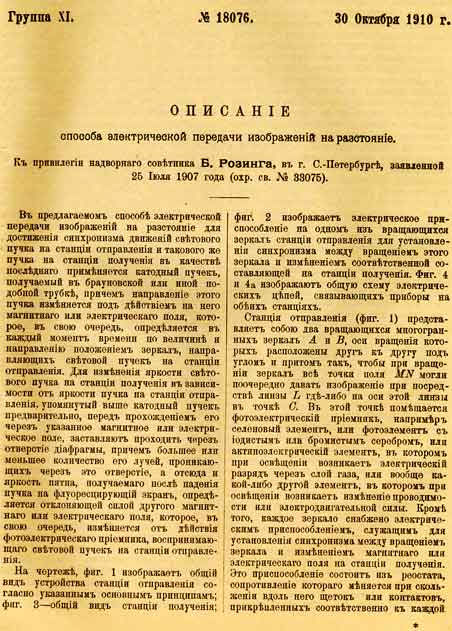
Rosing's interest in television — or the "electric telescope", as he called it — began in 1897. Others had tried to develop a mechanical version of television. Rosing recognized the shortcomings of mechanical television; he thought that the image should be displayed electrically on a cathode ray tube (CRT). By 1902, Rosing began actual experimentation to test his ideas: he constructed a simple apparatus for electrically deflecting the beam of a CRT, which allowed him to draw figures on the tube's screen. At that time, mechanical devices scanned an image onto a selenium photoresistor, the resistance of which varied in response to the light striking it. However, selenium photoresistors responded to changes in light levels too slowly to accurately reproduce moving images. Therefore, Rosing used a photocell, a piece of alkaline metal in a vacuum tube which emitted electrons in response to light. Once Rosing had developed a rudimentary working television that incorporated his two innovations — a photocell detector and a CRT display — he filed a patent application in Russia on 25 July 1907[5] and — on the improved version of his system, which included magnetic deflection coils around the CRT — on 2 March 1911.[6] He followed up with a demonstration of which a report was published in the Scientific American with diagrams and full description of the invention's operation.[7][8] During 1912–1914, he did theoretical and experimental work on magnetic lenses. In 1918, he co-founded the North Caucasian Polytechnic Institute, now the Kuban State Technological University. In the early 1920s he resided in Krasnodar (formerly: Ekaterinodar), near the Black Sea. There, in 1920, he co-founded the Ekaterinodar Physical-Mathematical Society and became its chairman, and in 1923, he wrote his booklet The Electric Telescope: Vision at a distance.[9]
Rosing's invention expanded on the designs of Paul Nipkow and his mechanical system of rotating lenses and mirrors. Accordingly, Rosing's system employed a mechanical camera device, but used very early cathode ray tube (developed in Germany by Karl Ferdinand Braun) as a receiver. Rosing's Braun Tubes consisted of two parallel metal plates that were used to electrically shift the electron beam itself before it was scanned and reached the screen. These two plates were connected electrically to the photoelectric cell in the camera. Depending on the output of the photoelectric cells, the beam would be deflected up or down before entering the concentrating plate. Since this movement increased or decreased the number of electrons passing between the plates, it had the effect of varying the brightness of the electron beam. The system was primitive, but it was definitely one of the first experimental demonstrations where the cathode ray tube was employed for the purposes of television.[10] V. K. Zworykin, who pioneered television in the United States and Germany, was a pupil of Rosing and assisted him in some of his laboratory work.[11] In 1925, B. Rosing advised and helped young inventor Boris Grabovsky apply for a patent (issued under No 5592) of a fully electronic TV set, called Telefot.[12]
Rosing continued his television research until 1931 when he was exiled as a counter-revolutionary to Kotlas without right to work, but in 1932 was moved to Archangelsk, where took up physics at the Forestry Technology Institute. Rosing died in exile in 1933 of cerebral hemorrhage. He was buried in the Arkhangelsk Vologda (formerly: Kuznechevskaya) cemetery.[13]
References[edit]
- ^ "The story of BBC Television – How it all began". BBC World Service.
- ^ Biographical information from:
- Сергей В. Истомин [Sergei V. Istomin], Самые знаменитые изобретатели России [The most famous Russian inventors] (Moscow, Russia: Вече [Veche], 2002), pages 87–91. Available on-line at: "Изобретения России: Борис Львович Розинг (1869–1933)" Archived 16 May 2021 at the Wayback Machine [Russian Inventions: Boris L'vovich Rozing (1869–1933)]. (in Russian)
- Paul Marshall (2011) "Inventing Television: Transnational networks of co-operation and rivalry, 1870–1936," Ph.D. thesis, University of Manchester (England), pp. 194–197.
- ^ B. Rosing (1895) "On the change of length in soft iron wire placed in a uniform magnetic field," Philosophical Magazine, 5th series, 39 : 226–228.
- ^ Albert Abramson (1995). Zworykin, Pioneer of Television. University of Illinois Press. pp. 213–. ISBN 978-0-252-02104-6.
- ^ See:
- Russian patent no. 18,076 (filed: 25 July 1907 ; issued: 30 October 1910), "Cпособ электрической передачи изображений на разстояние" (Method for the electrical transmission of images over a distance)
- Deutsches Reich Patent no. 209,320 (filed: 26 November 1907 ; issued: 24 April 1909), "Verfahren zur elektrischen Fernübertragung von Bildern" (Method for the electrical transmission of images)
- British patent no. 27,570 / 1907 (filed: 13 December 1907 ; issued: 25 June 1908), "New or improved method of electrically transmitting to a distance real optical images and apparatus therefor"
- ^ See, for example:
- Boris Rosing, "Art of electric telescopy," U.S. Patent no. 1,161,734 (filed: 5 April 1911 ; issued: 23 November 1915).
- Boris Rosing, "Electrical telescopy," U.S. Patent no. 1,135,624 (filed: 5 April 1911 ; issued: 13 April 1915).
- British patent no. 5,486 / 1911 (filed: 4 March 1911).
- ^ See:
- Robert Grimshaw (1 April 1911) "The "Telegraphic Eye" ," Scientific American, 104 : 335–336.
- Jacques Boyer (17 June 1911) "Prof. Rozing's 'Electric Eye' — a new apparatus for television," Scientific American Supplement, 71 (1850) : 384.
- (Ernest Ruhmer) (23 December 1911) "Important step in the problem of television," Scientific American, 105 : 574.
- ^ "Boris Lvovich Rosing". Retrieved 26 October 2012.
- ^ B.L. Rozing (1923). Электрическая телескопия: Видение на расстоянии [The Electric Telescope: Vision at a distance]. Petrograd, Soviet Union: Academia.
- ^ Abramson, Albert. Zworykin, Pioneer of Television. Urbana: University of Illinois, 1995. Print.
- ^ "VLADIMIR K. ZWORYKIN (1889–1982)". M.I.T., The Lemelson Foundation. Archived from the original on 2 March 2003. Retrieved 26 October 2012.
- ^ "Boris Grabowski – the inventor of electronic television". Archived from the original on 18 May 2015. Retrieved 15 May 2015.
- ^ Boris L. Rosing's grave. arh-necropol.narod.ru
Further reading[edit]

- Петр Кузьмич Горохов [Peter Kuz'mich Gorokhov], Б. Л. Розинг: Основоположник электронного телевидения [B. L. Rozing: Founder of Electronic Television], (Moscow, Soviet Union: Nauka, 1964). (in Russian)
- Блинов, В.И. and Урвалов, В.А. [Blinov, V.I. and Urvalov, V.A.], Б. Л. Розинг [B. L. Rozing] (Moscow, Russia: Просвещение [Enlightenment], 1991). (in Russian)
- Сергей В. Истомин [Sergei V. Istomin], Самые знаменитые изобретатели России [The most famous Russian inventors] (Moscow, Russia: Вече [Veche], 2002), pages 87–91. Available on-line at: "Изобретения России: Борис Львович Розинг (1869—1933)" Archived 16 May 2021 at the Wayback Machine [Russian Inventions: Boris L'vovich Rozing (1869—1933)]. (in Russian)
- Куценко, Игорь Яковлевич [Kutsenko, Igor Yakovlevich], Б. Л. Розинг — первооткрыватель электронного телевидения, основатель Кубанского Политехнического Института [B. L. Rozing — discoverer of electronic television, founder of the Kuban Polytechnic Institute] (Maykop, Republic of Adygea, Russia: Kuban State University of Technology, 2007). (in Russian)
- Boris Rosing's patents registered in the Soviet Union. (in Russian)
| International | |
|---|---|
| National | |
| Academics | |