


Chebyshev nodes

In numerical analysis, Chebyshev nodes are a set of specific real algebraic numbers, used as nodes for polynomial interpolation. They are the projection of equispaced points on the unit circle onto the real interval the diameter of the circle.
![{\displaystyle [-1,1],}](https://wikimedia.org/api/rest_v1/media/math/render/svg/d9c504e0d448149f190679df28cd10275a67f117)
The Chebyshev nodes of the first kind, also called the Chebyshev zeros, are the zeros of the Chebyshev polynomials of the first kind. The Chebyshev nodes of the second kind, also called the Chebyshev extrema, are the extrema of the Chebyshev polynomials of the first kind, which are also the zeros of the Chebyshev polynomials of the second kind. Both of these sets of numbers are commonly referred to as Chebyshev nodes in literature.[1] Polynomial interpolants constructed from these nodes minimize the effect of Runge's phenomenon.[2]
Definition
[edit]


For a given positive integer the Chebyshev nodes of the first kind in the open interval are



These are the roots of the Chebyshev polynomials of the first kind with degree . For nodes over an arbitrary interval an affine transformation can be used:


Similarly, for a given positive integer the Chebyshev nodes of the second kind in the closed interval are
![{\displaystyle [-1,1]}](https://wikimedia.org/api/rest_v1/media/math/render/svg/51e3b7f14a6f70e614728c583409a0b9a8b9de01)

These are the roots of the Chebyshev polynomials of the second kind with degree . For nodes over an arbitrary interval an affine transformation can be used as above. The Chebyshev nodes of the second kind are also referred to as Chebyshev-Lobatto points or Chebyshev extreme points.[3] Note that the Chebyshev nodes of the second kind include the end points of the interval while the Chebyshev nodes of the first kind do not include the end points. These formulas generate Chebyshev nodes which are sorted from greatest to least on the real interval.
![{\displaystyle [a,b]}](https://wikimedia.org/api/rest_v1/media/math/render/svg/9c4b788fc5c637e26ee98b45f89a5c08c85f7935)
Both kinds of nodes are always symmetric about the midpoint of the interval. Hence, for odd , both kinds of nodes will include the midpoint. Geometrically, for both kinds of nodes, we first place points on the upper half of the unit circle with equal spacing between them. Then the points are projected down to the -axis. The projected points on the -axis are called Chebyshev nodes.

Approximation
[edit]The Chebyshev nodes are important in approximation theory because they form a particularly good set of nodes for polynomial interpolation. Given a function f on the interval and points in that interval, the interpolation polynomial is that unique polynomial of degree at most which has value at each point . The interpolation error at is for some (depending on x) in [−1, 1].[4] So it is logical to try to minimize
![{\displaystyle [-1,+1]}](https://wikimedia.org/api/rest_v1/media/math/render/svg/daa72f1a806823ec94fda7922597b19cbda684f4)





![{\displaystyle \max _{x\in [-1,1]}{\biggl |}\prod _{i=1}^{n}(x-x_{i}){\biggr |}.}](https://wikimedia.org/api/rest_v1/media/math/render/svg/b38dc4fef26c4c65c23333e518008a07694bc9da)
This product is a monic polynomial of degree n. It may be shown that the maximum absolute value (maximum norm) of any such polynomial is bounded from below by 21−n. This bound is attained by the scaled Chebyshev polynomials 21−n Tn, which are also monic. (Recall that |Tn(x)| ≤ 1 for x ∈ [−1, 1].[5]) Therefore, when the interpolation nodes xi are the roots of Tn, the error satisfies For an arbitrary interval [a, b] a change of variable shows that
![{\displaystyle \left|f(x)-P_{n-1}(x)\right|\leq {\frac {1}{2^{n-1}n!}}\max _{\xi \in [-1,1]}\left|f^{(n)}(\xi )\right|.}](https://wikimedia.org/api/rest_v1/media/math/render/svg/f64f6106ba7b0c9cd871333b78e37242fc26867c)
![{\displaystyle \left|f(x)-P_{n-1}(x)\right|\leq {\frac {1}{2^{n-1}n!}}\left({\frac {b-a}{2}}\right)^{n}\max _{\xi \in [a,b]}\left|f^{(n)}(\xi )\right|.}](https://wikimedia.org/api/rest_v1/media/math/render/svg/148e710a7ce3a352abf06d2fb5640289a8b3228b)
Even order modified Chebyshev nodes
[edit]Many applications for Chebyshev nodes, such as the design of equally terminated passive Chebyshev filters, cannot use Chebyshev nodes directly, due to the lack of a root at 0. However, the Chebyshev nodes may be modified into a usable form by translating the roots down such that the lowest roots are moved to zero, thereby creating two roots at zero of the modified Chebyshev nodes.[6]
The even order modification translation is:
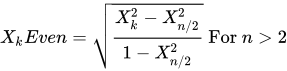
The sign of the function is chosen to be the same as the sign of .


For example, the Chebyshev nodes for a 4th order Chebyshev function are, {0.92388,0.382683,-0.382683,-0.92388}, and is , or 0.146446. Running all the nodes through the translation yields to be {0.910180, 0, 0, -0.910180}.


The modified even order Chebyshev nodes now contains two nodes of zero, and is suitable for use in designing even order Chebyshev filters with equally terminated passive element networks.
Notes
[edit]- ^ Trefethen 2013, pp. 7
- ^ Fink & Mathews 1999, pp. 236–238
- ^ Trefethen 2013, pp. 7
- ^ Stewart 1996, (20.3)
- ^ Stewart 1996, Lecture 20, §14
- ^ Saal, Rudolf (January 1979). Handbook of Filter Design (in English and German) (1st ed.). Munich, Germany: Allgemeine Elektricitais-Gesellschaft. pp. 25, 26, 56–61, 116, 117. ISBN 3-87087-070-2.
References
[edit]- Fink, Kurtis D.; Mathews, John H. (1999). Numerical Methods using MATLAB (3rd ed.). Upper Saddle River NJ: Prentice Hall.
- Stewart, Gilbert W. (1996). Afternotes on Numerical Analysis. SIAM. ISBN 978-0-89871-362-6.
- Trefethen, Lloyd N. (2013), Approximation Theory and Approximation Practice, SIAM
Further reading
[edit]- Burden, Richard L.; Faires, J. Douglas: Numerical Analysis, 8th ed., pages 503–512, ISBN 0-534-39200-8.
