


Complete graph
| Complete graph | |
|---|---|
 K7, a complete graph with 7 vertices | |
| Vertices | n |
| Edges | |
| Radius | |
| Diameter | |
| Girth | |
| Automorphisms | n! (Sn) |
| Chromatic number | n |
| Chromatic index |
|
| Spectrum | |
| Properties | |
| Notation | Kn |
| Table of graphs and parameters | |

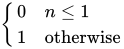
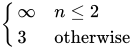
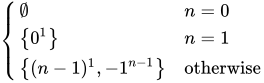
In the mathematical field of graph theory, a complete graph is a simple undirected graph in which every pair of distinct vertices is connected by a unique edge. A complete digraph is a directed graph in which every pair of distinct vertices is connected by a pair of unique edges (one in each direction).[1]
Graph theory itself is typically dated as beginning with Leonhard Euler's 1736 work on the Seven Bridges of Königsberg. However, drawings of complete graphs, with their vertices placed on the points of a regular polygon, had already appeared in the 13th century, in the work of Ramon Llull.[2] Such a drawing is sometimes referred to as a mystic rose.[3]
Properties
[edit]The complete graph on n vertices is denoted by Kn. Some sources claim that the letter K in this notation stands for the German word komplett,[4] but the German name for a complete graph, vollständiger Graph, does not contain the letter K, and other sources state that the notation honors the contributions of Kazimierz Kuratowski to graph theory.[5]
Kn has n(n – 1)/2 edges (a triangular number), and is a regular graph of degree n – 1. All complete graphs are their own maximal cliques. They are maximally connected as the only vertex cut which disconnects the graph is the complete set of vertices. The complement graph of a complete graph is an empty graph.
If the edges of a complete graph are each given an orientation, the resulting directed graph is called a tournament.
Kn can be decomposed into n trees Ti such that Ti has i vertices.[6] Ringel's conjecture asks if the complete graph K2n+1 can be decomposed into copies of any tree with n edges.[7] This is known to be true for sufficiently large n.[8][9]
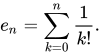
The number of all distinct paths between a specific pair of vertices in Kn+2 is given[10] by

where e refers to Euler's constant, and
The number of matchings of the complete graphs are given by the telephone numbers
- 1, 1, 2, 4, 10, 26, 76, 232, 764, 2620, 9496, 35696, 140152, 568504, 2390480, 10349536, 46206736, ... (sequence A000085 in the OEIS).
These numbers give the largest possible value of the Hosoya index for an n-vertex graph.[11] The number of perfect matchings of the complete graph Kn (with n even) is given by the double factorial (n – 1)!!.[12]
The crossing numbers up to K27 are known, with K28 requiring either 7233 or 7234 crossings. Further values are collected by the Rectilinear Crossing Number project.[13] Rectilinear Crossing numbers for Kn are
- 0, 0, 0, 0, 1, 3, 9, 19, 36, 62, 102, 153, 229, 324, 447, 603, 798, 1029, 1318, 1657, 2055, 2528, 3077, 3699, 4430, 5250, 6180, ... (sequence A014540 in the OEIS).
Geometry and topology
[edit]
A complete graph with n nodes represents the edges of an (n – 1)-simplex. Geometrically K3 forms the edge set of a triangle, K4 a tetrahedron, etc. The Császár polyhedron, a nonconvex polyhedron with the topology of a torus, has the complete graph K7 as its skeleton.[15] Every neighborly polytope in four or more dimensions also has a complete skeleton.
K1 through K4 are all planar graphs. However, every planar drawing of a complete graph with five or more vertices must contain a crossing, and the nonplanar complete graph K5 plays a key role in the characterizations of planar graphs: by Kuratowski's theorem, a graph is planar if and only if it contains neither K5 nor the complete bipartite graph K3,3 as a subdivision, and by Wagner's theorem the same result holds for graph minors in place of subdivisions. As part of the Petersen family, K6 plays a similar role as one of the forbidden minors for linkless embedding.[16] In other words, and as Conway and Gordon[17] proved, every embedding of K6 into three-dimensional space is intrinsically linked, with at least one pair of linked triangles. Conway and Gordon also showed that any three-dimensional embedding of K7 contains a Hamiltonian cycle that is embedded in space as a nontrivial knot.
Examples
[edit]Complete graphs on vertices, for between 1 and 12, are shown below along with the numbers of edges:

| K1: 0 | K2: 1 | K3: 3 | K4: 6 |
|---|---|---|---|

|

|

|

|
| K5: 10 | K6: 15 | K7: 21 | K8: 28 |

|

|

|

|
| K9: 36 | K10: 45 | K11: 55 | K12: 66 |

|

|

|

|
See also
[edit]- Fully connected network, in computer networking
- Complete bipartite graph (or biclique), a special bipartite graph where every vertex on one side of the bipartition is connected to every vertex on the other side
- The simplex, which is identical to a complete graph of vertices, where is the dimension of the simplex.

References
[edit]- ^ Bang-Jensen, Jørgen; Gutin, Gregory (2018), "Basic Terminology, Notation and Results", in Bang-Jensen, Jørgen; Gutin, Gregory (eds.), Classes of Directed Graphs, Springer Monographs in Mathematics, Springer International Publishing, pp. 1–34, doi:10.1007/978-3-319-71840-8_1; see p. 17
- ^ Knuth, Donald E. (2013), "Two thousand years of combinatorics", in Wilson, Robin; Watkins, John J. (eds.), Combinatorics: Ancient and Modern, Oxford University Press, pp. 7–37, ISBN 978-0191630620.
- ^ Mystic Rose, nrich.maths.org, retrieved 23 January 2012.
- ^ Gries, David; Schneider, Fred B. (1993), A Logical Approach to Discrete Math, Springer-Verlag, p. 436, ISBN 0387941150.
- ^ Pirnot, Thomas L. (2000), Mathematics All Around, Addison Wesley, p. 154, ISBN 9780201308150.
- ^ Joos, Felix; Kim, Jaehoon; Kühn, Daniela; Osthus, Deryk (2019-08-05). "Optimal packings of bounded degree trees" (PDF). Journal of the European Mathematical Society. 21 (12): 3573–3647. doi:10.4171/JEMS/909. ISSN 1435-9855. S2CID 119315954. Archived (PDF) from the original on 2020-03-09. Retrieved 2020-03-09.
- ^ Ringel, G. (1963). Theory of Graphs and its Applications. Proceedings of the Symposium Smolenice.
- ^ Montgomery, Richard; Pokrovskiy, Alexey; Sudakov, Benny (2021). "A proof of Ringel's Conjecture". Geometric and Functional Analysis. 31 (3): 663–720. arXiv:2001.02665. doi:10.1007/s00039-021-00576-2.
- ^ Hartnett, Kevin. "Rainbow Proof Shows Graphs Have Uniform Parts". Quanta Magazine. Archived from the original on 2020-02-20. Retrieved 2020-02-20.
- ^ Hassani, M. "Cycles in graphs and derangements." Math. Gaz. 88, 123–126, 2004.
- ^ Tichy, Robert F.; Wagner, Stephan (2005), "Extremal problems for topological indices in combinatorial chemistry" (PDF), Journal of Computational Biology, 12 (7): 1004–1013, CiteSeerX 10.1.1.379.8693, doi:10.1089/cmb.2005.12.1004, PMID 16201918, archived (PDF) from the original on 2017-09-21, retrieved 2012-03-29.
- ^ Callan, David (2009), A combinatorial survey of identities for the double factorial, arXiv:0906.1317, Bibcode:2009arXiv0906.1317C.
- ^ Oswin Aichholzer. "Rectilinear Crossing Number project". Archived from the original on 2007-04-30.
- ^ Ákos Császár, A Polyhedron Without Diagonals. Archived 2017-09-18 at the Wayback Machine, Bolyai Institute, University of Szeged, 1949
- ^ Gardner, Martin (1988), Time Travel and Other Mathematical Bewilderments, W. H. Freeman and Company, p. 140, Bibcode:1988ttom.book.....G, ISBN 0-7167-1924-X
- ^ Robertson, Neil; Seymour, P. D.; Thomas, Robin (1993), "Linkless embeddings of graphs in 3-space", Bulletin of the American Mathematical Society, 28 (1): 84–89, arXiv:math/9301216, doi:10.1090/S0273-0979-1993-00335-5, MR 1164063, S2CID 1110662.
- ^ Conway, J. H.; Cameron Gordon (1983). "Knots and Links in Spatial Graphs". Journal of Graph Theory. 7 (4): 445–453. doi:10.1002/jgt.3190070410.
External links
[edit]

| International | |
|---|---|
| National | |

