


Doctor Dolittle
| Doctor Dolittle | |
|---|---|
 Portrait from the title page of The Story of Doctor Dolittle. | |
| First appearance | The Story of Doctor Dolittle (1920) |
| Created by | Hugh Lofting |
| Portrayed by | |
| Voiced by | Bob Holt {1970} John Stephenson (The Voyages of Dr. Dolittle, 1984) |
| In-universe information | |
| Alias | King Jong Thinkalot |
| Gender | Male |
| Occupation | Doctor, naturalist |
| Family | Lisa Dolittle (wife, 1998 series) Charisse Dolittle (daughter, 1998 series) Maya Dolittle (daughter, 1998 series) Lily Dolittle (wife, 2020 film) |
| Relatives | Sarah Dolittle (sister) Archer Dolittle (father, 1998 series) |
| Nationality | British American (1998–2001) |

Doctor John Dolittle is the central character of a series of children's books by Hugh Lofting starting with the 1920 The Story of Doctor Dolittle. He is a physician who shuns human patients in favour of animals, with whom he can speak in their own languages. He later becomes a naturalist, using his abilities to speak with animals to better understand nature and the history of the world.[1]
Doctor Dolittle first appeared in the author's illustrated letters to his children, written from the trenches during World War I when actual news, he later said, was either too horrible or too dull. The stories are set in early Victorian England, where Doctor John Dolittle lives in the fictional English village of Puddleby-on-the-Marsh in the West Country.[1]
Doctor Dolittle has a few close human friends, including his young assistant Tommy Stubbins, and Matthew Mugg, the Cats'-Meat Man. The animal team includes Polynesia (a parrot), Gub-Gub (a pig), Jip (a dog), Dab-Dab (a duck), Chee-Chee (a monkey), Too-Too (an owl), the Pushmi-pullyu, and a white mouse later named simply "Whitey".[1] Later on, in the 1925 novel Doctor Dolittle's Zoo, Whitey founds (with the doctor's help) the Rat and Mouse Club, whose membership eventually reaches some 5,000 rats and mice.
Inspiration
[edit]One inspiration for his character appears to be the Scottish surgeon John Hunter.[2][3]
Stories
[edit]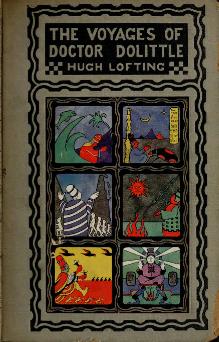
The Story of Doctor Dolittle: Being the History of His Peculiar Life at Home and Astonishing Adventures in Foreign Parts Never Before Printed (1920) begins the series. The sequel The Voyages of Doctor Dolittle (1922) won the prestigious Newbery Medal. The next three, Doctor Dolittle's Post Office (1923), Doctor Dolittle's Circus (1924), and Doctor Dolittle's Caravan (1926) take place during and/or after the events of The Story of Doctor Dolittle. Five more novels followed, and after Lofting's death in 1947, two more volumes of short, previously unpublished pieces appeared.
The stories, in order of publication, are:
- The Story of Doctor Dolittle (1920)
- The Voyages of Doctor Dolittle (1922)
- Doctor Dolittle's Post Office (1923)
- Doctor Dolittle's Circus (1924)
- "Doctor Dolittle Meets a Londoner in Paris" (1925)
- Doctor Dolittle's Zoo (1925)
- Doctor Dolittle's Caravan (1926)
- Doctor Dolittle's Garden (1927)
- Doctor Dolittle in the Moon (1928)
- Gub Gub's Book: An Encyclopaedia of Food (1932)
- Doctor Dolittle's Return (1933)
- Doctor Dolittle's Birthday Book (1936)
- Doctor Dolittle and the Secret Lake (copyrighted 1923, but not published until 1948)
- Doctor Dolittle and the Green Canary (1950)
- Doctor Dolittle's Puddleby Adventures (1952)
- "The Sea Dog"
- "Dapple"
- "The Dog Ambulance"
- "The Stunned Man"
- "The Crested Screamers"
- "The Green Breasted Martins"
- "The Story of the Maggot"
- "The Lost Boy"
Gub Gub's Book: An Encyclopaedia of Food (1932) is purportedly written by the pig Gub-Gub. It is a series of food-themed animal vignettes. In the text, the pretence of Gub-Gub's authorship is dropped; Tommy Stubbins, Dr. Dolittle's assistant, explains that he is reporting a series of Gub-Gub's discourses to the other animals of the Dolittle household around the evening fire. Stubbins also says that the full version of Gub-Gub's encyclopaedia, which was an immense and poorly-organized collection of scribblings written by the pig in a language for pigs invented by Dr. Dolittle, was too long to translate into English.
Doctor Dolittle's Birthday Book (1936) is a little day-book illustrated with pictures and quotations from the earlier stories. It appeared between Doctor Dolittle's Return and Doctor Dolittle and the Secret Lake.
"Doctor Dolittle Meets a Londoner in Paris" is a short story included in The Flying Carpet, pp. 110–19 (1925), an anthology of children's short stories and poems with illustrations by Cynthia Asquith.
The character entered public domain in the 1990s, which allowed for the legal creation of derivative works based on it without the need to acquire permission from the Lofting estate, which was required previously.[4][5][6] For example, in April 2021, the Japanese biologist Shinichi Fukuoka created a new story Dr. Dolittle Saves Galápagos Islands which appeared in The Asahi Shimbun.[7][8]
Chronology
[edit]The main events of The Story of Doctor Dolittle take place in 1819 or 1820,[9] although the events of the early chapters seem to be spread over several years. The Voyages of Doctor Dolittle begins in 1839.[10]
Dolittle returned from his journey to the moon in Doctor Dolittle's return during a full lunar eclipse that was visible low in the sky one late evening in spring. This was the first full lunar eclipse for a couple of years, and it took place in May 1844 in real life.[11][12]
Backstory references indicate that Dr. Dolittle travelled to the North Pole in April 1809, and already knew how to speak to some species of animals at that date, suggesting that the early chapters of The Story of Doctor Dolittle take place before that date.[13] However, it is possible that the internal chronology is not consistent.
The internal chronology of the books is somewhat different from the publishing order. The first book is followed by Doctor Dolittle's Circus (1924), Doctor Dolittle's Caravan (1926), and Doctor Dolittle and the Green Canary (1950). Only then follows the second book, The Voyages of Doctor Dolittle (1922), continued by Doctor Dolittle's Zoo (1925). After that, the publishing order is restored; Doctor Dolittle's Garden (1927) is followed by Doctor Dolittle in the Moon (1928) and Doctor Dolittle's Return (1933), ending with Doctor Dolittle and the Secret Lake (1948).[14]
Doctor Dolittle's Post Office (1923) can't be placed anywhere in the internal chronology without creating contradictions. Doctor Dolittle's Circus contains references to events that occurred in Post Office, indicating that Post Office must precede Circus.[15] But the Prologue of Post Office indicates just as definitely that it must happen sometime after Circus.[16] Furthermore, in the narrative sequence that stretches from the end of the first book, through Circus and Caravan, to Green Canary, there's no gap into which Post Office could be inserted. For the sake of a reading order, the most logical options are to place Post Office immediately before Circus, or immediately after Green Canary.
The stories, in order of internal chronology, are:
- The Story of Doctor Dolittle (1920)
- "The Green Breasted Martins" (follows Chapter XII in The Story of Doctor Dolittle; collected in Doctor Dolittle's Puddleby Adventures (1952))
- Doctor Dolittle's Circus (1924)
- Doctor Dolittle's Caravan (1926)
- "The Crested Screamers" (takes place within Part One, Chapter 12 of Doctor Dolittle's Caravan; collected in Doctor Dolittle's Puddleby Adventures (1952))
- "The Lost Boy" (takes place within Part One, Chapter 12 of Doctor Dolittle's Caravan; collected in Doctor Dolittle's Puddleby Adventures (1952))
- "Doctor Dolittle Meets a Londoner in Paris" (1925 – uncollected)
- Doctor Dolittle's Post Office (1923)
- The Voyages of Doctor Dolittle (1922)
- Doctor Dolittle's Zoo (1925)
- Doctor Dolittle's Garden (1927)
- "The Sea Dog" (takes place at the beginning of Doctor Dolittle's Garden; collected in Doctor Dolittle's Puddleby Adventures (1952))
- "Dapple" (takes place at the beginning of Doctor Dolittle's Garden; collected in Doctor Dolittle's Puddleby Adventures (1952))
- "The Dog Ambulance" (takes place at the beginning of Doctor Dolittle's Garden; collected in Doctor Dolittle's Puddleby Adventures (1952))
- "The Stunned Man" (takes place at the beginning of Doctor Dolittle's Garden; collected in Doctor Dolittle's Puddleby Adventures (1952))
- "The Story of the Maggot" (given a greatly reduced summary at the conclusion to early printings of Part Two, Chapter 4 of Doctor Dolittle's Garden; collected in Doctor Dolittle's Puddleby Adventures (1952))
- Gub Gub's Book: An Encyclopaedia of Food (1932)
- Doctor Dolittle in the Moon (1928)
- Doctor Dolittle's Return (1933)
- Doctor Dolittle's Birthday Book (1936)
- Doctor Dolittle and the Secret Lake (copyrighted 1923, but not published until 1948)
Adaptations
[edit]There have been a number of adaptations of the Doctor Dolittle stories in other media:
Animation:
- 1928: Doktor Dolittle und seine Tiere (Doctor Dolittle and his Animals), a silent animated short in German by Lotte Reiniger[17][18]
- 1970–1972: Doctor Dolittle animated TV series, produced at DePatie-Freleng Enterprises for 20th Century Fox Television[19][circular reference]
- 1984: The Voyages of Doctor Dolittle (ドリトルせんせいものがたり) (U.S.-Japan coproduction, not aired in Japan until 1997)
- 2011: The Voyages of Young Doctor Dolittle direct-to-video animated film, starring Jane Seymour, Jason Alexander, and Tim Curry[20]
Audio:
- 1933–1934: NBC radio series[18]
- 1995–2001: BBC audio books read by Alan Bennett[21]
Stages
- 1973: stage adaptation by the Philadelphia Boys Choir & Chorale, which was used during their concert tour to Belgium and Kenya[22]
- 1998: Doctor Dolittle stage musical by Leslie Bricusse, based on the 1967 film musical[23][circular reference]
- 2007: stage musical adaptation by TheatreWorksUSA, written by Randy Courts and Mark St. Germain[24]
Film:
- 1967: Doctor Dolittle, starring Rex Harrison[25]
- 1998: Dr. Dolittle and its sequels: Dr. Dolittle 2 (2001), Dr. Dolittle 3 (2006), Dr. Dolittle: Tail to the Chief (2008), and Dr. Dolittle: Million Dollar Mutts (2009). The first two star Eddie Murphy in the title role, whereas all five star Kyla Pratt as his daughter, Maya. Norm Macdonald appears in each film as the voice of their dog, Lucky.
- 2020: Dolittle, a live action adaptation starring Robert Downey Jr., Michael Sheen, and Antonio Banderas.[26]
Video games:
- 2006: Dr. Dolittle PS2 video game produced by Aqua Pacific and distributed by Blast! Entertainment Ltd.
Appearances in other languages
[edit]A Russian children's novel Doctor Aybolit (Doctor Oh-it-hurts) by Korney Chukovsky (first published in 1924) was loosely based on the stories of Doctor Dolittle. The original novel credited Lofting's work,[27] as did Chukovsky in his memoirs.[28]
Norwegian playwright, songwriter, and illustrator Thorbjørn Egner made an album called Doktor Dyregod (Doctor good-toward-animals) with songs and story based on Doctor Dolittle.
All the books in the series have been translated into Japanese by Masuji Ibuse and into Lithuanian by Pranas Mašiotas.
See also
[edit]References
[edit]- ^ a b c Schmidt, G. D. (1992). Hugh Lofting. New York: Twayne Publishing
- ^ Goddard, J. (2005). "The Knife Man: the Extraordinary Life and Times of John Hunter, Father of Modern Surgery". J R Soc Med. 98 (7): 335. doi:10.1177/014107680509800718. PMC 1168927.
- ^ Conniff, Richard (27 February 2011). "How Species Save Our Lives". The New York Times. Retrieved 2011-03-31.
- ^ "Rewriting History: Copyright, Free Speech, and Reimagining Classic Works". Villanova Law Review. 69 (2): 319–360. 2024.
{{cite journal}}:|first=missing|last=(help) - ^ Smith, Cathay (2023-03-07). "From Roald Dahl to Goosebumps, revisions to children's classics are really about copyright – a legal expert explains". The Conversation. Retrieved 2024-08-21.
- ^ Smith, Cathay Y. N. (2024-01-12). "Editing Classic Books: A Threat to the Public Domain? - Virginia Law Review". virginialawreview.org. Retrieved 2024-08-21.
- ^ "ドリトル先生 ガラパゴスを救う-福岡伸一:朝日新聞デジタル". 2021-04-11. Archived from the original on 2021-04-11. Retrieved 2024-08-21.
- ^ "福岡伸一さん×新津ちせさん 新ドリトル先生物語刊行で読書愛語る:朝日新聞デジタル". 朝日新聞デジタル (in Japanese). 2022-07-29. Retrieved 2024-08-21.
- ^ "I can never be quite sure of my age", said Polynesia. "It's either a hundred and eighty-three or a hundred and eighty-two. But I know that when I first came here from Africa, King Charles was still hiding in the oak-tree — because I saw him. He looked scared to death". ... "Dear old Africa!" sighed Polynesia. "It's good to get back. Just think — it'll be a hundred and sixty-nine years to-morrow since I was here!" — The Story of Doctor Dolittle
- ^ "Of course now, when almost everybody in the whole world has heard about Doctor Dolittle and his books, if you were to go to that little house in Puddleby where my father had his cobbler's shop you would see, set in the wall over the old-fashioned door, a stone with writing in it which says: 'JOHN DOLITTLE, THE FAMOUS NATURALIST, PLAYED THE FLUTE IN THIS HOUSE IN THE YEAR 1839'". — The Voyages of Doctor Dolittle, part 1, chapter 6.
- ^ "Total Lunar Eclipse of 31 May, 1844". 31 July 2021.
- ^ "There were several high trees near the house; and at half-past ten the moon looked as though it might very soon be hidden by their top branches—that is, if one tried to watch the eclipse from the garden". — Doctor Dolittle"s return, chapter 3
- ^ "Yes, I discovered the North Pole in April, 1809. But shortly after I got there the polar bears came to me in a body and told me there was a great deal of coal there, buried beneath the snow. They knew, they said, that human beings would do anything, and go anywhere, to get coal. So would I please keep it a secret". — The Voyages of Doctor Dolittle, part 2, chapter 11.
- ^ Schmidt, G.D. (1992). Hugh Lofting. New York: Twayne Publishing
- ^ In Part 1, Chapter 1 of Circus, Matthew Mugg says to Dolittle, "I got your letter about the sparrow." This refers to a letter written in Part 2, Chapter 1 of Post Office. In Circus Part 1, Chapter 6, Sophie the seal says she heard about the Doctor through the animals' post office. Part 1, Chapter 7, concerns a seagull who brought Dolittle "the warning about Cape Stephen Light," an incident from Post Office.
- ^ Circus begins with the pushmi-pullyu's arrival in England, and the Prologue of Post Office states that it takes place after the pushmi-pullyu has had "a long stay in England."
- ^ "Dr. Dolittle and His Animals" – via www.imdb.com.
- ^ a b "Doctor Dolittle (1967)". Turner Classic Movies.
- ^ Doctor Dolittle (TV series)
- ^ "The Voyages of Young Doctor Dolittle" – via www.imdb.com.
- ^ Alan Bennett: Doctor Dolittle Stories: Classic readings from the BBC archive (Classic Readings from the BBC Archives): Amazon.co.uk: Hugh Lofting, Alan Bennett: 9781785296833: Books. ASIN 1785296833.
- ^ "Doctor Dolittle". techsciencenews.com. Archived from the original on 2018-04-27. Retrieved 2018-04-26.
- ^ Doctor Dolittle (musical)
- ^ "Archived copy" (PDF). Archived from the original (PDF) on 2018-04-26. Retrieved 2018-04-26.
{{cite web}}: CS1 maint: archived copy as title (link) - ^ "Doctor Dolittle" – via www.imdb.com.
- ^ "Robert Downey Jr. to star in The Voyage of Doctor Dolittle". The List. 21 March 2017.
- ^
Kuriy, Sergei (4 April 2012). Является ли "Айболит" К. Чуковского плагиатом "Доктора Дулиттла"? [Is Chukovsky's Doctor Aybolit a plagiarism of Doctor Dolittle?] (in Russian). Retrieved 24 October 2013.
In 1924, Dolittle garnered noticed in Soviet Russia. A publisher ordered two translations. The first was designed for older children, and was written by E. Khavkin. This version was subsequently forgotten and never republished. The second version bore the title Гай Лофтинг. Доктор Айболит. Для маленьких детей пересказал К. Чуковский [Hugh Lofting. Doctor Veterinarian. For young children, as told by K. Chukovsky].
- ^ Chukovsky, Korney. "The Story of my 'Doctor Dolittle'". Archived from the original on 13 February 2008. Retrieved 24 October 2013.
External links
[edit]
- A collection of Doctor Dolittle eBooks at Standard Ebooks
- The Voyages of Dr. Dolittle, full text
- Dr. Dolittle und seine Tiere at IMDb (1928 cartoon)
- Doctor Dolittle at IMDb (1970–1972 cartoon)
- The Voyages of Dr. Dolittle at IMDb (1984 cartoon)
- Doctor Dolittle first editions listed with images – https://sites.google.com/site/hughloftingfirsteditionsuk/

- Doctor Dolittle
- Book series introduced in 1920
- Characters in British novels of the 20th century
- Characters in children's literature
- Characters in fantasy literature
- Fantasy novel series
- Fiction about talking animals
- Fictional British medical doctors
- Fictional characters from the 19th century
- Fictional characters who can communicate with animals
- Fictional English people
- Fictional polyglots
- Fictional veterinarians
- Literary characters introduced in 1920
- Series of children's books