


Energy–momentum relation
In physics, the energy–momentum relation, or relativistic dispersion relation, is the relativistic equation relating total energy (which is also called relativistic energy) to invariant mass (which is also called rest mass) and momentum. It is the extension of mass–energy equivalence for bodies or systems with non-zero momentum.
It can be formulated as:
|
| (1) |

This equation holds for a body or system, such as one or more particles, with total energy E, invariant mass m0, and momentum of magnitude p; the constant c is the speed of light. It assumes the special relativity case of flat spacetime[1][2][3] and that the particles are free. Total energy is the sum of rest energy and relativistic kinetic energy: Invariant mass is mass measured in a center-of-momentum frame. For bodies or systems with zero momentum, it simplifies to the mass–energy equation , where total energy in this case is equal to rest energy.


The Dirac sea model, which was used to predict the existence of antimatter, is closely related to the energy–momentum relation.
Connection to E = mc2
[edit]
The energy–momentum relation is consistent with the familiar mass–energy relation in both its interpretations: E = mc2 relates total energy E to the (total) relativistic mass m (alternatively denoted mrel or mtot), while E0 = m0c2 relates rest energy E0 to (invariant) rest mass m0.
Unlike either of those equations, the energy–momentum equation (1) relates the total energy to the rest mass m0. All three equations hold true simultaneously.
Special cases
[edit]- If the body is a massless particle (m0 = 0), then (1) reduces to E = pc. For photons, this is the relation, discovered in 19th century classical electromagnetism, between radiant momentum (causing radiation pressure) and radiant energy.
- If the body's speed v is much less than c, then (1) reduces to E = 1/2m0v2 + m0c2; that is, the body's total energy is simply its classical kinetic energy (1/2m0v2) plus its rest energy.
- If the body is at rest (v = 0), i.e. in its center-of-momentum frame (p = 0), we have E = E0 and m = m0; thus the energy–momentum relation and both forms of the mass–energy relation (mentioned above) all become the same.
A more general form of relation (1) holds for general relativity.
The invariant mass (or rest mass) is an invariant for all frames of reference (hence the name), not just in inertial frames in flat spacetime, but also accelerated frames traveling through curved spacetime (see below). However the total energy of the particle E and its relativistic momentum p are frame-dependent; relative motion between two frames causes the observers in those frames to measure different values of the particle's energy and momentum; one frame measures E and p, while the other frame measures E′ and p′, where E′ ≠ E and p′ ≠ p, unless there is no relative motion between observers, in which case each observer measures the same energy and momenta. Although we still have, in flat spacetime:

The quantities E, p, E′, p′ are all related by a Lorentz transformation. The relation allows one to sidestep Lorentz transformations when determining only the magnitudes of the energy and momenta by equating the relations in the different frames. Again in flat spacetime, this translates to;

Since m0 does not change from frame to frame, the energy–momentum relation is used in relativistic mechanics and particle physics calculations, as energy and momentum are given in a particle's rest frame (that is, E′ and p′ as an observer moving with the particle would conclude to be) and measured in the lab frame (i.e. E and p as determined by particle physicists in a lab, and not moving with the particles).
In relativistic quantum mechanics, it is the basis for constructing relativistic wave equations, since if the relativistic wave equation describing the particle is consistent with this equation – it is consistent with relativistic mechanics, and is Lorentz invariant. In relativistic quantum field theory, it is applicable to all particles and fields.[4]
Origins and derivation of the equation
[edit]The energy–momentum relation goes back to Max Planck's article[5] published in 1906. It was used by Walter Gordon in 1926 and then by Paul Dirac in 1928 under the form , where V is the amount of potential energy.[6][7]

The equation can be derived in a number of ways, two of the simplest include:
- From the relativistic dynamics of a massive particle,
- By evaluating the norm of the four-momentum of the system. This method applies to both massive and massless particles, and can be extended to multi-particle systems with relatively little effort (see § Many-particle systems below).
Heuristic approach for massive particles
[edit]For a massive object moving at three-velocity u = (ux, uy, uz) with magnitude |u| = u in the lab frame:[1]
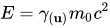
is the total energy of the moving object in the lab frame,

is the three dimensional relativistic momentum of the object in the lab frame with magnitude |p| = p. The relativistic energy E and momentum p include the Lorentz factor defined by:
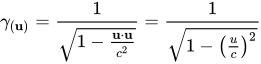
Some authors use relativistic mass defined by:

although rest mass m0 has a more fundamental significance, and will be used primarily over relativistic mass m in this article.
Squaring the 3-momentum gives:
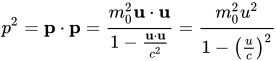
then solving for u2 and substituting into the Lorentz factor one obtains its alternative form in terms of 3-momentum and mass, rather than 3-velocity:
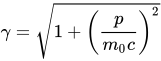
Inserting this form of the Lorentz factor into the energy equation gives:
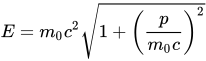
followed by more rearrangement it yields (1). The elimination of the Lorentz factor also eliminates implicit velocity dependence of the particle in (1), as well as any inferences to the "relativistic mass" of a massive particle. This approach is not general as massless particles are not considered. Naively setting m0 = 0 would mean that E = 0 and p = 0 and no energy–momentum relation could be derived, which is not correct.
Norm of the four-momentum
[edit]
Special relativity
[edit]In Minkowski space, energy (divided by c) and momentum are two components of a Minkowski four-vector, namely the four-momentum;[8]
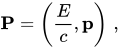
(these are the contravariant components).
The Minkowski inner product ⟨ , ⟩ of this vector with itself gives the square of the norm of this vector, it is proportional to the square of the rest mass m of the body:

a Lorentz invariant quantity, and therefore independent of the frame of reference. Using the Minkowski metric η with metric signature (− + + +), the inner product is

and

so

or, in natural units where c = 1,
- .

General relativity
[edit]In general relativity, the 4-momentum is a four-vector defined in a local coordinate frame, although by definition the inner product is similar to that of special relativity,
in which the Minkowski metric η is replaced by the metric tensor field g:

solved from the Einstein field equations. Then:[9]

Performing the summations over indices followed by collecting "time-like", "spacetime-like", and "space-like" terms gives:

where the factor of 2 arises because the metric is a symmetric tensor, and the convention of Latin indices i, j taking space-like values 1, 2, 3 is used. As each component of the metric has space and time dependence in general; this is significantly more complicated than the formula quoted at the beginning, see metric tensor (general relativity) for more information.
Units of energy, mass and momentum
[edit]In natural units where c = 1, the energy–momentum equation reduces to
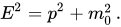
In particle physics, energy is typically given in units of electron volts (eV), momentum in units of eV·c−1, and mass in units of eV·c−2. In electromagnetism, and because of relativistic invariance, it is useful to have the electric field E and the magnetic field B in the same unit (Gauss), using the cgs (Gaussian) system of units, where energy is given in units of erg, mass in grams (g), and momentum in g·cm·s−1.
Energy may also in theory be expressed in units of grams, though in practice it requires a large amount of energy to be equivalent to masses in this range. For example, the first atomic bomb liberated about 1 gram of heat, and the largest thermonuclear bombs have generated a kilogram or more of heat. Energies of thermonuclear bombs are usually given in tens of kilotons and megatons referring to the energy liberated by exploding that amount of trinitrotoluene (TNT).
Special cases
[edit]Centre-of-momentum frame (one particle)
[edit]For a body in its rest frame, the momentum is zero, so the equation simplifies to

where m0 is the rest mass of the body.
Massless particles
[edit]If the object is massless, as is the case for a photon, then the equation reduces to

This is a useful simplification. It can be rewritten in other ways using the de Broglie relations:
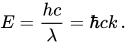
if the wavelength λ or wavenumber k are given.
Correspondence principle
[edit]Rewriting the relation for massive particles as:
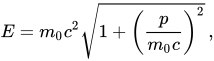
and expanding into power series by the binomial theorem (or a Taylor series):
![{\displaystyle E=m_{0}c^{2}\left[1+{\frac {1}{2}}\left({\frac {p}{m_{0}c}}\right)^{2}-{\frac {1}{8}}\left({\frac {p}{m_{0}c}}\right)^{4}+\cdots \right]\,,}](https://wikimedia.org/api/rest_v1/media/math/render/svg/73e1b985b3bdff59b33935e9347e3eb6eb7aac22)
in the limit that u ≪ c, we have γ(u) ≈ 1 so the momentum has the classical form p ≈ m0u, then to first order in (p/m0c)2
(i.e. retain the term (p/m0c)2n
for n = 1 and neglect all terms for n ≥ 2) we have
![{\displaystyle E\approx m_{0}c^{2}\left[1+{\frac {1}{2}}\left({\frac {m_{0}u}{m_{0}c}}\right)^{2}\right]\,,}](https://wikimedia.org/api/rest_v1/media/math/render/svg/5705f3941aff6e1a40e6f8302c2b87b3eb139c8b)
or
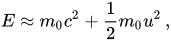
where the second term is the classical kinetic energy, and the first is the rest energy of the particle. This approximation is not valid for massless particles, since the expansion required the division of momentum by mass. Incidentally, there are no massless particles in classical mechanics.
Many-particle systems
[edit]Addition of four momenta
[edit]In the case of many particles with relativistic momenta pn and energy En, where n = 1, 2, ... (up to the total number of particles) simply labels the particles, as measured in a particular frame, the four-momenta in this frame can be added;

and then take the norm; to obtain the relation for a many particle system:

where M0 is the invariant mass of the whole system, and is not equal to the sum of the rest masses of the particles unless all particles are at rest (see mass in special relativity for more detail). Substituting and rearranging gives the generalization of (1);
|
| (2) |
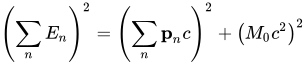
The energies and momenta in the equation are all frame-dependent, while M0 is frame-independent.
Center-of-momentum frame
[edit]In the center-of-momentum frame (COM frame), by definition we have:

with the implication from (2) that the invariant mass is also the centre of momentum (COM) mass–energy, aside from the c2 factor:

and this is true for all frames since M0 is frame-independent. The energies ECOM n are those in the COM frame, not the lab frame. However, many familiar bound systems have the lab frame as COM frame, since the system itself is not in motion and so the momenta all cancel to zero. An example would be a simple object (where vibrational momenta of atoms cancel) or a container of gas where the container is at rest. In such systems, all the energies of the system are measured as mass. For example the heat in an object on a scale, or the total of kinetic energies in a container of gas on the scale, all are measured by the scale as the mass of the system.
Rest masses and the invariant mass
[edit]Either the energies or momenta of the particles, as measured in some frame, can be eliminated using the energy momentum relation for each particle:

allowing M0 to be expressed in terms of the energies and rest masses, or momenta and rest masses. In a particular frame, the squares of sums can be rewritten as sums of squares (and products):


so substituting the sums, we can introduce their rest masses mn in (2):

The energies can be eliminated by:

similarly the momenta can be eliminated by:

where θnk is the angle between the momentum vectors pn and pk.
Rearranging:

Since the invariant mass of the system and the rest masses of each particle are frame-independent, the right hand side is also an invariant (even though the energies and momenta are all measured in a particular frame).
Matter waves
[edit]Using the de Broglie relations for energy and momentum for matter waves,

where ω is the angular frequency and k is the wavevector with magnitude |k| = k, equal to the wave number, the energy–momentum relation can be expressed in terms of wave quantities:

and tidying up by dividing by (ħc)2 throughout:
|
| (3) |
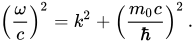
This can also be derived from the magnitude of the four-wavevector
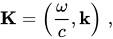
in a similar way to the four-momentum above.
Since the reduced Planck constant ħ and the speed of light c both appear and clutter this equation, this is where natural units are especially helpful. Normalizing them so that ħ = c = 1, we have:
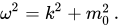
Tachyon and exotic matter
[edit]The velocity of a bradyon with the relativistic energy–momentum relation

can never exceed c. On the contrary, it is always greater than c for a tachyon whose energy–momentum equation is[10]

By contrast, the hypothetical exotic matter has a negative mass[11] and the energy–momentum equation is

See also
[edit]References
[edit]- ^ a b Kleppner, Daniel; Robert J. Kolenkow (2010) [1973]. An Introduction to Mechanics. Cambridge University Press. pp. 499–500. ISBN 978-0-521-19821-9.
- ^ J.R. Forshaw; A.G. Smith (2009). Dynamics and Relativity. Wiley. pp. 149, 249. ISBN 978-0-470-01460-8.
- ^ D. McMahon (2006). Relativity. DeMystified. Mc Graw Hill (USA). p. 20. ISBN 0-07-145545-0.
- ^ D. McMahon (2008). Quantum Field Theory. DeMystified. Mc Graw Hill (USA). pp. 11, 88. ISBN 978-0-07-154382-8.
- ^ Planck, Max (1906). "Das Prinzip der Relativität und die Grundgleichungen der Mechanik". Verhandlungen der Deutschen Physikalischen Gesellschaft. 8 (7): 136–141.
- ^ Gordon, Walter (1926). "The Compton effect according to Schrödinger's theory". Z. Phys. 40: 117–133. doi:10.1007/BF01390840. S2CID 122254400.
- ^ Dirac, Paul (1928). "The Quantum Theory of the Electron". Proc. R. Soc. Lond. A. 117 (778): 610–624. Bibcode:1928RSPSA.117..610D. doi:10.1098/rspa.1928.0023.
- ^ J.R. Forshaw; A.G. Smith (2009). Dynamics and Relativity. Wiley. pp. 258–259. ISBN 978-0-470-01460-8.
- ^ J.A. Wheeler; C. Misner; K.S. Thorne (1973). Gravitation. W.H. Freeman & Co. pp. 201, 649, 1188. ISBN 0-7167-0344-0.
- ^ G. Feinberg (1967). "Possibility of faster-than-light particles". Physical Review. 159 (5): 1089–1105. Bibcode:1967PhRv..159.1089F. doi:10.1103/PhysRev.159.1089.
- ^ Z.Y.Wang (2016). "Modern Theory for Electromagnetic Metamaterials". Plasmonics. 11 (2): 503–508. doi:10.1007/s11468-015-0071-7. S2CID 122346519.
- A. Halpern (1988). 3000 Solved Problems in Physics, Schaum Series. McGraw-Hill. pp. 704–705. ISBN 978-0-07-025734-4.
- G. Woan (2010). The Cambridge Handbook of Physics Formulas. Cambridge University Press. p. 65. ISBN 978-0-521-57507-2.
- C.B. Parker (1994). McGraw-Hill Encyclopaedia of Physics (2nd ed.). McGraw-Hill. pp. 1192, 1193. ISBN 0-07-051400-3.
- R.G. Lerner; G.L. Trigg (1991). Encyclopaedia of Physics (2nd ed.). VHC Publishers. p. 1052. ISBN 0-89573-752-3.