


Tachyon
| Classification | Elementary particle |
|---|---|
| Status | Hypothetical |
| Theorized | 1967 |
A tachyon (/ˈtækiɒn/) or tachyonic particle is a hypothetical particle that always travels faster than light. Physicists believe that faster-than-light particles cannot exist because they are inconsistent with the known laws of physics.[1][2] If such particles did exist they could be used to send signals faster than light and into the past. According to the theory of relativity this would violate causality, leading to logical paradoxes such as the grandfather paradox.[1] Tachyons would exhibit the unusual property of increasing in speed as their energy decreases, and would require infinite energy to slow to the speed of light. No verifiable experimental evidence for the existence of such particles has been found.
In the 1967 paper that coined the term, Gerald Feinberg proposed that tachyonic particles could be made from excitations of a quantum field with imaginary mass.[3] However, it was soon realized that Feinberg's model did not in fact allow for superluminal (faster-than-light) particles or signals and that tachyonic fields merely give rise to instabilities, not causality violations.[4] The term tachyonic field refers to imaginary mass fields rather than to faster-than-light particles.[2][5]
Etymology
[edit]The term tachyon comes from the Greek: ταχύς, tachus, meaning swift.[6]: 515 The complementary particle types are called luxons (which always move at the speed of light) and bradyons (which always move slower than light); both of these particle types are known to exist.
History
[edit]The first hypothesis regarding faster-than-light particles is sometimes attributed to physicist Arnold Sommerfeld, who, in 1904, named them "meta-particles".[7][8] The possibility of existence of faster-than-light particles was also proposed by Lev Yakovlevich Shtrum in 1923.[9]
The term tachyon was coined by Gerald Feinberg in a 1967 paper titled "Possibility of faster-than-light particles".[3] He had been inspired by the science-fiction story "Beep" by James Blish.[10] Feinberg studied the kinematics of such particles according to special relativity. In his paper, he also introduced fields with imaginary mass (now also referred to as tachyons) in an attempt to understand the microphysical origin such particles might have.
Oleksa-Myron Bilanuik, Vijay Deshpande and E. C. George Sudarshan discussed this more recently in their 1962 paper on the topic[11] and in 1969.[12]
In September 2011, it was reported that a tau neutrino had traveled faster than the speed of light; however, later updates from CERN on the OPERA experiment indicate that the faster-than-light readings were due to a faulty element of the experiment's fibre optic timing system.[13]
Special relativity
[edit]In special relativity, a faster-than-light particle would have spacelike four-momentum,[3] unlike ordinary particles that have time-like four-momentum. While some theories suggest the mass of tachyons is imaginary, modern formulations often consider their mass to be real,[14][15][16] with redefined formulas for momentum and energy. Additionally, since tachyons are confined to the spacelike portion of the energy–momentum graph, they cannot slow down to subluminal (slower-than-light) speeds.[3]
Mass
[edit]In a Lorentz invariant theory, the same formulas that apply to ordinary slower-than-light particles (sometimes called bradyons in discussions of tachyons) must also apply to tachyons. In particular, the energy–momentum relation:

(where p is the relativistic momentum of the bradyon and m is its rest mass) should still apply, along with the formula for the total energy of a particle:
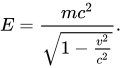
This equation shows that the total energy of a particle (bradyon or tachyon) contains a contribution from its rest mass (the "rest mass–energy") and a contribution from its motion, the kinetic energy. When (the particle's velocity) is larger than (the speed of light), the denominator in the equation for the energy is imaginary, as the value under the square root is negative. Because the total energy of the particle must be real (and not a complex or imaginary number) in order to have any practical meaning as a measurement, the numerator must also be imaginary (i.e. the rest mass m must be imaginary, as a pure imaginary number divided by another pure imaginary number is a real number).


In some modern formulations of the theory, the mass of tachyons is regarded as real.[14][15][16]
Speed
[edit]One curious effect is that, unlike ordinary particles, the speed of a tachyon increases as its energy decreases. In particular, approaches zero when approaches infinity. (For ordinary baryonic matter, increases with increasing speed, becoming arbitrarily large as approaches , the speed of light.) Therefore, just as bradyons are forbidden to break the light-speed barrier, so too are tachyons forbidden from slowing down to below c, because infinite energy is required to reach the barrier from either above or below.

As noted by Albert Einstein, Richard C. Tolman, and others, special relativity implies that faster-than-light particles, if they existed, could be used to communicate backwards in time.[17]
Neutrinos
[edit]In 1985, Chodos proposed that neutrinos can have a tachyonic nature.[18] The possibility of standard model particles moving at faster-than-light speeds can be modeled using Lorentz invariance violating terms, for example in the Standard-Model Extension.[19][20][21] In this framework, neutrinos experience Lorentz-violating oscillations and can travel faster than light at high energies. This proposal was strongly criticized.[22]
Superluminal information
[edit]
If tachyons can transmit information faster than light, then, according to relativity, they violate causality, leading to logical paradoxes of the "kill your own grandfather" type. This is often illustrated with thought experiments such as the "tachyon telephone paradox"[17] or "logically pernicious self-inhibitor."[23]
The problem can be understood in terms of the relativity of simultaneity in special relativity, which says that different inertial reference frames will disagree on whether two events at different locations happened "at the same time" or not, and they can also disagree on the order of the two events. (Technically, these disagreements occur when the spacetime interval between the events is 'space-like', meaning that neither event lies in the future light cone of the other.)[24]
If one of the two events represents the sending of a signal from one location and the second event represents the reception of the same signal at another location, then, as long as the signal is moving at the speed of light or slower, the mathematics of simultaneity ensures that all reference frames agree that the transmission-event happened before the reception-event.[24] However, in the case of a hypothetical signal moving faster than light, there would always be some frames in which the signal was received before it was sent, so that the signal could be said to have moved backward in time. Because one of the two fundamental postulates of special relativity says that the laws of physics should work the same way in every inertial frame, if it is possible for signals to move backward in time in any one frame, it must be possible in all frames. This means that if observer A sends a signal to observer B which moves faster than light in A's frame but backwards in time in B's frame, and then B sends a reply which moves faster than light in B's frame but backwards in time in A's frame, it could work out that A receives the reply before sending the original signal, challenging causality in every frame and opening the door to severe logical paradoxes.[25] This is known as the tachyonic antitelephone.
Reinterpretation principle
[edit]The reinterpretation principle[3][11][25] asserts that a tachyon sent back in time can always be reinterpreted as a tachyon traveling forward in time, because observers cannot distinguish between the emission and absorption of tachyons. The attempt to detect a tachyon from the future (and violate causality) would actually create the same tachyon and send it forward in time (which is causal).
However, this principle is not widely accepted as resolving the paradoxes.[17][25][26] Instead, what would be required to avoid paradoxes is that, unlike any known particle, tachyons do not interact in any way and can never be detected or observed, because otherwise a tachyon beam could be modulated and used to create an anti-telephone[17] or a "logically pernicious self-inhibitor".[23] All forms of energy are believed to interact at least gravitationally, and many authors state that superluminal propagation in Lorentz invariant theories always leads to causal paradoxes.[27][28]
Fundamental models
[edit]In modern physics, all fundamental particles are regarded as excitations of quantum fields. There are several distinct ways in which tachyonic particles could be embedded into a field theory.
Fields with imaginary mass
[edit]In the paper that coined the term "tachyon", Gerald Feinberg studied Lorentz invariant quantum fields with imaginary mass.[3] Because the group velocity for such a field is superluminal, naively it appears that its excitations propagate faster than light. However, it was quickly understood that the superluminal group velocity does not correspond to the speed of propagation of any localized excitation (like a particle). Instead, the negative mass represents an instability to tachyon condensation, and all excitations of the field propagate subluminally and are consistent with causality.[29] Despite having no faster-than-light propagation, such fields are referred to simply as "tachyons" in many sources.[5][30][31][32][2]
Tachyonic fields play an important role in modern physics. Perhaps the most famous is the Higgs boson of the Standard Model of particle physics, which has an imaginary mass in its uncondensed phase. In general, the phenomenon of spontaneous symmetry breaking, which is closely related to tachyon condensation, plays an important role in many aspects of theoretical physics, including the Ginzburg–Landau and BCS theories of superconductivity. Another example of a tachyonic field is the tachyon of bosonic string theory.[30][33]
Tachyons are predicted by bosonic string theory and also the Neveu-Schwarz (NS) and NS-NS sectors, which are respectively the open bosonic sector and closed bosonic sector, of RNS superstring theory prior to the GSO projection. However such tachyons are not possible due to the Sen conjecture, also known as tachyon condensation. This resulted in the necessity for the GSO projection.
Lorentz-violating theories
[edit]In theories that do not respect Lorentz invariance, the speed of light is not (necessarily) a barrier, and particles can travel faster than the speed of light without infinite energy or causal paradoxes.[27] A class of field theories of that type is the so-called Standard Model extensions. However, the experimental evidence for Lorentz invariance is extremely good, so such theories are very tightly constrained.[34][35]
Fields with non-canonical kinetic term
[edit]By modifying the kinetic energy of the field, it is possible to produce Lorentz invariant field theories with excitations that propagate superluminally.[29][28] However, such theories, in general, do not have a well-defined Cauchy problem (for reasons related to the issues of causality discussed above), and are probably inconsistent quantum mechanically.
In fiction
[edit]Tachyons have appeared in many works of fiction. They have been used as a standby mechanism upon which many science fiction authors rely to establish faster-than-light communication, with or without reference to causality issues. The word tachyon has become widely recognized to such an extent that it can impart a science-fictional connotation even if the subject in question has no particular relation to superluminal travel (a form of technobabble, akin to positronic brain).[36]
See also
[edit]- Lorentz-violating neutrino oscillations
- Massive particle – bradyon, aka tardyon
- Massless particle – luxon
- Retrocausality
- Tachyonic antitelephone
- Virtual particle
- Wheeler–Feynman absorber theory
References
[edit]- ^ a b
Tipler, Paul A.; Llewellyn, Ralph A. (2008). Modern Physics (5th ed.). New York, NY: W.H. Freeman & Co. p. 54. ISBN 978-0-7167-7550-8.
... so existence of particles v > c ... Called tachyons ... would present relativity with serious ... problems of infinite creation energies and causality paradoxes.
- ^ a b c Randall, Lisa (2005). Warped Passages: Unraveling the Mysteries of the Universe's Hidden Dimensions. Harper Collins. p. 286. ISBN 9780060531089.
People initially thought of tachyons as particles traveling faster than the speed of light ... But we now know that a tachyon indicates an instability in a theory that contains it. Regrettably, for science fiction fans, tachyons are not real physical particles that appear in nature.
- ^ a b c d e f
Feinberg, G. (1967). "Possibility of faster-than-light particles". Physical Review. 159 (5): 1089–1105. Bibcode:1967PhRv..159.1089F. doi:10.1103/PhysRev.159.1089.
Feinberg, G. (1978). "[no title cited]". Physical Review D. 17: 1651. doi:10.1103/physrevd.17.1651. - ^ Aharonov, Y.; Komar, A.; Susskind, L. (25 June 1969). "Superluminal behavior, causality, and instability". Physical Review. 182 (5): 1400–1403. Bibcode:1969PhRv..182.1400A. doi:10.1103/PhysRev.182.1400.
- ^ a b Sen, Ashoke (2002). "Rolling tachyon". Journal of High Energy Physics. 2002 (4): 048. arXiv:hep-th/0203211. Bibcode:2002JHEP...04..048S. doi:10.1088/1126-6708/2002/04/048. S2CID 12023565.
- ^ Fox, R.; Kuper, C. G.; Lipson, S. G. (1970). "Faster-Than-Light Group Velocities and Causality Violation". Proceedings of the Royal Society of London. Series A, Mathematical and Physical Sciences. 316 (1527): 515–524. ISSN 0080-4630.
- ^ Sommerfeld, A. (1904). "Simplified Deduction of the Field and the Forces of an Electron Moving in Any Given Way". KNKL. Acad. Wetensch. 7: 345–367.
- ^ Davidson, Mark P. (2001). "Tachyons, Quanta, and Chaos". arXiv:quant-ph/0103143.
- ^ Chashchina, Olga; Silagadze, Zurab (13 April 2022). "Relativity 4-ever?". Physics. 4 (2): 421–439. arXiv:2107.10739. doi:10.3390/physics4020028. ISSN 2624-8174.
- ^
Benford, Gregory (6 July 2013). Old Legends. p. 276.
He told me years later that he had begun thinking about tachyons because he was inspired by James Blish's [1954] short story, "Beep". In it, a faster-than-light communicator plays a crucial role in a future society but has an annoying final beep at the end of every message. The communicator necessarily allows sending of signals backward in time, even when that's not your intention. Eventually, the characters discover that all future messages are compressed into that beep, so the future is known, more or less by accident. Feinberg had set out to see if such a gadget was theoretically possible.
- ^ a b Bilaniuk, O.-M.P.; Deshpande, V.K.; Sudarshan, E.C.G. (1962). "'Meta' Relativity". American Journal of Physics. 30 (10): 718. Bibcode:1962AmJPh..30..718B. doi:10.1119/1.1941773.
- ^ Bilaniuk, O.-M.P.; Sudarshan, E.C.G. (1969). "Particles beyond the Light Barrier". Physics Today. 22 (5): 43–51. Bibcode:1969PhT....22e..43B. doi:10.1063/1.3035574.
- ^ "Neutrinos Sent from CERN to Gran Sasso Respect the Cosmic Speed Limit" (Press release). CERN. 8 June 2012. Archived from the original on 22 February 2014. Retrieved 8 June 2012.
- ^ a b Recami, E. (16 October 2007). "Classical tachyons and possible applications". Rivista del Nuovo Cimento. 9 (6): 1–178. Bibcode:1986NCimR...9e...1R. doi:10.1007/BF02724327. ISSN 1826-9850. S2CID 120041976.
- ^ a b Vieira, R. S. (2011). "An introduction to the theory of tachyons". Rev. Bras. Ens. Fis. 34 (3). arXiv:1112.4187. Bibcode:2011arXiv1112.4187V.
- ^ a b Hill, James M.; Cox, Barry J. (8 December 2012). "Einstein's special relativity beyond the speed of light". Proceedings of the Royal Society A. 468 (2148): 4174–4192. Bibcode:2012RSPSA.468.4174H. doi:10.1098/rspa.2012.0340. ISSN 1364-5021.
- ^ a b c d Benford, G.; Book, D.; Newcomb, W. (1970). "The Tachyonic Antitelephone". Physical Review D. 2 (2): 263–265. Bibcode:1970PhRvD...2..263B. doi:10.1103/PhysRevD.2.263.
- ^ Chodos, A. (1985). "The neutrino as a tachyon". Physics Letters B. 150 (6): 431–435. Bibcode:1985PhLB..150..431C. doi:10.1016/0370-2693(85)90460-5. hdl:2022/20737.
- ^ Colladay, D.; Kostelecky, V.A. (1997). "CPT Violation and the Standard Model". Physical Review D. 55 (11): 6760–6774. arXiv:hep-ph/9703464. Bibcode:1997PhRvD..55.6760C. doi:10.1103/PhysRevD.55.6760. S2CID 7651433.
- ^ Colladay, D.; Kostelecky, V. A. (1998). "Lorentz-Violating Extension of the Standard Model". Physical Review D. 58 (11): 116002. arXiv:hep-ph/9809521. Bibcode:1998PhRvD..58k6002C. doi:10.1103/PhysRevD.58.116002. S2CID 4013391.
- ^ Kostelecky, V. A. (2004). "Gravity, Lorentz Violation, and the Standard Model". Physical Review D. 69 (10): 105009. arXiv:hep-th/0312310. Bibcode:2004PhRvD..69j5009K. doi:10.1103/PhysRevD.69.105009. S2CID 55185765.
- ^ Hughes, Richard J.; Stephenson, G. J. (1990). "Against Tachyonic Neutrinos". Physics Letters B. 244 (1): 95–100. Bibcode:1990PhLB..244...95H. doi:10.1016/0370-2693(90)90275-B.
- ^ a b
Fitzgerald, P. (1970). "Tachyons, backwards causation, and freedom". Proceedings of the Biennial Meeting of the Philosophy of Science Association vol. 1970. The Philosophy of Science Association, 1970 Biennial Meeting. PSA. Vol. 1970. pp. 425–426.
A more powerful argument to show that retrocausal tachyons involve an intolerable conceptual difficulty is illustrated by the 'Case of the Logically Pernicious Self-Inhibitor' ...
- ^ a b Jarrell, Mark. "The Special Theory of Relativity" (PDF). Electrodynamics course, chapter 11. University of Cincinnati. pp. 7–11. Archived from the original (PDF) on 13 September 2006. Retrieved 27 October 2006.
- ^ a b c
Grøn, Ø.; Hervik, S. (2007). Einstein's General Theory of Relativity: With Modern Applications in Cosmology. Springer. p. 39. ISBN 978-0-387-69199-2.
The tachyon telephone paradox cannot be resolved by means of the reinterpretation principle.
- ^
Recami, Erasmo; Fontana, Flavio; Garavaglia, Roberto (2000). "Special Relativity and Superluminal Motions: A Discussion of Some Recent Experiments". International Journal of Modern Physics A. 15 (18): 2793–2812. arXiv:0709.2453. doi:10.1142/S0217751X00001403.
it is possible ... to solve also the known causal paradoxes, devised for [refuting] 'faster than light' motion, although this is not widely recognized yet.
- ^ a b
Barceló, Carlos; Finazzi, Stefano; Liberati, Stefano (2010). "On the impossibility of superluminal travel: The warp drive lesson". arXiv:1001.4960 [gr-qc].
As a matter of fact, any mechanism for superluminal travel can be easily turned into a time machine and hence lead to the typical causality paradoxes ...
- ^ a b Adams, Allan; Arkani-Hamed, Nima; Dubovsky, Sergei; Nicolis, Alberto; Rattazzi, Riccardo (2006). "Causality, analyticity and an IR obstruction to UV completion". Journal of High Energy Physics. 2006 (10): 014. arXiv:hep-th/0602178. Bibcode:2006JHEP...10..014A. doi:10.1088/1126-6708/2006/10/014. S2CID 2956810.
- ^ a b Aharonov, Y.; Komar, A.; Susskind, L. (1969). "Superluminal Behavior, Causality, and Instability". Phys. Rev. 182 (5): 1400–1403. Bibcode:1969PhRv..182.1400A. doi:10.1103/PhysRev.182.1400.
- ^ a b Greene, Brian (2000). The Elegant Universe. Vintage Books.
- ^ Kutasov, David; Mariño, Marcos; Moore, Gregory (2000). "Some exact results on tachyon condensation in string field theory". Journal of High Energy Physics. 2000 (10): 045. arXiv:hep-th/0009148. Bibcode:2000JHEP...10..045K. doi:10.1088/1126-6708/2000/10/045. S2CID 15664546.
- ^ Gibbons, G.W. (13 June 2002). "Cosmological evolution of the rolling tachyon". Physics Letters B. 537 (1–2): 1–4. arXiv:hep-th/0204008. Bibcode:2002PhLB..537....1G. doi:10.1016/S0370-2693(02)01881-6. S2CID 119487619.
- ^ Polchinski, J. (1998). "String Theory". Proceedings of the National Academy of Sciences of the United States of America. 95 (19). Cambridge, UK: Cambridge University Press: 11039–11040. Bibcode:1998PNAS...9511039G. doi:10.1073/pnas.95.19.11039. PMC 33894. PMID 9736684.
- ^ Glashow, Sheldon Lee (2004). "Atmospheric Neutrino Constraints on Lorentz Violation". arXiv:hep-ph/0407087.
- ^ Coleman, Sidney R. & Glashow, Sheldon L. (1999). "High-energy tests of Lorentz invariance". Physical Review D. 59 (11): 116008. arXiv:hep-ph/9812418. Bibcode:1999PhRvD..59k6008C. doi:10.1103/PhysRevD.59.116008. S2CID 1273409.
- ^ Wagstaff, Keith (15 July 2018). "The Science Behind Star Trek Technobabble". Mashable. Retrieved 12 February 2021.
External links
[edit]

- "The faster than light (FTL) FAQ". Iowa State University. Archived from the original on 21 November 2000.
- Weisstein, Eric Wolfgang (ed.). "Tachyon". ScienceWorld.
- "Tachyons". Mathematics. Physics FAQ / Particle and Nuclear. Riverside, California: University of California.
| Elementary |
| ||||||||||||||||||||||||
|---|---|---|---|---|---|---|---|---|---|---|---|---|---|---|---|---|---|---|---|---|---|---|---|---|---|
| Composite |
| ||||||||||||||||||||||||
| Quasiparticles | |||||||||||||||||||||||||
| Lists | |||||||||||||||||||||||||
| Related | |||||||||||||||||||||||||

