


Essential singularity

_-Schilling_XIV,_6_-_312-_(2).jpg)
In complex analysis, an essential singularity of a function is a "severe" singularity near which the function exhibits striking behavior.
The category essential singularity is a "left-over" or default group of isolated singularities that are especially unmanageable: by definition they fit into neither of the other two categories of singularity that may be dealt with in some manner – removable singularities and poles. In practice some[who?] include non-isolated singularities too; those do not have a residue.
Formal description[edit]
Consider an open subset of the complex plane . Let be an element of , and a holomorphic function. The point is called an essential singularity of the function if the singularity is neither a pole nor a removable singularity.




For example, the function has an essential singularity at .


Alternative descriptions[edit]
Let be a complex number, and assume that is not defined at but is analytic in some region of the complex plane, and that every open neighbourhood of has non-empty intersection with .

- If both and exist, then is a removable singularity of both and .


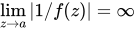
- Similarly, if does not exist (in fact ) but exists, then is a pole of and a zero of .
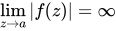
- If neither nor exists, then is an essential singularity of both and .
Another way to characterize an essential singularity is that the Laurent series of at the point has infinitely many negative degree terms (i.e., the principal part of the Laurent series is an infinite sum). A related definition is that if there is a point for which no derivative of converges to a limit as tends to , then is an essential singularity of .[1]


On a Riemann sphere with a point at infinity, , the function has an essential singularity at that point if and only if the has an essential singularity at 0: i.e. neither nor exists.[2] The Riemann zeta function on the Riemann sphere has only one essential singularity, at .[3] Indeed, every meromorphic function aside that is not a rational function has a unique essential singularity at .


The behavior of holomorphic functions near their essential singularities is described by the Casorati–Weierstrass theorem and by the considerably stronger Picard's great theorem. The latter says that in every neighborhood of an essential singularity , the function takes on every complex value, except possibly one, infinitely many times. (The exception is necessary; for example, the function never takes on the value 0.)

References[edit]
- ^ Weisstein, Eric W. "Essential Singularity". MathWorld. Wolfram. Retrieved 11 February 2014.
- ^ "Infinity as an Isolated Singularity" (PDF). Retrieved 2022-01-06.
- ^ Steuding, Jörn; Suriajaya, Ade Irma (2020-11-01). "Value-Distribution of the Riemann Zeta-Function Along Its Julia Lines". Computational Methods and Function Theory. 20 (3): 389–401. doi:10.1007/s40315-020-00316-x. hdl:2324/4483207. ISSN 2195-3724.
- Lars V. Ahlfors; Complex Analysis, McGraw-Hill, 1979
- Rajendra Kumar Jain, S. R. K. Iyengar; Advanced Engineering Mathematics. Page 920. Alpha Science International, Limited, 2004. ISBN 1-84265-185-4