


François Jouffroy
François Jouffroy | |
|---|---|
 | |
| Born | 1 February 1806 |
| Died | 25 June 1882 (aged 76) |
| Occupation | Sculptor |
François Jouffroy (French pronunciation: [fʁɑ̃swa ʒufʁwa]; 1 February 1806 – 25 June 1882) was a French sculptor.
Biography[edit]
Jouffroy was born in Dijon, France, the son of a baker, and attended the local drawing school before being admitted to the École des Beaux-Arts in Paris in 1824. In 1832 he won the Prix de Rome. Jouffroy often had to compete with Pierre-Jean David d'Angers for public commissions, but during the Second Empire (1851–1870) he still participated in the decoration of several public buildings.
He was a professor at the École des Beaux-Arts from 1865 until his death.[1] Among his students were Per Hasselberg, Jean Dampt, Léopold Morice, Augustus Saint-Gaudens, José Simões de Almeida (Tio), António Soares dos Reis, Elisa de Lamartine, and Adrien Étienne Gaudez.[2] Jouffroy died at Laval, Mayenne in 1882.
Works[edit]
| Name | Location | Date | Notes |
|---|---|---|---|
| "La Mort d'Orion" | Whereabouts not known | 1826 | With this work Jouffroy won second prize in the 1826 Prix de Rome competition. He had entered the l'École des Beaux-arts in 1824.[3] |
| "Un Jeune pâtre napolitain pleurant sur son Tombeau" | Whereabouts not known | 1835 | This was Jouffroy's first submission to the Paris Salon.[3] |
| A holy water font in Trinitarian marble | Saint-Germain l'Auxerrois | 1844 | Jouffroy created a marble font for this church based on drawing by his student Elisa de Lamartine. This piece was also cast in bronze by Barbedienne.[4][5] |
| Bust of Lamartine | Musée Lamartine in Mâcon | 1843 | A bust of Lamartine can be seen in this museum. |
| Marie Leszczynska | Versailles, châteaux de Versailles et de Trianon | 1844 | Bust of ex Queen of France. |
| Jean-Baptiste de Santeuil | Versailles, châteaux de Versailles et de Trianon | Bust of the French writer.[7] | |
| Charles-Paris d'Orléans-Longueville | Versailles, Châteaux de Versailles et de Trianon | 1838 | A bust of the Duke of Longueville[8] |
| Pierre-Claude Berrier du Metz | Versailles, châteaux de Versailles et de Trianon | 1838 | This bust is in plaster.[9] |
| Saint Bernard | Dijon | 1844 | Statue stands in La place Saint-Bernard in Dijon[10] |
| "Le Prince de Joinville remettant le cercueil de l'empereur à Louis-Philippe" | Invalides - Napoleon's tomb | 1851 | One of two white marble bas-reliefs in the crypt of Les Invalides. One descends to the crypt through an imposing bronze door which leads to a staircase. On this door are inscribed an extract from Napoleon's will
At the bottom of this staircase are Jouffroy's bas-reliefs. Jouffroy depicts the Prince of Joinville delivering Napoleon's coffin to Louis-Philippe. Napoleon had died on 5 May 1821 on the island of St. Helena, where he had been in exile since 1815. He was buried on the island and his remains stayed there until 1840 when Louis-Philippe decided to have the body brought back to France. A body of French sailors, under the command of the Prince of Joinville, brought his coffin to France aboard the ship "Belle Poule". This episode is known as the Retour des cendres.[11][12] [13] |
| Les quatre Evangélistes | Paris, Église de Sainte Clotilde. | 1851 | Jouffroy executed depictions of the four evangelists for the church's altar. |
| The works Marine Guerrière, Marine marchande and others. | Palais du Louvre, Guichets Lesdiguières | See note | In the Aile Lescot of the Cour Carree is the work "La Sculpture", in the guichets Lesdiguières are the "Marine Guerrière" and "Marine marchande" of 1868, the 1867 statue "Massillon" is located in the Aile Henri 1V, "L'Art et La Science" of 1857 is in the Pavillon Mollien, two caryatides are also in the Pavillon Mollien dating to 1857 and Saint Bernard in the Aile Colbert. |
| Saint Charles de Borromée | Paris, Église de la Madeleine | Charles de Borromée is depicted holding a large cross. See page 116 in link/reference. | |
| "Le Prince de Joinville assistant à l'exhumation du corps de l'empereur à Sainte-Hélène" | Invalides - Napoleon's tomb | 1851 | In this marble bas-relief Jouffroy depicts the exhumation of Napoleon's body on St Helena. Again see Retour des cendres[18][19] |
| The allegories "La Protection" and "Le Châtiment" | Palais de Justice. Paris | 1859 | These two statues are on the west façade of the Palais de Justice in the rue d'Harlay[20][21] |
| Le Christ et les douze apôtres | Église de Saint-Augustin, Paris | 1862 | Above the church porch is a large frieze which contains Jouffroy's bas-relief depicting Christ and the apostles.
 |
| Achille Leclère | Thionville; Tribunal de grande Instance | 1872 | Achille François René Leclère was a French architect of distinction.[23] |
| "Ariane abandonnée" | Tarbes, Musée Massey | 1853 | Jouffroy depicts Ariadne who had been abandoned by Theseus on Naxos where she was found by Dionysus whom she married[24] |
| "Erigone"' | Dijon, Musée des Beaux-Arts | 1841 | Submitted to Paris Salon in 1850[25] |
| Source-Seine | Jouffroy executed a sculpture of a nymph and this was used by the architects Gabriel Davioud, Victor Baltard et Combaz as part of a grotto called the "nymphée" which marked one of the Seine's sources | ||
| "La Désillusion" | Dijon, Musée des Beaux-Arts | 1841 | A composition in marble submitted to the Paris Salon in 1841[27] |
| Gaspard Monge | Beaune Museum of Fine Arts | 1839 | Gaspard Monge, the Comte de Péluse was a French mathematician and inventor of descriptive geometry (the mathematical basis of technical drawing), and the father of differential geometry. During the French Revolution he served as the Minister of the Marine, and was involved in the reform of the French educational system, helping to found the École Polytechnique. Although kept in Beaune the bust is the property of the Musée de Dijon who hold many Jouffroy works including his busts of Bonaparte and Louis Dietsch. |
| "Capanée foudroyé sous les murs de Thebes" | Paris; École nationale supérieure des Beaux-Arts | 1832 | This was Jouffroy's winning piece for the 1832 Prix de Rome. The composition was in ronde bosse and in plaster. The composition depicts Capaneus striking the wall during the war of the Seven against Thebes, when he shouted that Zeus himself could not stop him from invading it[31] |
| "Cain après la malédiction" | Musee Chateau Compiegne | 1838 | This was Jouffrey's presentation at the Paris Salon of 1838. A distraught Cain is overcome with grief after he had killed his brother.[32] |
| "Premier secret confié à Vénus" or "Jeune fille confiant son secret à Vénus" | Paris; musée du Louvre département des Sculptures | 1839 | One of Jouffroy's best known pieces. This marble composition was acquired in 1840 by the Ministère de la Maison du roi for the Musée du Luxembourg. A plaster version is held by the Musée de Toulon and Jouffroy gave the Musée de Dijon a reduced plaster version. The plaster cast is held by the Musee Croatzier in Le Puy-en-Velay. The marble version was shown at the Paris Salon in 1839 and the 1855 Éxposition Universelle. A plaster statuette is held by the Musée de Grenoble acquired in 1874. |
| "Académie d'homme" | Douai; Musée de la Chartreuse | A high-relief in plaster.[36] | |
| Bust of Béat-Jacques de La Tour-Châtillon | Château de Versailles | 1840 | A work in plaster. Can be seen in the château's galerie des batailles.
 |
| Ferdinand de Marsin | Galerie des Batailles | 1842 | Bust in plaster[38] |
| Bust of Antoine François Eugène Merlin | Douai; Musée de la Chartreuse | 1844 | Merlin took part in the battle of Talavera while commanding the cavalry of the IV Corps d'Armées.[39] |
| Institute des jeunes aveugles | Paris | 1843 | Jouffrey executed a statue of Valentin Haüy for the front of the institute's building at 56, boulevard des Invalides, Paris 7e. In his composition Jouffrey depicts Haüy getting inspiration from an allegory of Charity and instructing the blind.[40] |
| Hôtel de Saint-Seine | Dijon | 1844 | This building is located in 29 rue Verrerie. In 1844 Jouffrey was commissioned to execute some sculptural work for the wall of the first floor landing. |
| Bust of Guillaume Dode de la Brunerie | Grenoble; Musée de Grenoble | 1849 | Plaster bust of one of France's marshals.[42] |
| Statue of Napoleon when Lieutenant Bonaparte | Auxonne | 1857 | Apart from the statue Jouffrey also executed a bas-relief for the pedestal. The monument celebrates Napoleon's time in Auxonne as a young officer.
 |
| "Les Arts et les Sciences"- Decoration for the Palais du Louvre. | Paris | 1855-1957 | This work is located on the front of the pavillon Mollien. The musee d'Orsay hold the original plaster model. Jouffrey also completed two caryatides for the pavillon Mollien. |
| Massillon | Palais du Louvre.Paris | 1855-1957 | Jouffrey also completed this statue for the Louvre's Henri IV wing. His "Saint Bernard" was part of the exterior decoration of the Colbert wing |
| Statues representing the cities of Warsaw and Brussels on the facade of the Gare du Nord | Paris | 1863 | Two of several statues decorating the facade of this main Paris station. |
| "L'Harmonie" | Paris; Musée d'Orsay | 1865 | The museum hold a plaster maquette of the sculpture which can be seen on the left hand facade of the Paris Opera House. The architect Charles Garnier commissioned four sculptural groups for the Opéra de Paris façade and apart from "L'Harmonie", other sculptors added the works "La Musique", "Le Drame" and "La Danse".
 |
| Napoléon Bonaparte | Auxonne; Musée Bonaparte | 1857 | Plaster maquette for the statue of Napoleon erected in 1857 in Auxonne's Place d'Armes.[47] |
| "L'Aurore" | Paris | 1870 | Jouffroy's L'Aurore (The Dawn) can be seen in the Jardin Marco Polo, one of two parks created in 1867 between the Jardin du Luxembourg and the Observatoire de Paris. |
| Saint Bernard de Clairvaux | Cathédrale Saint-Vaast Arras | 1877 | Jouffrey submitted this work in white marble to the 1877 Paris Salon and it was purchased by the French State for Paris' Église Sainte-Geneviève (The Panthéon). It was moved to Arras in 1934. |
| Bust of Henry Darcy | Dijon, Jardin Darcy | 1858 | Mounted at top of the Chateau d’Eau, Jardin Darcy, Dijon. A plaster version is on display at Château de Bourbilly, Vic-de-Chassenay |
Gallery of images[edit]
-
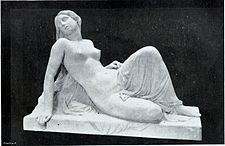 "Ariane abandonnée"
 -
 "Merchant Marine"
 -
 Bonaparte
 -
 Paris Opera
 -
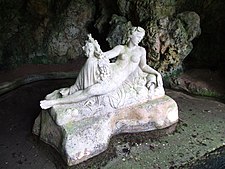 "Source of the Seine"
 -
 "Premier-secret-confie-a-Venus"


References[edit]

- ^ De Forest, Julia B. (1913). "A Short History of Art".
- ^ "Adrien Etienne Gaudez". AskArt.com. Retrieved 2 July 2015.
- ^ a b "wikiphidias". Retrieved 21 March 2014.
- ^ "Three putti around a cross". Retrieved 21 March 2014.
- ^ "Three putti around a Cross (2)". Retrieved 21 March 2014.
- ^ "Marie Leszczynska". Retrieved 19 March 2014.
- ^ "Jean-Baptiste de Santeuil". Retrieved 20 March 2014.
- ^ "Charles-Paris d'Orléans, duc de Longueville". Retrieved 19 March 2014.
- ^ "Pierre-Claude Berrier du Metz". Retrieved 20 March 2014.
- ^ "Saint Bernard". Retrieved 21 March 2014.
- ^ "Le Prince de Joinville remettant le cercueil de l'empereur à Louis-Philippe". Retrieved 18 March 2014.
- ^ "Napoleon's tomb". Retrieved 20 March 2014.
- ^ Driskel, Michael Paul (1993). Les Invalides. Kent State University Press. ISBN 9780873384841. Retrieved 20 March 2014.
- ^ Erlande-Brandenburg, Alain; Leniaud, Jean-Michel; Dectot, Xavier (2001). Les quatre Evangélistes (1). École nationale des chartes. ISBN 9782900791448. Retrieved 20 March 2014.
- ^ "Les quatre Evangélistes (2)". doi:10.3406/lha.2006.1048. Retrieved 20 March 2014.
- ^ "Marine Guerrière and Marine marchande". Retrieved 20 March 2014.
- ^ "Saint Charles de Borromée". doi:10.3406/lha.2006.1053. Retrieved 21 March 2014.
- ^ "Le Prince de Joinville assistant à l'exhumation du corps de l'empereur à Sainte-Hélène". Retrieved 18 March 2014.
- ^ "Retour des Cendres". Retrieved 20 March 2014.
- ^ "The allegories "La Protection" and "Le Châtiment"". Retrieved 18 March 2014.
- ^ "The allegories "La Protection" and "Le Châtiment" (2)". Retrieved 18 March 2014.
- ^ "Le Christ et les douze apôtres". Retrieved 19 March 2014.
- ^ "Achille François René Leclère". CNAP. Retrieved 15 July 2022.
- ^ "Ariane abandonnée". CNAP. Retrieved 15 July 2022.
- ^ "Erigone". Base Arcade. Retrieved 15 July 2022.
- ^ "Nymph". Archived from the original on 22 March 2014. Retrieved 21 March 2014.
- ^ "La Désillusion". CNAP. Retrieved 15 July 2022.
- ^ "Gaspard Monge". Base Arcade. Retrieved 15 July 2022.
- ^ "Gaspard Monge (2)". Retrieved 20 March 2014.
- ^ "Gaspard Monge (3)". Retrieved 20 March 2014.
- ^ Base Joconde: Capanée foudroyé sous les murs de Thebes, French Ministry of Culture. (in French)
- ^ "Cain après la malédiction" (PDF). Archived from the original (PDF) on 22 March 2014. Retrieved 18 March 2014.
- ^ Base Joconde: Premier secret confié à Vénus, Louvre, French Ministry of Culture. (in French)
- ^ Base Joconde: Jeune fille confiant à Vénus son premier secret, Le Puy-en-Velay, French Ministry of Culture. (in French)
- ^ Base Joconde: Le Premier Secret confié à Vénus, Grenoble, French Ministry of Culture. (in French)
- ^ Base Joconde: Académie d'homme, French Ministry of Culture. (in French)
- ^ "Bust of Béat-Jacques de La Tour-Châtillon, comte de Zurlauben". Retrieved 17 March 2014.
- ^ "Ferdinand, comte de Marsin, maréchal de France". Retrieved 19 March 2014.
- ^ Base Joconde: Bust of Eugène Merlin, French Ministry of Culture. (in French)
- ^ "Institute des jeunes aveugles". Retrieved 18 March 2014.
- ^ Base Mérimée: Hôtel de Saint-Seine, Ministère français de la Culture. (in French)
- ^ Base Joconde: Bust of Guillaume Dode de la Brunerie, French Ministry of Culture. (in French)
- ^ "Statue of Napoleon when Lieutenant Bonaparte". Retrieved 19 March 2014.
- ^ "Gare du Nord". Retrieved 18 March 2014.
- ^ Base Joconde: L'Harmonie, French Ministry of Culture. (in French)
- ^ "Paris Opera". Retrieved 20 March 2014.
- ^ Base Joconde: Napoléon Bonaparte, French Ministry of Culture. (in French)
- ^ "L'Aurore". Retrieved 20 March 2014.
- ^ "Album of photographs of works submitted to 1877 Paris Salon and purchased by the French State". Retrieved 18 March 2014.
- ^ Base Palissy: Saint Bernard de Clairvaux, Ministère français de la Culture. (in French)
| International | |
|---|---|
| National | |
| Artists | |
