Fulk FitzWarin

Fulk FitzWarin (c. 1160 – c. 1258), variant spellings (Latinized Fulco filius Garini, Welsh Syr ffwg ap Gwarin), the third (Fulk III), was a prominent representative of a marcher family associated especially with estates in Shropshire (on the English border with Wales) and at Alveston in Gloucestershire. In young life (c. 1200–1203), early in the reign of King John (1199–1216), he won notoriety as the outlawed leader of a roving force striving to recover his familial right to Whittington Castle in Shropshire, which John had granted away to a Welsh claimant. Progressively rehabilitated, and enjoying his lordship, he endured further setbacks in 1215–1217.[2]
Thereafter, his connections with the court of Llywelyn ap Iorwerth and his usefulness to the English king placed him in the midst of a larger conflict in which he lost Whittington to Llywelyn for a year in 1223–1224, though that prince was said to have married his daughter. During the 1220s Fulk founded Alberbury Priory in Shropshire, which became the smallest and last-established of the three English houses dependent upon the Order of Grandmont. Always ready to defend his rights, Fulk lived to a ripe old age and was buried at Alberbury beside his two wives, leaving heirs and daughters and a plentiful posterity among whom the name of Fulk FitzWarin was continuously renewed in later centuries. His grandson was Fulk V FitzWarin, 1st Baron FitzWarin (1251–1315).[3]
After his death, Fulk became the subject of a popular "ancestral romance" in French verse, Fouke le Fitz Waryn, relating his life as an outlaw and his struggle to regain his patrimony from the king.[4] This survives in a prose version, and combines historical material with legendary and fantastical elements which are heroic rather than strictly biographical.[5]
Origins
[edit]Although the name Fitz Warin means "son of Warin", it was Fulk's grandfather, Fulk I FitzWarin, whose father's name was Warin, or Guarine, of Metz, in Lorraine.[6][7] Warin (who appears in the Romance of Fouke le Fitz Waryn as "Warin de Meer") is however a "shadowy or mythical figure" about whom little is known.[6] Whatever his origin, the head of this family is generally held to have come to England during the reign of William the Conqueror (1066–1087). Neither he nor his sons were then tenants-in-chief (i.e. important vassals or feudal barons): their estates were granted by later kings.[8]
Fulk I was associated with the Peverels: William Peverel the Younger granted him a knight's fee in Tadlow, Cambridgeshire, before 1148 which King Henry II confirmed in 1154.[9] Henry rewarded Fulk I for his support of the Empress Matilda during the civil war by conferring upon him the royal manor of Alveston in Gloucestershire (by 1155)[10] and the manor of Whadborough in Loddington, Leicestershire.[11] His son Fulk II held those properties after the death of his father in 1171.[12] In the time of Robert Foliot, Bishop of Hereford (1174–1186), Fulk II gave land at Tadlow to Shrewsbury Abbey to settle a controversy over the patronage of the church of Alberbury, Shropshire, in his own favour. The FitzWarin land tenure at Alberbury, held from the Fee of Caus, was therefore presumably already in place.[13]
At some time before 1178 Fulk II married Hawise, one of the two daughters and co-heirs of Josce de Dinan[14] and his wife Sybil, widow of Pain fitzJohn. Josce had held Ludlow Castle in the Welsh Marches for the Empress Matilda during the civil war, but it was not expedient for Henry II to confirm Ludlow to Josce, and in place thereof, he granted to him the large manorial estate of Lambourn in Berkshire,[15] with its appurtenances, amounting to a considerable value.[16][17] Josce died by 1167, and Lambourn became the inheritance, in two parts, of his daughters Hawise and Sybil (who married Hugo de Plugenet).[6] Fulk II and Hawise de Dinan were the parents of Fulk FitzWarin III.
- How John and Fulk came to blows
The FitzWaryn Romance tells that Fulk II and Hawise lived in proximity to the king, and had sons Fulk, William, Philip, John and Alan (who appear as real historical persons in contemporary records[18]). It further states that young Fulk was bred with the four sons of King Henry, who all loved him except for Prince John (born 1166): Fouke le jeouene fust norry ou les iiij. fitz Henré le roy, et mout amé de tous, estre de Johan... The story goes that Fulk and John quarrelled over a game of chess: John struck Fulk over the head with the chessboard, whereat Fulk's foot made a connection with the prince's abdomen, and John fell back, banging his head against the wall. John went off to tell his father, who had him beaten for complaining.[19]
This merry episode reflects a truth, for John was brought up under the tutelage of Ranulf de Glanvill (who became King Henry's Chief Justiciar in 1180), as were Ranulf's nephews Hubert Walter and Theobald Walter,[20] with whom (and with Ranulf's grandson Robert de Auberville), Fulk III later became closely connected by marriage.[21] The milieus of the English royal court and the princely courts of Wales are never far distant from Fulk's story.
Career
[edit]The lordship of Whittington
[edit]
Fulk II encountered many problems in receiving his capital patrimony and other claimed lands. Among the latter was Whittington Castle, a site north-east of Oswestry which had been fortified by William Peverel the younger in 1138 in support of Empress Matilda.[22] Fulk I, it is supposed, had held this from the Honour of Peverel.[23] The Castle stands on the English (eastern) side of Offa's Dyke, the ancient boundary between England and Wales. During the late 1140s the lordship of Whittington, as with Oswestry and Overton, was ceded from English authority and became a Welsh marcher lordship within the Kingdom of Powys.[24]
In 1165 Henry II granted the castle of Whittington to Roger de Powys, a Welsh leader, and in about 1173 gave him funds for its repair.[25] Fulk II successfully claimed for the restitution of Whittington, a judgement mentioned in the Pipe Roll for 1195 when he owed a Fine of 40 marks to have seisin: but he never paid this, and was dead by 1197.[26] It, therefore, remained in Welsh hands.[22] Fulk III then renewed his father's claim,[5][27] and in 1197 offered relief of £100 for it as his inheritance. However, on 11 April 1200 King John granted it to Meurig (Maurice), son of Roger of Powis, who had offered half that sum. Again, after Maurice's death in August 1200, King John granted it to Maurice's son Werennoc.[28]
Rebellion and outlawry
[edit]Whether John's refusal to honour Fulk's hereditary claim to Whittington was personal or political, it was this which by April 1201 drove Fulk openly into armed defiance of the King. He was accompanied by approximately fifty-two followers including his brothers William, Phillip and John, by his cousins, and by the family's many tenants and allies in the Marches.[5][27] Although it is an important element in the Romance of Fouke, the uprising is not described in detail by more formal chroniclers.
It was sufficiently troublesome, however, that when in the spring of 1201 King John crossed into Normandy and Poitou to suppress a revolt by the Lusignans,[29] he assigned 100 knights to Hubert de Burgh with instructions for him to put down the activities of Fulk and his band, and those of a renegade in Devon.[30] The Annales Cestrienses tell that in 1202 Fulk was obliged to make his escape by sea, and, having got away with a few of his followers, took refuge in Stanley Abbey near Chippenham, Wiltshire. There he was besieged by the king's forces, after which Archbishop Hubert Walter with a number of the clergy got him away and kept him for some time in his court. Then Fulk set off quietly with many armed men to join the King of France.[31]
Pardons were granted during that year for Eustace de Kivilly and Gilbert de Duure, for having been associated with him.[32] Fulk himself seems to have had difficulty coming to terms with the king, for in 1203 there are three separate safe-conducts for him and his company to attend and leave the royal presence.[33] In November 1203 he was pardoned together with over thirty of his followers.[34] In October 1204, by a fine of 200 marks, Fulk at last received "right and inheritance" in Whittington.[35] The castle thereafter descended in the FitzWarin family, all subsequent holders being named Fulk, until the death of Fulk (XI), the 7th Baron FitzWarin, in 1420.[36]
The first marriage
[edit]By 1207 Fulk III married Maud (Matilda), daughter and heir of Robert le Vavasour, and widow of Theobald Walter, 1st Chief Butler of Ireland, who died late in 1205 in Ireland.[37] Theobald (of Warrington), who was granted his Irish office in 1185 in service to Prince John's Lordship of Ireland, assisted his brother Hubert Walter in receiving the surrender of John's supporters in Lancaster in 1194. John, after his accession to the throne in 1199, in 1200 deprived Theobald of his lands and offices and did not restore them to him until 1202. His children included the second Theobald.[38]
Maud's dower included one-third of the lands Theobald had held from the king in Ireland, as well as of those in Norfolk and Lancashire: which were released immediately, but a dower from Theobald's lands in Amounderness was in the king's hand in 1215.[39] For the huge fine of 1,200 marks levied upon Fulk for this marriage he secured pledges from his brother William and from Maud's father,[40] a tenant of the feudal barony of Skipton in Yorkshire.[41][42] The high regard in which Fulk was then held is shown by the names of his sureties, which included the Peverels, Alan Basset, William de Braose (died 1230), a de Lacy, William Longespée, 3rd Earl of Salisbury and Henry de Bohun, 1st Earl of Hereford.[43] In 1210 he accompanied the king to Ireland, and was at Dublin and Carrickfergus.[44] In 1213 the king granted timbers from Leicester Forest to Fulk for his dwelling at the Vavasour hereditament of Narborough, Leicestershire, and for the construction of a chamber there.[45]
On 9 February 1214, when King John again set sail for Poitou, Fulk was among the barons who accompanied him. He is believed to have been a vassal of Geoffrey de Mandeville, Earl of Gloucester at that time.[46] In September of that year Fulk, Walter de Lacy and many others were with King John at Parthenay, to witness John's 5-year peace treaty with King Philip Augustus of France.[47] Over the months immediately following he is found among the malcontent barons who, between their meetings at Bury St Edmunds in November and at the New Temple in January, sought to bring John to a realization of their grievances.[48] By December 1215 Fulk's name appears in the list of English barons excommunicated by Pope Innocent III's bull, for his part in their opposition to the king.[49]
Further confrontations
[edit]In 1215 Fulk was one of many giving great trouble to the Sheriff of Shropshire. Before the accession of the infant king Henry III (John's son) in 1216, Fulk's manor of Alveston had already been seized by the crown:[50] in the following year (1217) all of his other lands in Gloucestershire were likewise seized. By 1218, however, Fulk had made peace and his lands were ordered to be restored to him by the king's regents:[51] his market at his manor of Narborough was withdrawn from him as being "a manifest enemy" of the king's in 1217,[52] but was regranted in 1218, and the Amounderness dower was also restored.[53] In the latter year the king also granted a fair for his manor of Lambourn in Berkshire,[54] the inheritance from Joce de Dinant. Fulk's mother Hawise died at about this time.[55]
By 1220 Fulk had regained some favour with the young King Henry III and had been allowed to rebuild and fortify Whittington,[56] and to hold a weekly market and annual two-day fair there.[57] In 1223 Whittington Castle fell to Llywelyn the Great, Prince of Wales, but was recovered and restored to him, as Kinnerley[58] was restored to Fulk's kinsman Baldwin de Hodenet.[59] However his disputes with Llywelyn continued and more of Fulk's lands fell into the king's hands. During the 1220s Fulk hoped to marry his son Fulk to Anghared, daughter of Madog ap Griffin, a union which Llywelyn sought to prevent.[60] By 1228 a truce seems to have been reached between Fulk, Thomas Corbet and Llywelyn, following the intervention of the king.[61][62]
Throughout these years Fulk's relations with the King were changeable and seemed to be directly dependent on the state of affairs in Wales. As a marcher lord Fulk's role as a protector of the English border against the Welsh was vital to the English King. He arbitrated several border disputes on behalf of the King and although there were more personal disagreements, there were no more rebellions on the part of Fulk III.[63]
Alberbury Priory
[edit]
Between 1221 and 1226 Fulk began to build his priory at Alberbury on a moated site at a bend in the river Severn on the border of England and Wales.[64] He first intended it as a house of Augustinian canons following the Arrouasian rule, and invited Alan, the Abbot of Lilleshall, to establish the convent. However his endowments were found insufficient, and Alan's successor Abbot William renounced any interest in the project.[65] Fulk, therefore, turned instead to the Grandmontine Order, following the example of Walter de Lacy's house founded at Craswall Priory in Herefordshire c. 1220–1225,[66] but placing Alberbury under the immediate authority of Grandmont Abbey in Limousin.[67] Having been intended for the Augustinians, the buildings lacked the special features of a Grandmontine plan. In addition to the priory site with its lands and rights in Alberbury with Pecknall, a fishery in the Severn, and the right to construct mills, Fulk's endowments to the priory included his manor of Whadborough at Loddington in eastern Leicestershire. These were confirmed by King Henry III's charter of 1232.[68] The Castle in Alberbury, of which a ruin remains, is also attributed to Fulk III as representing the seat of his manor here.[69]
Estates and suits
[edit]- Narborough, Leicestershire
In 1226 Maud the wife of Fulk FitzWarin died, which was no doubt a stimulus to the completion of the priory, where she was buried.[42] In that year Theobald Walter the younger (son of Maud's first marriage) unsuccessfully challenged William Pantolf and Hawise his wife (Fulk's daughter) for title to the manor of Narborough in Leicestershire,[70] a Vavasour hereditament.[37] Fulke's market at Narborough had received the King's re-confirmation in 1220, but a suit of 1276 shows that the manor had been given by Maud to her daughter Hawise,[71] who by her marriage to Pantolf became Lady of the barony of Wem,[72] as the FitzWarin Romance reminds us.[73] Theobald simultaneously challenged Fulk for the manor of Edlington in Yorkshire, another part of the same inheritance.[74] After Pantolf died in 1233, and Fulk paid 600 marks for custody of his heirs and lands,[75] Hawise remarried to Hubert Husse, taking Narborough as her maritagium with her, and in 1235 Hubert obtained a renewal of the market, which had by then lapsed.[76][77]
.jpg)
- Lambourn and Wantage, Berkshire[78]
In 1227 the fair at Lambourn was re-granted.[79] Before 1224 William Marshal, Earl of Pembroke had by his charter[80] enfeoffed Fulk III in the nearby manor of Wantage, Berkshire[81] and in the Hundred of Wantage and Gamenefeud: for although the King's attorney later challenged the FitzWarin right to the Hundreds, they remained in their hands.[82] The King claimed Wantage manor against him as terra Flandrensium – the land of Robert de Béthune – in 1236–37,[83] but Fulk's possession of it was warranted by Gilbert Marshal,[84] and he defended his possession again in 1241 against Robert de Béthune in his own person.[85]
In due course, Fulk by charter granted his entire manor of Lambourn to his daughter Mabil and to the heirs of her body, and acknowledged the fact before the Court of King's Bench in 1249.[86] A seal-matrix of Fulk FitzWarin (equestrian) found at Little Bedwyn, Wiltshire, about five miles south of Lambourn, corresponds to a seal-impression on a charter in the Harleian collection which is dated probably early in the reign of Henry III, and therefore likely to represent Fulk III:[87] another FitzWarin charter with armorial seal, dated 1258, grants land and rent at Wantage.[88]
The second marriage
[edit]Mabil was the daughter of Fulk's second wife, Clarice de Auberville, who (as the Fine rolls record) was certainly living in 1250.[89] The marriage features in the Romance narrative (which calls her "une molt gentile dame") and is said to have occurred "a good while" after the death of Maud. The legend tells that after their marriage Fulk was struck blind for the last seven years of his life, and that he outlived Clarice by one year.[90] It has been accepted (or asserted) that Clarice was the daughter (rather than the widow) of Sir Robert de Auberville, of Iden and Iham (Higham, in Icklesham[91]), near Winchelsea, Sussex.[92] Sir Robert, of an influential Norman family seated at Westenhanger, Kent, was a grandson of Ranulf de Glanvill's, and on the death of his father William de Auberville, c. 1195, had become a ward of Hubert Walter's.[93] He was a Constable of Hastings Castle, and Keeper of the Coast in 1228–1229. Robert's wife Clarice was daughter of Robert and granddaughter of Samson de Gestling, benefactors of Robertsbridge Abbey.[94] Robert de Auberville is supposed to have died c. 1230.[95]
In 1230 Fulk commenced a suit against Philip de Burwardsley (i.e. of Broseley, Shropshire), apparently a FitzWarin cousin, concerning lands in Shropshire and Staffordshire which had been disputed between their grandfathers, and which did not come to a full Assize until after 1233.[96][97]
Service
[edit]Fulk attended the King's court in Westminster in October 1229:[98] he received a writ of protection during absence upon foreign service in April 1230, and was required to supply one knight for foreign service in aid of the "Earl of Bretaigne" in May 1234.[99] In July 1236 he was appointed one of the Arbitrators (for North Wales) of the truce between King Henry and Llywelyn, as William FitzWarin was among those for South Wales.[100] In March 1238 he was among the powerful men summoned by the King to Oxford, to deliberate upon Llywelyn's action in causing his son Dafydd to receive homage from the magnates of Gwynedd and Powys.[101] The Romance narrative tells that, after the death of Joan, Lady of Snowdon in 1237 (who was buried at Beaumaris), Llywelyn ap Iorwerth took Eva, daughter of Fulk, as his last wife (with which the Annales Cestrienses concur[102]): and, after Llywelyn's death in 1240, she remarried to William de Blancmouster (de Whitchurch).[103][104]
In June 1245, faced by the rapacity of the Papal nuncio Martin (resulting in a prohibition of tournaments), an assembly of nobles at Dunstable and Linton deputed Fulk to proceed to London to order Martin out of the kingdom. As Matthew Paris relates their interview, Fulk told him to leave England immediately, but Martin questioned his authority to demand it. Fulk told him to be off within three days if he did not wish to be utterly brought down, and withdrew in anger, heaping threats upon threats with a terrible oath against him. Martin hurried off to the king, who told him that he had brought the kingdom to the brink of revolt: being asked for safe conduct the King answered, "May the Devil take you to hell."[105] A week later Fulk witnessed a charter of the King's at Windsor.
Last controversies
[edit]Although Fulk seems certainly to have lived after 1250, in this late period it is increasingly difficult to distinguish him from his two sons named Fulk, among the various references to Fulk "senior" and "junior". At a Shropshire Assize of January 1256, Fulk "junior" (possibly the younger son called Fulk Glas) was claiming that Thomas Corbet had disseised him of his free tenement of Alberbury. At an earlier hearing, he had become enraged when Corbet referred to his father as "Proditor" (Traitor), and had renounced any homage he had made to Corbet, vowing never to hold land of him again.[106] The court found for FitzWarin, but Corbet later brought an appeal.
The Hundred Rolls for 1255 show that Fulk FitzWarin was then holding two hides geldable in Alberbury of the fee of Caus (of which Thomas Corbet of Caus Castle was lord), and that the Grandmontensian brothers there held two virgates by the gift of Fulk FitzWarin senior (i.e. Fulk III in 1232), and of the fee of Caus.[107] The services owing by Fulk FitzWarin for a knight's fee held from Corbet at Alberbury had been set forth in a concord of 1248,[108] the Fine for which was recorded in the Great Roll of the Pipe for 1250 and remained unpaid in 1252.
In 1245 the king had appointed Fulk FitzWarin, John le Strange and Henry de Audley to settle a land dispute between Gruffydd ap Madog, whose land had been seized by Dafydd ap Llywelyn during the king's last war, and which had been seized back from Dafydd and was now claimed by Gruffydd ap Gwenwynwyn[109] (whose mother was Margaret Corbet, and whose wife Hawise was daughter of John le Strange of Knockin Castle). On the occasion of Thomas Corbet's outrageous remark, the court had been meeting by royal precept to settle contentions between Corbet and Gruffydd ap Gwenwynwyn.[110] In time, Gruffydd's daughter Margaret became the wife of Fulk V FitzWarin, son of Fulk IV.[111]
Death and burial
[edit]Historians cannot exactly state when FitzWarin died but 1258 is given as the latest probable date. Most likely, he handed some of his affairs over to his son Fulk IV during his lifetime. According to the Romance narrative, his second wife Clarice died before him. She was buried at Alberbury Priory, and he died a year later and was laid to rest beside both of his wives in the monastery church, part of which was incorporated into later buildings at the site.[112]
Family
[edit]
Fulk III FitzWarin married first, c. 1207, to Maud (Matilda) le Vavasour, daughter of Robert le Vavasour and widow of Theobald Walter.[113] Maud died in 1226 and was buried at Alberbury Priory (alias New Abbey, Alberbury) in Shropshire.[42][114][115] Their offspring included:[116]
- Fulk IV FitzWarin (d.1264).[117] He received the manor of Edlington, Yorkshire, as part of his inheritance.[118] He married Constance de Tosny, and was the father of Fulk V FitzWarin, 1st Baron FitzWarin.
- Hawise FitzWarin, married (first) William Pantulf, a Marcher Lord (who died in 1233), and (secondly) Hubert Huse.[117] She received the manor of Narborough.
- Joan FitzWarin[117] married Sir Henry de Penebrugge, of Pembridge Castle, Herefordshire.[119]
- Eleanor FitzWarin, married William de Rivers (de Ripariis)[120] of Great Shefford in the Lambourn valley, Berkshire, son of Richard de Rivers of East Mersea (Essex).[121]
- Eve FitzWarin,[117] married William de Blanchminister. It was claimed in the Romance narrative and in the Annales Cestrienses that she first married Llywelyn ap Iorwerth.[102]
- Fulk Glas[117] (sometimes attributed to his father's second marriage)
Fulk's second marriage, to Clarice de Auberville, is described in the Romance narrative. Clarice is taken to have been the daughter and heiress of Robert de Auberville of Iden and Iham (Higham, in Icklesham), Sussex, and his wife Clarice de Gestling. Fulk's daughter by this marriage was:
- Mabel FitzWarin (−1297), who married (first) William de Crevequer (no issue), and (secondly) John Tregoz, Lord Tregoz (died before 6 Sept 1300). By the second marriage she had two daughters and coheirs, Clarice and Sybil Tregoz.[42][117] She received the manor of Lambourn.
Sir William Dugdale, in his Baronage, accepted as factual the identification of Clarice as the second wife of Fulk III[122] and, despite occasional doubts, later accounts of the family have followed this precedent.[123]
Romance of Fouke le Fitz Waryn
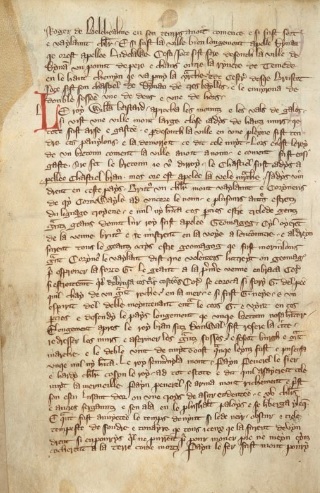
[edit]During the later 13th century, when the actual events of Fulk's life were still in living memory or common report, a romance known as Fouke le Fitz Waryn, probably first in French verse, was written about him.[4] This survives in an early 14th-century French prose version, in a single manuscript in the Royal manuscripts, British Library, which is thought to follow the lost verse quite closely.[124] The 16th-century antiquary John Leland saw and briefly described the French verse version,[125] and made an extended abstract from a Middle English verse version called The Nobile Actes of the Guarines,[126] the original of which is also lost. Various contemporary references show that the tale was widely-known in the later Middle Ages.[127]
In recent years the work has proved a fruitful and versatile resource for the speculative analysis of its themes and its representation of literary archetypes. The Fouke le Fitz Waryn narrative, while constructed around historical events and factual or quasi-factual information, is not a fully historical account.[128] It cultivates the literary and social preoccupations and heroic landscapes of its age, and is consciously absorbed within the framework of legendary and folkloric themes which are sometimes referred to as the "Matter of England".[129] That term should not deflect the recognition that the literary and cultural, as well as the geographical, landscape which the real Fulk inhabited was equally English and Welsh in outlook,[62] as it was also French and Latin in language.
About one-third of the text sets up the historical backdrop to Fulk's life, through his father and grandfather FitzWarin (who merge into one figure) and his grandfather Josce de Dinan, their relations with the Peverels during the Civil War, and the confrontations of the English and Welsh rulers. Themes of outlawry, dispossession and restitution, adventure and occasional piety surround the main subject, culminating in Fulk's second marriage, blindness, death, and burial at Alberbury. Its tales of mysterious lands, imprisoned maidens, prophecies and similarly allegorical or chivalric material are instructive in the operations of the romance idiom. Some episodes have been compared to elements of the Robin Hood legends.[130][131]
- Editions
- F. Michel (ed.), Histoire de Foulques Fitz-Warin, d'après un Manuscrit du Musée Britannique (Silvestre Libraire, Paris 1840). (Google) (Edition without translation, but includes the Leland abstracts).
- T. Wright (ed. and translator), The History of Fulk FitzWarin, an Outlawed Baron, in the Reign of King John, edited from a manuscript preserved in the British Museum, with an English translation and illustrative notes (Printed for the Warton Club, London, 1855). at pp. 1–183 text, pp. 183–231 notes.
- J. Stephenson (ed. and translator), 'The Legend of Fulk FitzWarin' (parallel French text and English translation), in Rerum Britannicarum Medii Aevi Scriptores, Rolls Series Vol. 66: Radulphi de Coggeshall Chronicon Anglicanum (etc.) (Longman & Co., Trübner & Co., London 1875), at pp. 277–415 (Google).
- A.C. Wood (ed.), Fulk Fitz-Warin. Text, and a Study of the Language (Blades, East and Blades, London 1911).
- L. Brandin (ed.), Fouke Fitz Warin, Les Classiques françaises du Moyen Age (Paris 1930).
- E.J. Hathaway (ed.), Fouke le Fitz Waryn, Anglo-Norman Text Society (Basil Blackwell, Oxford 1976).
References
[edit]- ^ Arms of Fulk V FitzWarin, St George's Roll of Arms, 1285, briantimms.com, St George's Roll, part 1, no. E69
- ^ H.R. Tedder, 'Fitzwarine, Fulk', Dictionary of National Biography (1885-1900), Volume 19 (Wikisource).
- ^ George Edward Cokayne The Complete Peerage of England Scotland Ireland Great Britain and the United Kingdom, Extant Extinct or Dormant, ed. Vicary Gibbs; vol. V, p. 495, Baron FitzWarin.
- ^ a b T. Wright (ed. and transl.), The History of Fulk Fitz Warine, an Outlawed Baron in the Reign of King John, Warton Club, (London 1855) (Internet Archive).
- ^ a b c K. Bedford, 'Fouke le Fitz Waryn: Outlaw or Chivalric Hero?', in A.L. Kaufman (ed.), British Outlaws of Literature and History: Essays on Medieval and Early Modern Figures from Robin Hood to Twm Shon Catty, (Jefferson, NC: McFarland & Co., 2011), p. 97.
- ^ a b c G.E. Cokayne, The Complete Peerage, V, p. 495, note (c)
- ^ Suppe, F., 'Fitzwarine family (per. c. 1145-1315)', Oxford Dictionary of National Biography (2004), Vol. "F", pp. 953–4.
- ^ Janet Meisel, Barons of the Welsh Frontier: The Corbet, Pantulf, and Fitz Warin Families 1066–1272, (Lincoln: University of Nebraska Press, 1980), p. 34. (See also J.A. Meisel, "The Lives of Obscure Men: A Study of Three Baronial Families on the Welsh March 1066-1272" (Dissertation, University of California, Berkeley 1974)).
- ^ Eyton, Antiquities of Shropshire,, VII, pp. 67–68 (Internet Archive).
- ^ J. Hunter (ed.), The Great Rolls of the Pipe for the Second, Third, and Fourth Years of the Reign of Henry II (Eyre & Spottiswoode, London 1844), p. 49, 100, 167 (Internet Archive).
- ^ J. Nichols, The History and Antiquities of the County of Leicester, Vol. 3 part 1: East Goscote Hundred (John Nichols, London 1800), pp. 332–34 (Hathi Trust). See first charter, p. 333b.
- ^ Meisel, Barons of the Welsh Frontier, pp. 34, 35
- ^ 'Alberbury', in R.W. Eyton, Antiquities of Shropshire (John Russell Smith, London 1858), VII, p. 69 (Internet Archive).
- ^ Painter, The Reign of King John, p. 49 (Google).
- ^ 'Parishes: Lambourn', in W. Page and P.H. Ditchfield (eds), A History of the County of Berkshire, Vol. IV (V.C.H., London 1924), pp. 251–266 (British History Online).
- ^ 'Ludlow', in R.W. Eyton, Antiquities of Shropshire (John Russell Smith, London 1857), V, at pp. 243–48 (Google).
- ^ Hunter, Great Rolls of the Pipe, 2, 3 and 4 Henry II, p. 34 (Internet Archive).
- ^ e.g. Eyton, Antiquities of Shropshire, VII, p. 69 (Internet Archive).
- ^ Wright, The History of Fulk Fitz Warine, pp. 62–64 (Internet Archive).
- ^ C.R. Young, Hubert Walter, Lord of Canterbury and Lord of England (Duke University Press, Durham N.C. 1968), e.g. pp. 3–5.
- ^ S. J. Bailey, 'Ranulf de Glanvill and His Children', The Cambridge Law Journal, Vol. 15, No. 2, (Nov. 1957); R. Mortimer, 'The Family of Rannulf de Glanville', Bulletin of the Institute of Historical Research LIV (129), (May 1981), pp. 1–16.
- ^ a b Meisel, Barons of the Welsh Frontier, p. 35
- ^ 'Whittington', in R.W. Eyton, Antiquities of Shropshire (John Russell Smith, London 1860), XI, at pp. 29–38 (Internet Archive).
- ^ P. Brown, P. King, and P. Remfry, 'Whittington Castle: The marcher fortress of the Fitz Warin family', Shropshire Archaeology and History LXXIX (2004), pp. 106–127.
- ^ D. Stephenson, Medieval Powys: Kingdom, Principality and Lordships, 1132-1293 (The Boydell Press, Woodbridge 2016), p. 286 (Google); citing F. Suppe, 'Roger of Powys, Henry II's Anglo-Welsh Middleman, and His Lineage', The Welsh History Review, Vol. 21 part 1 (2002), pp. 1–23.
- ^ Eyton, Antiquities of Shropshire, VII, pp. 70–71 (Internet Archive).
- ^ a b Painter, The Reign of King John, p. 52
- ^ Meisel, Barons of the Welsh Frontier, p. 36
- ^ Painter, The Reign of King John, p. 157
- ^ Painter, The Reign of King John, pp. 48, 84
- ^ R.C. Christie (ed.), Annales Cestrienses: Chronicle of the Abbey of S. Werburg, at Chester Lancashire and Cheshire Record Society, XIV (London 1887), pp. 46–47 (Internet Archive).
- ^ Meisel, Barons of the Welsh Frontier, p. 38
- ^ T.D. Hardy (ed.), Rotuli Litterarum Patentium in Turri Londinensi Asservati I Part 1 (Commissioners, 1802), pp. 33 b, 34 a, b (Google). Printed in full at F. Michel (ed.), Histoire de Foulques Fitz-Warin, d'après un Manuscrit du Musée Britannique (Silvestre Libraire, Paris 1840), Introduction pp. IV-V (Google).
- ^ Rotuli Litterarum Patentium, I Part 1, p. 36 (Google); Printed more at length in F. Michel, Histoire de Foulques Fitz-Warin, Introduction, pp. V-VIII (Google).
- ^ Rotuli Litterarum Patentium, I Part 1, p. 46 b (Google).
- ^ Painter, The Reign of King John, pp. 51–52
- ^ a b W. Farrer and C.T. Clay, Early Yorkshire Charters, XI: The Percy Fee (Cambridge University Press, 1963 edition), p. 130 (Google).
- ^ J.E.A. Jolliffe, Angevin Kingship (Adam and Charles Black, London 1955), pp. 65–68.
- ^ T.D. Hardy (ed.), Rotuli Litterarum Clausarum in Turri Londinensi Asservati, I: 1204-1224, (Commissioners 1833), p. 92 and p. 223 (Mecklenburg Verpommern Digital).
- ^ T.D. Hardy (ed.), Rotuli de Oblatis et Finibus in Turri Londinensi Asservati, tempore Regis Johannis (Commissioners, 1835), pp. 405–06 (Google).
- ^ M. Lieberman, The Medieval March of Wales: The Creation and Perception of a Frontier, 1066-1283 (Cambridge University Press 2010), pp. 87–97.
- ^ a b c d Emma Cavell, 'The Burial of Noblewomen in Thirteenth-Century Shropshire,' in B. Weiler, J. Burton, P. Schofield and K. Stöber (eds), Thirteenth Century England XI (The Boydell Press, Woodbridge 2007), p. 174 & note 2.
- ^ Meisel, Barons of the Welsh Frontier, p. 39.
- ^ T.D. Hardy (ed.), Rotuli de Liberate ac de Misis et Praestitis, Regnante Johanne (Eyre & Spottiswoode, 1844), pp. 182–85, 203-06 and 224-26 (Google).
- ^ Rotuli Litterarum Clausarum, I, p. 129 b (Mecklenburg Verpommern Digital).
- ^ Painter, The Reign of King John, pp. 280, 294.
- ^ N. Vincent, 'Peace with Philip Augustus: 14 September 1214 to 20 September 1214', King John's Diary and Itinerary (Magna Carta Project); citing '1083. Litterae Johannis Regis Angliae de Treugis ad Quinque Annos' (Archives Nationales, J 628, Angleterre II, no. 5), in A. Teulet (ed.) (General Editor H.F. Delaborde), Layettes du Trésor de Chartes, 5 Vols (Henri Plon, Paris 1863-1909), I, pp. 405–06 (Google).
- ^ J.B. Bury (ed. J.R. Tanner, C.W. Previté-Orton and Z.N. Brooke), The Cambridge Mediaeval History, VI: Victory of the Papacy (Cambridge University Press, 1929), pp. 242–44 (Internet Archive). See Magna Carta Project, passim.
- ^ 'Excommunicatio specialis in barones Angliae', in T. Rymer and R. Sanderson, ed. A. Clarke and F. Holbrooke, Foedera, Conventiones, Litterae, et cujuscunque generis Acta Publica, New Edition, 4 Vols in 8 (London 1816), I Part 1: 1066-1272, p. 139 (Hathi Trust).
- ^ Rotuli Litterarum Clausarum, I, p. 276 (Mecklenburg Verpommern Digital).
- ^ Meisel, Barons of the Welsh Frontier, pp. 41, 43
- ^ Rotuli Litterarum Clausarum, I, p. 321 (Mecklenburg Verpommern Digital).
- ^ Rotuli Litterarum Clausarum, I, p. 352 (Mecklenburg Verpommern Digital).
- ^ Fine Rolls, 3 Henry III, ref C 60/11, nos. 436 and 437, image at m. 1 (Henry III Fine Rolls Project).
- ^ 'Parishes: Lambourn', in W. Page and P.H. Ditchfield (eds), A History of the County of Berkshire, Vol. 4, ed. (London, 1924), pp. 251–66 (British History Online).
- ^ Rotuli Litterarum Clausarum, I, p. 460 (Mecklenburg Verpommern).
- ^ Fine Rolls, 4 Henry III, ref C 60/12, item 16, image at m. 9 (Henry III Fine Rolls Project).
- ^ E. Ekwall, The Concise Oxford Dictionary of English Place-Names, 4th Edition (Clarendon Press, Oxford 1960), p. 278, takes this reference for Kinnerley, Shropshire, even though Kynnersley, Shropshire, which has the same etymology, is much nearer to Hodnet, from which Baldwin took his name.
- ^ Rotuli Litterarum Clausarum, I, p. 537, p. 554 and p. 565 (Mecklenburg Verpommern Digital).
- ^ 'CCLI: Fulk FitzWarin to Hubert de Burgh', and 'CCLII: Walter de Lacy to Hubert de Burgh', in W.W. Shirley, Royal and other Historical Letters Illustrative of the Reign of Henry III Rolls Series (Longman, Green, Longman and Roberts, London 1862), Vol. I: 1216-1235, pp. 305–07 (Internet Archive).
- ^ Meisel, Barons of the Welsh Frontier, pp. 41–42; 'CCLXXV: Henry III to Llewellyn', in W.W. Shirley, Royal and other Historical Letters, I, p. 334 (Internet Archive).
- ^ a b I.J. Sanders, 'Fitz Warin lords of Whittington and Alderbury (Salop) and Alveston (Gloucs.)', Y Bywgraffiadur Cymreig (1959), (Welsh Dictionary of National Biography online).
- ^ Meisel, Barons of the Welsh Frontier, pp. 42, 43, 45
- ^ M.J. Angold, G.C. Baugh, M.M. Chibnall, D.C. Cox, D.T.W. Price, M. Tomlinson and B.S. Trinder, 'House of Grandmontine monks: Priory of Alberbury', in A.T. Gaydon and R.B. Pugh, A History of the County of Shropshire, Vol. 2 (V.C.H., London 1973), pp. 47–50 (British History Online): citing the Alberbury documents in the muniments of All Souls' College, Oxford.
- ^ R. Graham and A.W. Clapham, 'Alberbury Priory', Transactions of the Shropshire Archaeological and Natural History Society, Series 4 vol. XI (1927-1928), pp. 257–303.
- ^ See the Craswall Priory website.
- ^ 'The Order of Grandmont and its houses in England', in R. Graham, English Ecclesiastical Studies, being Some Essays in Research in Mediaeval History (S.P.C.K., London 1929), pp. 209–46.
- ^ 'Priory of Alberbury, or Abberbury, in Shropshire', in W. Dugdale, Monasticon Anglicanum, VI Part 2, pp. 1031–1032, Num. I (Google); Calendar of Charter Rolls, Henry III, 1226-1257 (HMSO 1903), p. 172 (Internet Archive).
- ^ Historic England: List entry for Alberbury Castle: tower keep castle 70m south west of the Church of St Michael and All Angels, Record 1020662 (Historic England).
- ^ T.D. Hardy (ed.), Rotuli Litterarum Clausarum in Turri Londinensi Asservati, II: 1224-1227 (Commissioners, 1844), p. 147 b (Mecklenburg Verpommern Digital).
- ^ "Robertus [Vavasor] dedit premissa Matilde filie sue; que dedit premissa Hawisie filie sue": Plea quoted in 'Narborough', in J. Nichols, The History and Antiquities of the County of Leicester, Reprint, 4 volumes in 8 (John Nichols, London 1811/Leicester County Council with S.R. Publishing Ltd., 1971), Vol. 4 Part 2: Sparkenhoe Hundred, at p. 814 (Hathi Trust).
- ^ I.J. Sanders, English Baronies: A Study of Their Origin and Descent 1086–1327 (Clarendon Press, Oxford 1960), pp. 94–95.
- ^ R.W. Eyton, Antiquities of Shropshire (John Russell Smith, London 1858), VII, pp. 66–83, at pp. 75–76 (Internet Archive).
- ^ Rotuli Litterarum Clausarum, II, p. 147 b (as above).
- ^ Fine Rolls, 17 Henry III, ref. C 60/32, item 108, image at m. 8 (Henry III Fine Rolls Project).
- ^ Close Rolls of the Reign of Henry III, 1234-1237 (HMSO 1908), p. 210 (Internet Archive).
- ^ "Rex concessit Huberto Hues' quod mercatum quod consuevit aliquando teneri apud manerium de Northbrug' (manerio illo existente in manu Fulconis filii Warini) et quod postea decidit, iterum relevetur et teneatur..." There is no indication here that Fulke had died.
- ^ Wantage has been administered as part of Oxfordshire since 1974.
- ^ Calendar of Charter Rolls, Henry III, 1226-1257 (HMSO 1903), p. 58 (Internet Archive).
- ^ Recited in Placita de Quo Warranto Temporibus Edw. I, II & III (Commissioners, 1818), pp. 81–82 (Hathi Trust).
- ^ According to the Romance narrative it was Hugh Bigod, 3rd Earl of Norfolk who enfeoffed him in the manor of Wantage, for military service during the affairs of 1215, but the charter itself and Bracton's abridgement show otherwise.
- ^ 'Wantage Hundred: Introduction', in W. Page and P.H. Ditchfield (eds), A History of the County of Berkshire, Vol. 4 (London, 1924), pp. 267–68 (British History Online).
- ^ F.W. Maitland (ed.), Bracton's Note Book: A Collection of Cases Decided in the King's Courts during the Reign of Henry the Third, 3 Vols (C.J. Clay & Sons, London 1887), III, No. 1220, pp. 232–34 (Internet Archive).
- ^ Placitorum in Domo Capitulari Westmonasteriensi Asservati Abbreviatio (Commissioners, 1811), p. 105 (Google).
- ^ 'Parishes: Wantage', A History of the County of Berkshire, Vol. 4, pp. 319–32 (British History Online).
- ^ J. Meisel, Barons of the Welsh Frontier: The Corbet, Pantulf and Fitz Warin Families, 1066-1272 (University of Nebraska Press, Lincoln 1980), p. 96.
- ^ Portable Antiquities Scheme, Object report BERK-FDCFD2 : Seal Matrix' (with observations by A. Ailes, C. Cheesman (Richmond Herald) and J. Cherry), citing W. de G. Birch, Catalogue of Seals in the Department of Manuscripts in the British Museum, Volume II (Trustees of the British Museum, London 1892), p. 293, no. 6022; L.C Loyd and D.M Stenton (eds), Sir Christopher Hatton's Book of Seals, Northamptonshire Record Society 15 (1950), no. 172.
- ^ The National Archives (UK), Release by Fulk FitzWarin of Whittington, Salop to William son of Alan FitzWarin, of land in Wantage, Ancient Deeds Series A, ref. E 40/6195 (Discovery Catalogue description).
- ^ Fine Rolls, C 60/47, 34 Henry III, membrane 2, no. 786, i.e. the penultimate entry in the membrane imaged as "m. 16". (Henry III Fine Rolls Project).
- ^ T. Wright (ed. and transl.), The History of Fulk Fitz Warine, an Outlawed Baron in the Reign of King John, Warton Club (London 1855): see pp. 177–83 (Internet Archive).
- ^ i.e. the settlement around the now demolished church of St Leonard, immediately north-west of New Winchelsea. 'Higham, ("Iham" or "Ihomme"), an old name of Winchelsea' – E. Ekwall, The Concise Oxford Dictionary of English Place-Names, 4th edition (Clarendon Press, Oxford 1960), p. 238.
- ^ W. Dugdale, The Baronage of England After the Norman Conquest (Thomas Newcomb, for Abel Roper, John Martin and Henry Herringman, London 1675-76), I, pp. 443–47 (Umich/eebo); R.W. Eyton, Antiquities of Shropshire (John Russell Smith, London 1858), VII, pp. 66–83, esp. p. 76 notes 52 and 53 (Internet Archive).
- ^ S.J. Bailey, 'Ranulf de Glanvill and His Children', The Cambridge Law Journal Vol. 15, No. 2 (Nov. 1957), pp. 163–182, at note 51.
- ^ 'Quitclaim', The National Archives Discovery Catalogue, item description: CCA-DCc-ChAnt/A/117 (Canterbury Cathedral Archives). See also C.T. Flower (ed.), Curia Regis Rolls: 7-9 Henry III (HMSO 1955), p. 325 (Google snippet).
- ^ G. Paget, An Official, Genealogical and Heraldic Baronage of England (1957), 11: 1-2.
- ^ R.W. Eyton, Antiquities of Shropshire (John Russell Smith, London 1855), II, pp. 10–11 (Google).
- ^ 'Banco Rolls no. 6. Tower Records (April 1231)', in G. Wrottesley (ed.), 'Plea Rolls for Staffordshire: 1231-39', Staffordshire Historical Collections, IV (London 1883), p. 81 (British History Online).
- ^ Eyton, Antiquities of Shropshire, VII, 66-83, citing 'Carta concessa David filio Lewelini, nepoti Regis', in Rymer, Foedera, I Part 1, p. 196 (Hathi Trust).
- ^ Eyton, Antiquities of Shropshire, VII, 66-83, citing 'De auxilio comiti Brittanniae ferendo', in Rymer, Foedera, I Part 1, p. 212 (Hathi Trust).
- ^ Eyton, Antiquities of Shropshire, VII, 66-83, citing 'De treugis ex parte Lewelini', in Rymer, Foedera, I Part 1, p. 230 (Hathi Trust).
- ^ Eyton, Antiquities of Shropshire, VII, 66-83, citing 'De treugis Walliae', in Rymer, Foedera, I Part 1, p. 235 (Hathi Trust).
- ^ a b Christie (ed.), Annales Cestrienses, pp. 60–61, s.a. 1239 (Internet Archive).
- ^ T.W. King, 'On the coats of arms appropriated to the Welsh princes', Archaeologia, or Miscellaneous Tracts Relating to Antiquity XXIX (London 1842), Appendix, pp. 407–13 (Google).
- ^ T. Wright (ed. and transl.), The History of Fulk Fitz Warine, an Outlawed Baron in the Reign of King John, Warton Club (London 1855): see p. 177 (Internet Archive).
- ^ Eyton, Antiquities of Shropshire, VII, 66-83, citing H.R. Luard (ed.), Matthaei Parisiensis, Monachus Sancti Albani, Chronica Majora, Volume IV: 1240-1247, Rerum Britannicarum Medii Aevi Scriptores – Rolls Series (Longman & Co., Trübner & Co., London 1877) pp. 420–21 (Internet Archive).
- ^ Eyton, Antiquities of Shropshire, VII, pp. 80–81, citing Shropshire Assize Rolls, The National Archives (UK), ref. JUST 1/734, rot. 15 front. View original at AALT image 0920 (last full entry): "ita quod idem Thomas vocavit Fulconem patrem ipsius Fulconis proditorem...", etc.
- ^ 'Hundredum de Forde, Com. Salop.', in Rotuli Hundredorum Temp. Hen. III & Edw. I (Commissioners, 1818), II, pp. 66–67 (Google).
- ^ Feet of Fines, ref. CP 25(1)/193/4, no. 31: view original at AALT.
- ^ Calendar of Patent Rolls, Henry III, 1232-1247 (HMSO 1906), p. 466 (Internet Archive).
- ^ Eyton, Antiquities of Shropshire, VII, pp. 80–81, citing Shropshire Assize, as above; Calendar of Patent Rolls, Henry III, 1247-1258 (HMSO 1908), p. 438 (Internet Archive).
- ^ Sanders, 'Fitz Warin lords of Whittington', Y Bywgraffiadur Cymraeg.
- ^ Discover Shropshire Archived 1 March 2014 at the Wayback Machine
- ^ G.E. Cokayne, ed. Vicary Gibbs, The Complete Peerage of England Scotland Ireland Great Britain and the United Kingdom, Extant Extinct or Dormant, Vol. II (The St. Catherine Press, Ltd., London 1912), p. 448
- ^ Sir Bernard Burke, C.B., LL.D., Ulster King of Arms, Genealogical History of the Dormant, Abeyant, Forfeited, and Extinct Peerages of the British Empire, (Burke's Peerage/Genealogical Publishing Co., 1883), Reprinted 1985; 1996; p. 213
- ^ G.E. Cokayne, ed. Vicary Gibbs, The Complete Peerage of England Scotland Ireland Great Britain and the United Kingdom, Extant Extinct or Dormant, Volume II: Bass to Canning (The St. Catherine Press, Ltd., London 1912), p. 448
- ^ Liebermann, The Medieval March of Wales, pp. 94–95 (Google).
- ^ a b c d e f Meisel, Barons of the Welsh Frontier, p. 37
- ^ W. Farrer and C.T. Clay (eds), Early Yorkshire Charters, XI: The Percy Fee (Cambridge University Press, 1963), pp. 119–22 (Google).
- ^ Thus in the Romance, see Wright, History of Fulk Fitz Warine, p. 114 and Note p. 217 (Internet Archive). Sir Henry occurs with FitzWarin in the Close Rolls and Fine Rolls, e.g. Fine Roll, 22 Henry III (1237-1238), ref. E 371/5, no. 94, view original at membrane 1 (Henry III Fine Roll Project).
- ^ 'Parishes: Wantage', V.C.H. Berkshire IV, pp. 319–32, citing '269. John de Ripariis' in J.E.E.S. Sharp and A.E. Stamp (eds), Calendar of Inquisitions Post Mortem, II: Edward I, 1272-1291 (HMSO 1906), pp. 155–56 (Internet Archive); Calendar of the Close Rolls, Edward I: 1272-1279 (HMSO 1900), p. 477 (Internet Archive).
- ^ 'Parishes: West or Great Shefford', V.C.H. Berkshire IV, pp. 238–42 (British History Online). Search term: Rivers.
- ^ W. Dugdale, The Baronage of England After the Norman Conquest (Thomas Newcomb, for Abel Roper, John Martin and Henry Herringman, London 1675-76), I, pp. 443–47 (Umich/eebo).
- ^ R.W. Eyton, Antiquities of Shropshire (John Russell Smith, London 1858), VII, pp. 66–83, esp. p. 76 notes 52 and 53 (Internet Archive).
- ^ 'Royal 12. C.xii. ff. 36-60 b. Fulk Fitz-Warin', in H.L.D. Ward (ed.), Catalogue of Romances in the Department of Manuscripts in the British Museum (Trustees of the British Museum, London 1883), I, pp. 501–08 (Internet Archive). Image Courtesy of British Library at Llangollen Museum website. View the entire manuscript digitised at British Library website[permanent dead link].
- ^ T. Hearne (ed.), Joannis Lelandi Antiquarii De Rebvs Britannicis Collectanea, 2nd, enlarged edition, 6 vols (W. and J. Richardson, London 1770), I, pp. 236–37, representing fols. 268-69 (Hathi Trust).
- ^ Hearne (ed.), Joannis Lelandi Antiquarii De Rebvs Britannicis Collectanea, I, pp. 230–36, representing fols. 261-68 (Hathi Trust).
- ^ K. Bedford, 'Fouke le Fitz Waryn: Outlaw or Chivalric Hero?', in A.L. Kaufman (ed.), British Outlaws of Literature and History: Essays on Medieval and Early Modern Figures from Robin Hood to Twm Shon Catty (McFarland & Co., Jefferson, NC 2011), pp. 99–99.
- ^ "Nous sommes obligés de laisser de côté ces hauts faits, dont les uns appartiennent au domaine de la fable, et les autres à celui de l'histoire" – A. de Barthélemy, 'Joscelin de Dinan, Seigneur de Ludlow, en Schroppshire (XIIe siècle)', Mélanges historiques et archéologiques sur la Bretagne, 2e série, 1er fascicule (Aug. Aubry, Paris 1868), pp. 35–47, at p. 46 (Google).
- ^ N. Cartlidge, Boundaries in Medieval Romance, (D.S. Brewer, 2008), pp. 29–42. ISBN 1-84384-155-X, 9781843841555.
- ^ 'Introduction' to Fouke le Fitz Waryn, in S. Knight and T.H. Ohlgren (eds), Robin Hood and Other Outlaw Tales (Medieval Institute Publications, Kalamazoo, Michigan 1997).
- ^ R. Kiessmann, Untersuchungen über die Motive der Robin-Hood-Balladen Inaugural-Dissertation. (E. Karras, Halle a.S. 1895), pp. 28–31 and passim (Internet Archive).
Further reading
[edit]- Benecke, I., Der gute Outlaw: Studien zu einem literarischen Typus im 13. und 14. Jahrhundert Studien zur Englischen Philologie, Neue Folge, Vol. XVII (Max Niemeyer Verlag, Tübingen 1973).
- Burgess, G.S., Two Medieval Outlaws: Eustace the Monk and Fouke Fitz Waryn (D.S. Brewer, Woodbridge 2009)).
- Burton, J., P. Schofield and M. Lieberman, The English and the Welsh in "Fouke le Fitz Waryn" (Boydell Press, Woodbridge 2009).
- Cavell, E., 'Fouke le Fitz Waryn: Literary Space for Real Women?', Parergon, Vol. 27, no. 2 (Project Muse, 2010), pp. 89–109.
- Cox, E., 'Women of the Fitz Waryn Family in "Fouke Le FitzWaryn",' in H.T. Düzgün (ed.), Texts and Territories: Historicized Fiction and Fictionalised History in Medieval England and Beyond (Cambridge Scholars Publishing, Newcastle upon Tyne 2018), pp. 39–55 (Google).
- Dolmans, E., 'Locating the Border: Britain and the Welsh Marches in Fouke le Fitz Waryn,' in L. Ashe, W. Scase and D. Lawton (eds), New Medieval Literatures 16 Archived 6 August 2016 at the Wayback Machine (Boydell and Brewer, 2016), pp. 109–134. ISBN 9781843844334
- Francis, E., 'The background to Fulk Fitz Warin', Studies in Medieval French Presented to Alfred Ewart (Oxford 1961).
- Hanna, R., 'The Matter of Fulk: Romance and History in the Marches', The Journal of English and Germanic Philology, Vol. 110, no. 3 (University of Illinois Press, July 2011), pp. 337–58.
- Harlan-Haughey, S., The Ecology of the English Outlaw in Medieval Literature : from Fen to Greenwood (Routledge, Taylor and Francis Group, London/New York 2016)
- Jones, T., 'Geoffrey of Monmouth, "Fouke le Fitz Waryn," and National Mythology', Studies in Philology, Vol. 91, no. 3 (1994), pp. 233–249.
- Jordan, L., Das Volksbuch von Fulko Fitz Warin (Dt. Verlag-Actienges, Leipzig 1906).
- Kemp-Welch, A. (translator), L. Brandin (ed.), The History of Fulk Fitz-Warine (Alexander Moring Ltd., De La More Press, London 1904).
- Lecco, M., Il Romanzo di Folco Fitz Waryn (Fouke Fitz Waryn) (Edizioni dell'Orso, Alessandria 2012).
- Legge, M. Anglo-Norman Literature and its Background (Oxford 1963).
- Lévy, R., Fouke Fitz Warin, lexique supplémentaire (University of Iowa, 1933).
- Pensom, R., 'Inside and outside: fact and fiction in "Fouke le Fitz Waryn",' Medium Ævum, Vol. 63, no. 1 (1994), pp. 53–60.
- Phillips, H., Bandit Territories: British Outlaw Traditions (University of Wales Press, Cardiff 2008).
- Price, G., '"Le Gué Gymele" in "Fouke Fitz Warin"', The Modern Language Review, Vol. 56, no. 2 (1961), pp. 220–222.
- Rock, C.A., 'Fouke le Fitz Waryn and King John: Rebellion and Reconciliation,' in A.L. Kaufman (ed.), British Outlaws of Literature and History: Essays on Medieval and Early Modern Figures from Robin Hood to Twm Shon Catty (McFarland & Co., Jefferson, NC 2011). ISBN 0-7864-5877-1
- Stephenson, D., 'Fouke le Fitz Waryn and Llywelyn ap Gruffydd's Claim to Whittington', Transactions of the Shropshire Archaeological and Historical Society, LXXVII (2002), pp. 26–31.
- Williams, A.J., 'Manipulating the Past for the Sake of the Future: Optimistic Perspectives in the Outlaw Romance "Fouke le Fitz Waryn"', New Zealand Journal of French Studies, Vol. 28, no. 1 (2007), pp. 19–31.
- Williams, A., 'Stories within stories: writing history in "Fouke le Fitz Waryn"', Medium Ævum, Vol. 81, no. 1 (2012), pp. 70–87.
- Wogan-Browne, J., T.S. Fenster and D.W. Russell, Vernacular Literary Theory from the French of Medieval England : Texts and Translations, c.1120-c.1450 (D.S. Brewer, Woodbridge (UK)/Rochester (NY) 2016).
- Wright, T., The History of Ludlow and its Neighbourhood: forming a popular sketch of the History of the Welsh Border (R. Jones, Ludlow 1852), pp. 63–83 (Google).
- Zink, M., 'Le rêve avéré. La mort de Cahus et la langueur d'Arthur, du Perlesvaus à Fouke le Fitz Waryn', Littératures, Vol. 9, no. 1 (1984), pp. 31–38.
- Fiction
- Elizabeth Chadwick, The Outlaw Knight (Sourcebooks); formerly published as Lords of the White Castle (Little, Brown, 2000).
| International | |
|---|---|
| National | |