


Haft-sin


Haft Seen or Haft sin (Persian: هفتسین) is an arrangement of seven symbolic items which names start with the letter "س" (pronounced as "seen"), the 15th letter in the Persian alphabet; "haft" (هفت) is Persian for "seven".[1][2] It is traditionally displayed at Nowruz, the Iranian New Year, which is celebrated on the day of the vernal equinox, marking the beginning of spring in the Northern Hemisphere.
Items of Haft-seen[edit]

The following are the primary items of Haft-seen, whose Persian names begin with the letter S in the Persian alphabet.[1][2]
- Sabzeh (سبزه) – wheat, barley, mung bean, or lentil sprouts grown in a dish.
- Samanu (سمنو) – wheat germ sweet pudding.
- Senjed (سنجد) – oleaster.
- Serkeh (سرکه) – vinegar.
- Seeb (سیب) – apple.
- Seer (سیر) – garlic.
- Somagh (سماق) – sumac.


Coins (سکه sekke), hyacinth (سنبل sonbol), and clock (ساعت suat also pronounced so-at) are sometimes included too. Other symbolic items that are typically used to accompany Haft-sin include a mirror, candles, painted eggs, goldfish, and traditional Persian confections.
A "book of wisdom" is also commonly included, which might be, Avesta, the Shahnameh, the Quran or the Divān of Hafez.[1]
One of the most well-known traditions celebrated at the start of the new solar year is “haft sin”. Items that begin with the letter (S), such as apples, garlic, coins, and so on, are organized on the Sofre Haft-Sin. Haft Sin has been connected to the word “haft chin,” which denotes seven picks, in certain root searches.
Seven was regarded as a sacred number in the Sasanian faith, and at this time, individuals planted seven seeds on seven distinct pillars.
Iranians offer Haft Sin for either the twelve sacred tower numbers or the number seven Amshaspand. For the first day of spring, they placed items like greenery and water signifying growth and light, milk signifying rebirth, resurrection, and rebirth, a fire pit signifying the sustainability of heat and light, a mirror signifying purity and transparency, a freshly struck coin symbolizing possession and blessing, an egg signifying race and sperm, an oleaster signifying endearment and fertility and birth, an apple signifying the mystery of love, a pomegranate signifying sanctity, an orange representing the Earth sphere, a specific Esfand flower signifying Amshaspand Sepandarms on their tables and a fish signifying the end of the Esfand month.
In addition to the Holy Book, other items in the Sofreh Haft Sin were bread baked from seven grains, cheese, sugar, dates, rose water, olives, branches from the holy pomegranate tree, willow, and figs in bunches of seven, twelve, or three.
According to legend, the Haft Shin table was used by Persians before being given a new name. The Haft Shin table’s components were candles (Sham), wine (Sharab), nectar (Shahd), syrup (Sharbat), sweets (Shirini), boxwood (Shamshad), and anemones (Shaqayegh) or plant branches (Shakh-e-Nabat).
When Haft Shin first gained popularity among Iranians during the Sassanid era, Shamshad was set out on the table alongside the other Shins on Nowruz as a representation of longevity and greenness.
Persians used to prepare the “Seven Candles” table during the Sassanid era and before the advent of Islam, which contained wine, candles, sharbat, boxwood, nectar, and anemones. The Persian alphabet “Shin” changed into “Sin” when Islam was introduced to Iran and their “wine” was declared to be unlawful. At this point, its twin, vinegar, was put on the table.
Afghan Haft Mewa[edit]
In Afghanistan, people prepare Haft Mēwa (Persian: هفتمیوه) (literally translates as Seven Fruits) in addition to or instead of Haft Seen which is common in Iran. Haft Mewa is like a fruit salad made from seven different dried fruits, served in their own syrup. The seven dried fruits are: raisins, Senjed (the dried fruit of the oleaster tree), pistachios, hazelnuts, prunes (dried apricots), walnuts and either almonds or another species of plum fruit.[3][4]
Gallery[edit]
-
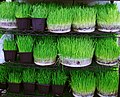 Wheatgrass, one of the items of Haft-sin.
 -
 A bowl of samanu, one of the items of Haft-sin.
 -
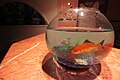 Goldfish, one of the items of Haft-sin.
 -
 A Haft-sin table at the White House.
 -
 A Haft-sin table at a hotel in Bijar, Kurdistan.
 -
 A Haft-sin table at Sharif University of Technology.
 -
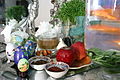 A Haft-sin table.
 -
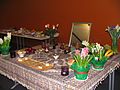 A Haft-sin table.
 -
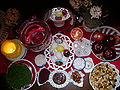 A Haft-sin table.
 -
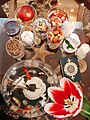 A Haft-sin table.
 -
 A Haft-sin table.
 -
 Haft Mewa
 -
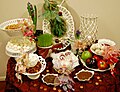 A Haft-sin table.
 -
 A Haft-sin table.
 -
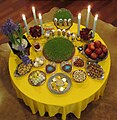 A Haft-sin table.
 -
 Haft Mewa


.jpg)


See also[edit]
- Passover Seder plate, an aesthetically similar (except for its element of animal sacrifice, a practice strictly banned by Zoroastrians) display for the Jewish holiday of Passover; and the Seven food Species from Deuteronomy 8:8 that Jews traditionally eat on Tu Bishvat (the Jewish "New Year for Trees", roughly January/February), Sukkot (the "Festival of Booths" - harvest/autumn), and Shavuot (the "Festival of Weeks", roughly seven weeks after the start of Passover).
- Twelve-dish Christmas Eve supper
References[edit]
- ^ a b c Campo, Juan Eduardo (2009). "Nawruz". Encyclopedia of Islam. Infobase Publishing. pp. 524–525. Archived from the original on 2017-10-14. Retrieved 2018-04-17.
- ^ a b "Noruz, manifestation of culture of peace, friendship among societies". Tehran Times. April 7, 2018. Archived from the original on April 18, 2018. Retrieved April 17, 2018.
- ^ Sethi, Simran (2022-03-21). "Nowruz is banned in Afghanistan, but families continue to celebrate". NPR. Archived from the original on 2022-04-28. Retrieved 2022-04-29.
- ^ Deravian, Naz (2022-03-14). "For Afghans Abroad, Nowruz Is a Chance to Reflect". The New York Times. ISSN 0362-4331. Archived from the original on 2022-04-29. Retrieved 2022-04-29.
External links[edit]

- Shahbazi, A. Shapur (March 1, 2012). "HAFT SIN". Encyclopaedia Iranica. Vol. XI. pp. 524–526.